Sushi Sho - New York
Rating: 18/20
Where: New York, NY
When: Dinner for 2 on 30 November 2025
Cost per Person: Tasting menu $450, Sake pairing $180-$250
Accolades: 3 Michelin Stars
Why: Varied Sushi preparations that go beyond traditional Japanese cuisine
Finally, the rain had stopped. But, this being late November, the evening air was still chilly when we exited the subway next to the New York Public Library on 5th Avenue. Luckily, we didn’t have to go very far, since our destination was just across the street: the city's newest three-Michelin-starred restaurant, Sushi Sho. About two weeks prior, chef Keiji Nakazawa's restaurant had become one of only three three-starred sushi restaurants in the world - a number that has remained oddly constant over the past few years; whenever there was a new three-starred sushi restaurant, another would lose its third star. Sushi Sho is chef Nakazawa's second restaurant in the United States, having opened another “Sushi Sho” at the Ritz Carlton hotel in Honolulu. We had been to the latter in mid-2024, when Mr Nakazawa had already decamped to open his latest outpost in New York. Back then, we thought that the sushi was good, but nowhere close to what one might get in Japan at a similar price point. So I was curious to see how New York's Sushi Sho would hold up in a much more competitive market.
Knowing that one of the worst offenses to commit at a sushi restaurant is showing up late for a reservation, we actually arrived 15 minutes early. That might have been overdoing it a bit, but thankfully we didn't have to wait outside in the cold, and were invited into a lounge and served a complimentary cup of hot buckwheat tea. The lovely tea tided us over until almost all parties had arrived, and we were then ushered one-by-one into the adjacent dining room. All ten diners were seated at a wooden counter facing the chefs. Chef Nakazawa prepared sushi in the middle, and two sous chefs plated appetizers on the left and right sides. Even more staff worked in a partially open kitchen behind the sushi chefs. The room had tall ceilings and was brightly lit with light wooden colors adding to that atmosphere.
Unfortunately, no photos were allowed during our dinner, and I didn't want to test the limits of that policy by taking pictures of the dining room before or after - I'd rather be able to come back for another dinner :) Like most sushi restaurants, the preparations tended to be on the more practical side (“fish on rice”) rather than visually over-the-top, so the lack of photos is hopefully not as problematic as it might have been at, say, a French restaurant.
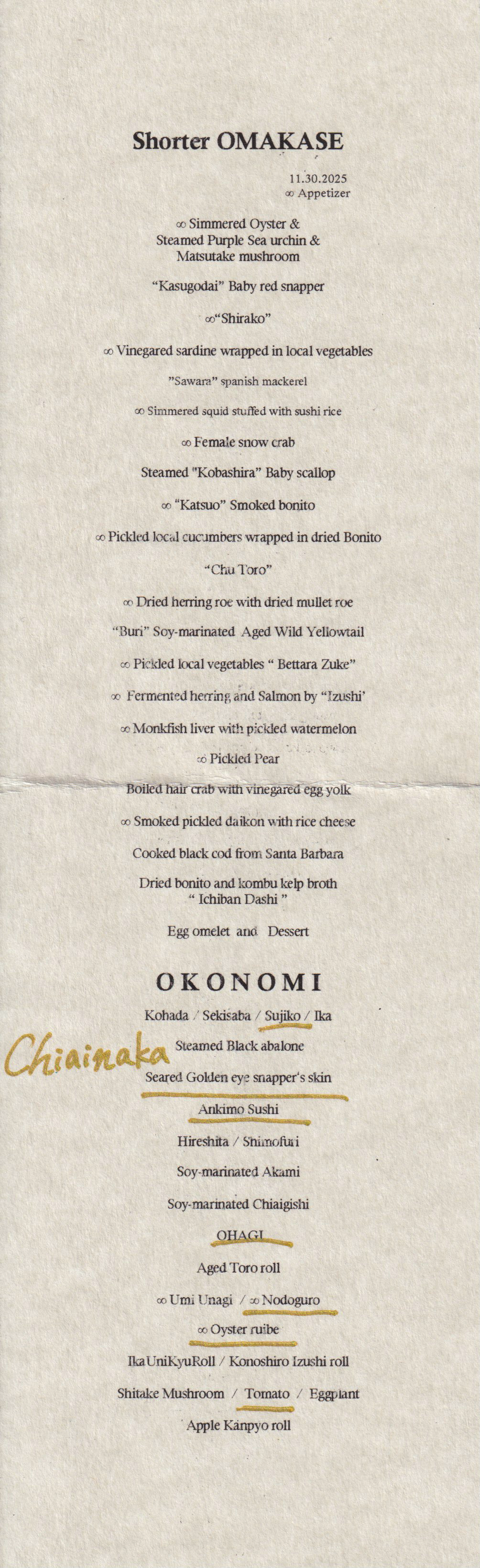
Our dinner was split into two parts. First, there was a chef-chosen tasting menu (omakase) with about twenty courses: a mix of appetizers (cold and hot) and seven pieces of nigiri sushi. After that, an a la carte menu (okonomi) allowed us to order more dishes, some of them appetizers, but mostly nigiri, with prices ranging from $20 to $60. It was also possible to revisit anything from the previous omakase menu. Looking around, everyone seemed to order at least some pieces from the additional menu, and no wonder: it actually contained some of the best dishes that I had all night.
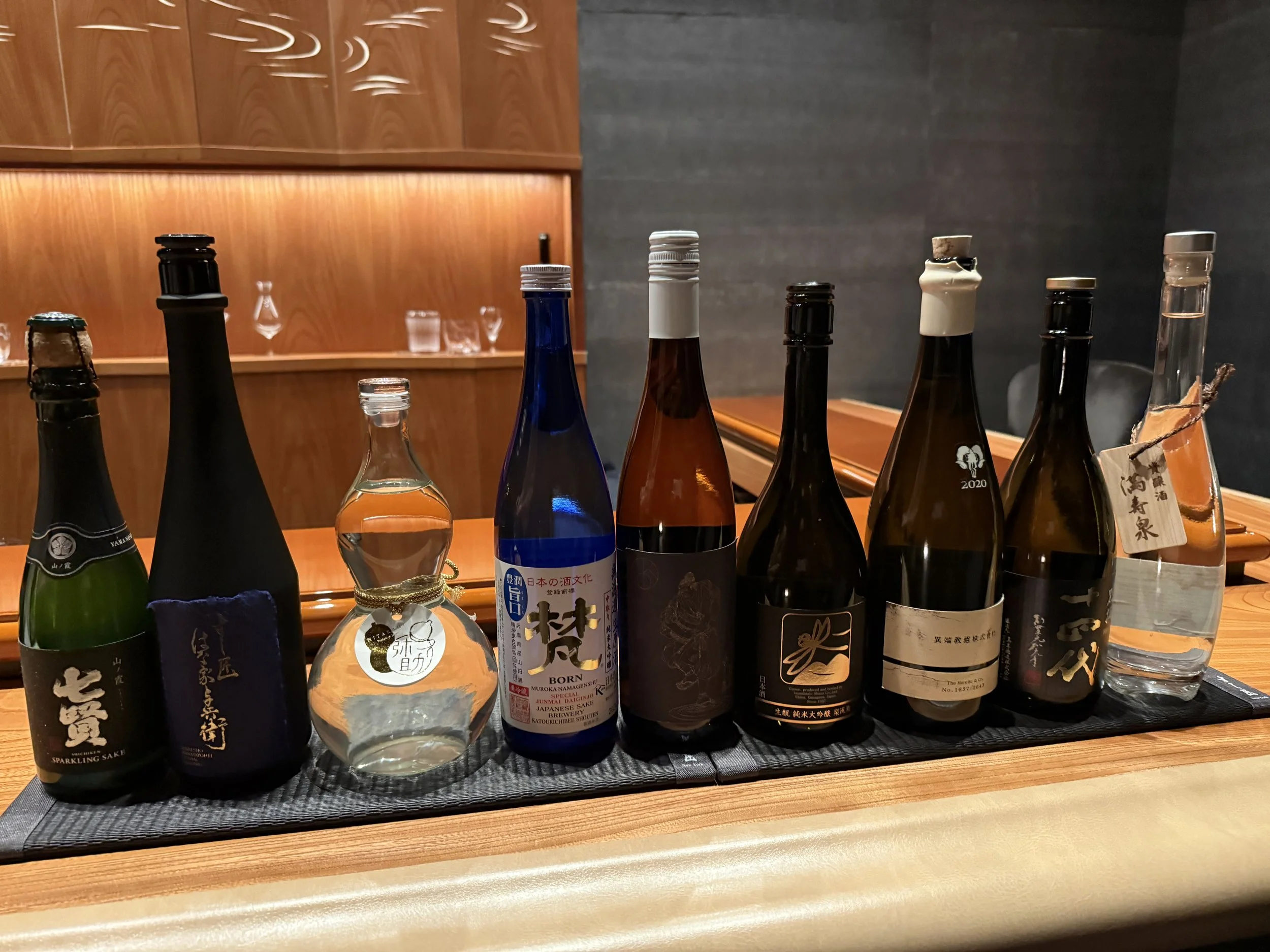
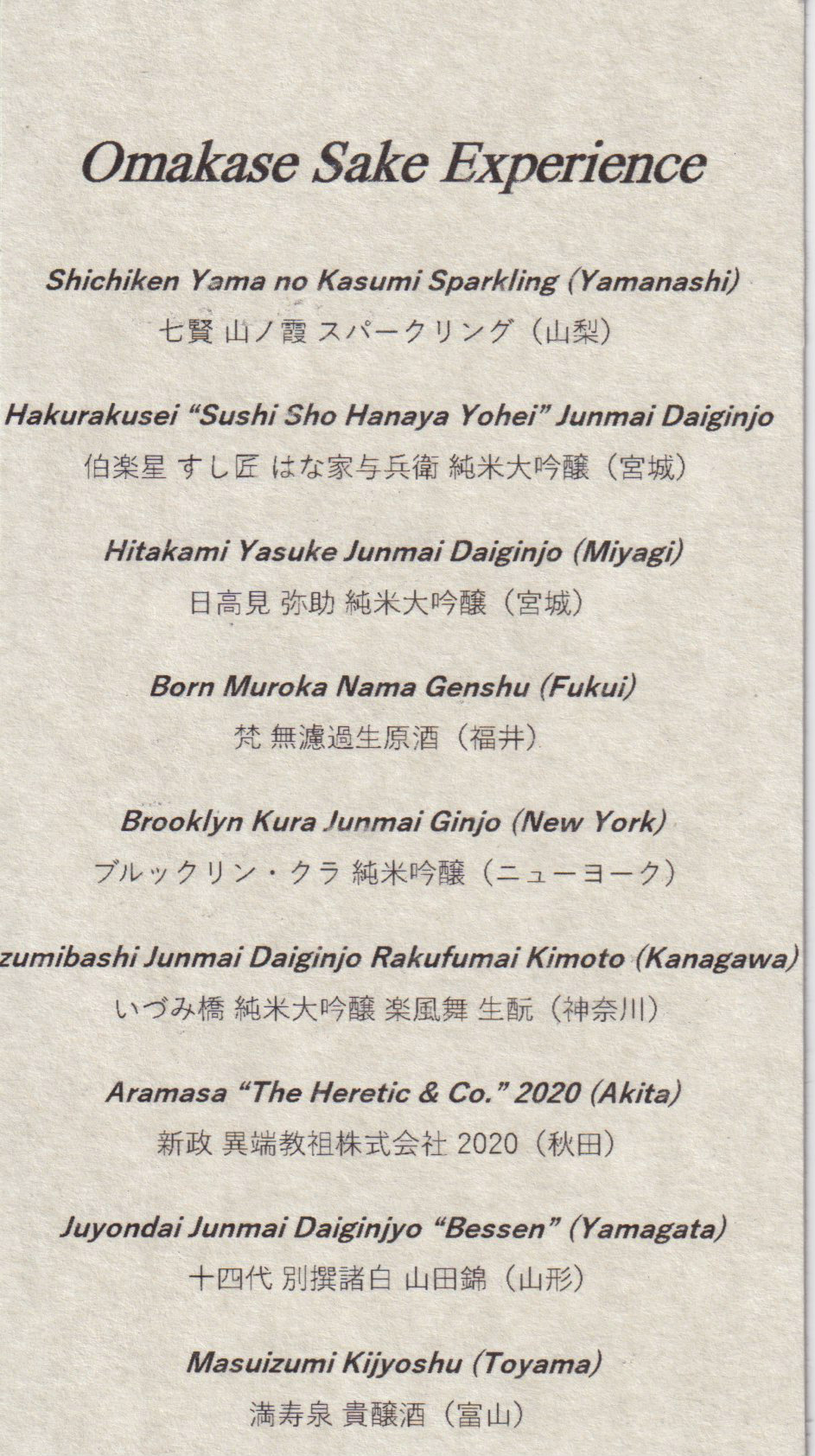
Beverage-wise, there were some wines by the glass (one champagne, two whites, one red), and a sake pairing. Consisting of nine different sakes, it cost either $180 or $250 depending on the size of the pours (11 oz or 16 oz total, respectively, across the nine sakes). As a practical matter, most sakes were served only after the previous one was finished, so if one drank slowly, one might not get through all nine. In my case, I asked for half-pours of the remaining ones near the end, and the price of the pairing was adjusted downwards accordingly. The sakes were all quite good, and they offered a great variety in terms of taste. One was being served hot (now the second three-starred Japanese restaurant in a row to do so for me, after Tokyo’s Myoujyaku). For $20-ish per glass, this seemed quite good value, especially compared to the often criminally overpriced wine pairings in the US.
Our first dish was a bowl filled with dashi, a steamed uni (sea urchin), a kumamoto oyster, and a slice of matsutake mushroom. All three solid ingredients were great: the mushroom had a great flavor, the oyster a good texture, and even the uni was still flavorful with a good consistency - not an easy thing to accomplish for cooked uni. An ostensibly simple, but very well executed dish 18.
The first nigiri sushi of the night was a baby red snapper, topped with shaved egg yolks and vinegar. The fish had a nicely creamy consistency emphasized by the egg yolks, and the acidity of the vinegar kept the bite from becoming too heavy. Very nice 19.
At this point, we were also given some palate cleansers: pickled ginger and small pieces of three different kinds of apples, with yellow, red and green skins. Clearly, the apples were a reference to New York. A nice thought, and they did their palate cleanser jobs well, but in the end these were just apples and decent ginger 14.
Next, a piece of shirako was served in ponzu. Shirako (aka milt aka fish sperm) is not served often in the United States, so we were asked beforehand whether we would like to try it. I have to admit, I'm generally not the greatest fan of shirako, but this was by far the best preparation that I've ever had. The shirako provided only a creamy texture, and the ponzu was what gave this dish a clean, focused flavor. If you didn't know what you were eating, you wouldn't think twice about it 18.
A sushi roll was made with sardines, cucumber, young ginger and topped with vinegar. It tasted very gingery - more than it tasted of fish, in fact -, and the wrapping nori was surprisingly (too?) tough for my taste 16.
The second nigiri was a Spanish mackerel topped with a “local vegetable” (I didn’t catch which one). The fish was creamy, and only very lightly fishy (I mean “fishy” here in a good way). Besides being tasty, this was also quite interesting: I had never really seen such a medium level of fishiness before, usually it feels like it's all or nothing 18.
A slice of spear squid filled with sushi rice had lots of flavor from the seasoned sushi rice - yummy. The squid's texture had a very solid bite, but still was tender; it might sound like a contradiction in terms, but this squid managed to have both 17.
An emptied crab shell was filled with the meat, roe and innards of a female snow crab. On the side was a small bowl of a sweet vinegar sauce, meant to be used for dipping. The crab’s meat was nice enough, and the eggs provided a nicely crumbly texture. However, neither of those were very strong in flavor, even when eaten together with the sauce. It was a pretty small crab, maybe bigger pieces of meat would have imparted more of a crab flavor? 16
Nigiri number three was topped with four slices of baby scallops. They had a light texture and were nicely seasoned 17.
Three pieces of smoked bonito were topped, respectively, with cooked onions, a home-made mustard and a soy-based sauce. All were smoky and meaty, and the mustard was surprisingly spicy 18.
The next bite also contained bonito: this time, a thin slice of bonito was wrapped around a cucumber pickle that had been seasoned with shaoxing wine. This dish had some prosciutto-and-melon vibes, but the bonito was much drier and the cucumber much crunchier than in the famous antipasto 16.
Chutoro (medium-fatty tuna) was the fourth nigiri of the night, and it melted in the mouth, yum 18.
The next dish featured preserved herring roe and preserved mullet roe, which is called “karasumi” in Japanese cuisine. The herring roe had been re-hydrated, giving it a crunchy texture that contrasted with the mullet roe's creamier consistency - the latter was a dead ringer for bottarga. An interesting play on different textures for essentially the same ingredient 17.
A wild hamachi (buri) nigiri was lovely as well, with a bit more flavor than the “normal” hamachi frequently seen in sushi restaurants all over the world 18.
Two pickles - a piece of daikon and a red radish - were a kind of palate cleanser. Both were oddly sweet, in particular the daikon. Fine, but a also bit unusual 14.
When sushi was invented in Japan, there was no infrastructure in place that could deliver fresh fish to restaurants, so they used fermented (i.e. preserved) fish instead. The next dish paid hommage to those times, and gave us two pieces of fermented sushi. One was a fermented herring served over a little piece of uni, the other a fermented salmon topped with salmon roe. The herring was much more fishy that any previous fish during this dinner, and also had a notably changed texture and a much stronger flavor. For some reason, it was also a bit sweet. The salmon likewise had a changed texture and was a bit vinegary. Both quite nice 17.
Two triangular pieces of ankimo (monkfish liver) were topped with a pickled baby watermelon in one case, and a Hawaiian spicy miso in the other. Both were nicely creamy, and surprisingly managed to not be that heavy thanks to their two toppings, which were crunchy and salty, respectively 18.
A little piece of pickled pear was refreshing and sweet 17.
Nigiri number six was a hairy crab from Hokkaido topped with egg yolk powder and a sweet vinegar jelly. It had a great crab flavor, which was enhanced by the acidity 18.
A slice of smoked daikon radish was wrapped around sushi rice that had been fermented for three months. The daikon was very crunchy, and notably smoky. The rice melted in the mouth - apparently, there is a similar dish in Japan that uses cheese instead of rice 17.
The final piece of nigiri of the omakase menu (number seven) was steamed black cod. Lightly warm, it melted in the mouth, and had a nice flavor. It's quite unusual to see warm nigiri in a sushi restaurant 17.
This ended the omakase portion of our meal. Both food and service had been great so far, just the speed of the proceedings was a tad on the fast side. I actually enjoy the leisurely pace in regular sushi restaurants, which is necessitated by a single person making all the sushi pieces for 8-10 people in a row. It's almost meditative to watch the same motion repeated time after time. Here, though, lots of things happened at the same time, chefs were moving around and assembling the different dishes that were served to different parties at the counter, and I didn't even know whether the nigiris that chef Nakazawa was working on were meant for us until he actually put them right in front of us.
Things slowed down a bit during the a la carte (or okonomi) part of the menu, since not as many different dishes were in flight at the same time, and the nigiri production actually became the bottle neck for serving all customers. That meant we were getting closer to the sequential nature of a traditional sushi experience.
At this point, I wasn't actively hungry, but I probably would have eaten something else not too long after leaving the restaurant. In that sense, the okonomi should be considered an essential part of the experience at Sushi Sho, and seemingly everybody ordered a few extra pieces. Most of them were priced in the $20-$40 range, but at least one cost $60 (per piece of nigiri, or per serving of an appetizer). Between the two of us, we ordered about half of the offered okonomi, and they cost us about an additional $500 on top of the $900 that we had already paid for the two omakases. I've listed the prices for the a la carte dishes below, but there were also some off-menu items of unknown cost.
The first dish I ordered was called an “oyster ruibe” - a frozen mixture of oysters and blue cheese ($20). Apparently this is a specialty in Japan, but I had never heard of it before, and it sounded so out there that I just had to try it. The dish consisted of three little discs of the frozen oyster/blue cheese mixture, all with different toppings: sea cucumber eggs, mustard and lobster caviar. Essentially, all of this tasted very cold, very salty, seafoody, and it had a hint of blue cheese flavor. It probably won't become my new go-to order, but it was definitely worth a try 16.
A piece of nigiri was topped with salmon roe marinated in miso ($40). The roe must still have had some connective tissue, since the pearls actually sat comfortably on top of a regular nigiri-style piece of rice - no nori in sight. The salmon roe had a nice flavor and texture, with a lightly cheesy aftertaste 18.
Two pieces of grilled nodoguro were topped with onions and young ginger in one case, and daikon, finger limes and house-made orange pepper in the other case ($30). The fish was served very hot, and was fatty, flavorful and had a firm texture. The toppings went nicely with the fish. Providing different toppings for different cuts of the same fish was a theme that we saw several times during our dinner. This serving in particular was delicious 19.
A signature dish of Sushi Sho was a warm kinmedai skin nigiri topped with horseradish and ginger ($40). This was a lovely piece of fish - in fact, it didn't feel much like skin at all. Its toppings added only subtle flavors, though 18.
Signature dish #2 among the okonomi: two kinds of tuna tartare that had been mixed and seasoned with daikon, scallions and sesame seeds, before finally being served as a nigiri ($40). A bit reminiscent of beef tartare mixed with onions, this got a nice crunch from the daikon pieces, and was very flavorful and melted in the mouth. Very tasty 18.
The restaurant's final signature dish was a nigiri of ankimo topped with pickled watermelon ($40). There probably is no pressing reason to order this, since the same dish (without rice) had been served earlier on. It was still good, though: creamy, with a light crunch, but also much heavier than the previous version 17.
At this point, we were served a bonito/kelp broth as a refresher. It had a very light flavor, the lightest of any dish in our dinner, and reminiscent of what one might get in Japan. There was only a light aftertaste of fish 15.
Recommended by the chef was a black abalone nigiri ($60). Two pieces of braised abalone had a very strong bite, but were not chewy at all - pretty much the perfect texture for a fresh abalone. It also had a nice inherent flavor and there was some taste of citrus as well 17.
Filefish topped by a piece of its own liver made for another nigiri. I noticed that the rice for this dish was much whiter than what had come before - apparently the amount of vinegar in the rice depended on the fish it was paired with. The filefish was very flavorful, so good in fact that it almost didn't need the creamy liver 18.
A roll of konoshiro (gizzard shad) seasoned with sancho pepper ($20) had a very fishy flavor (that's a compliment in this case) and was also quite spicy. Maybe not complex, but tasty 17.
A nigiri of soy marinated chiainaka was the chef's suggestion when I was looking for “just one more piece of tuna”. (Again off menu, and there was apparently just one piece left.) “Chiai” comes from near the spine of the tuna, and “naka” means center in Japanese, i.e. the best part of this particular cut. And it was unlike any other piece of tuna that I've ever had. It was clearly very fatty, but also had a very noticeable bite, much more so than otoro or even chutoro. A very unusual combination for sure. The nigiri was also noticeably vinegary which nicely played off the fattiness. Very tasty, and I'm happy that I didn't see the price for this one 18.
For my final piece of nigiri, I wanted to try something totally different and asked for one of the vegetarian nigiri on the menu. The chef recommended a tomato nigiri ($20). The de-seeded, skinned, compressed piece of tomato almost looked like a piece of tuna. It was intensely flavored, tasting of marinated tomato, and was also quite salty. Very tasty 18.
Most traditional sushi dinners end with a simple piece of tamago (egg omelet), but Sushi Sho had something special instead. They had two preparations of tamago, one from Osaka and one from Tokyo, which were combined into a single sushi roll. The two different tamagos created a contrast between sweet and salty, and were quite intensely flavored. The rice in the roll was needed to tone down the flavors. Again, very, very good 17.
Our first dessert were translucent arrowroot noodles served in ice water, meant to be dipped into a brown sugar syrup. The noodles were quite gelatinous and didn't taste of much, but the molasses-like syrup was very flavorful 16.
The final dessert was a salted milk ice cream. By itself, this ice cream was almost too salty to eat, but once one added the brown sugar syrup from the previous course, it became a creamy ice cream with an intense molasses flavor 18.
Chatting with the chef after the dinner, he mentioned that in the future they were planning to offer a fully vegan sushi dinner. For most sushi restaurants, this would sound like an absurd (and likely doomed) proposition, but after having had Sushi Sho's amazing tomato sushi, I would happily return to see what they come up with. If that one piece of tomato nigiri was any indication, then the result could be amazing.
Overall: A fast-paced journey though Japanese sushi, accompanied by many non-sushi dishes. Flavors were bold (especially for Japanese cuisine), and there were many preparations and cuts of fish rarely seen in the US (or anywhere outside of Japan, for that matter). With a fairly-priced sake pairing and wonderful service, Sushi Sho is definitely worth a stop if one can stomach the hefty price tag. My only nitpick would be the speed at which the dishes were served - slowing down the proceedings a bit to allow guests to appreciate the magic going on behind the counter might be a good idea 18.