Alliance - Paris
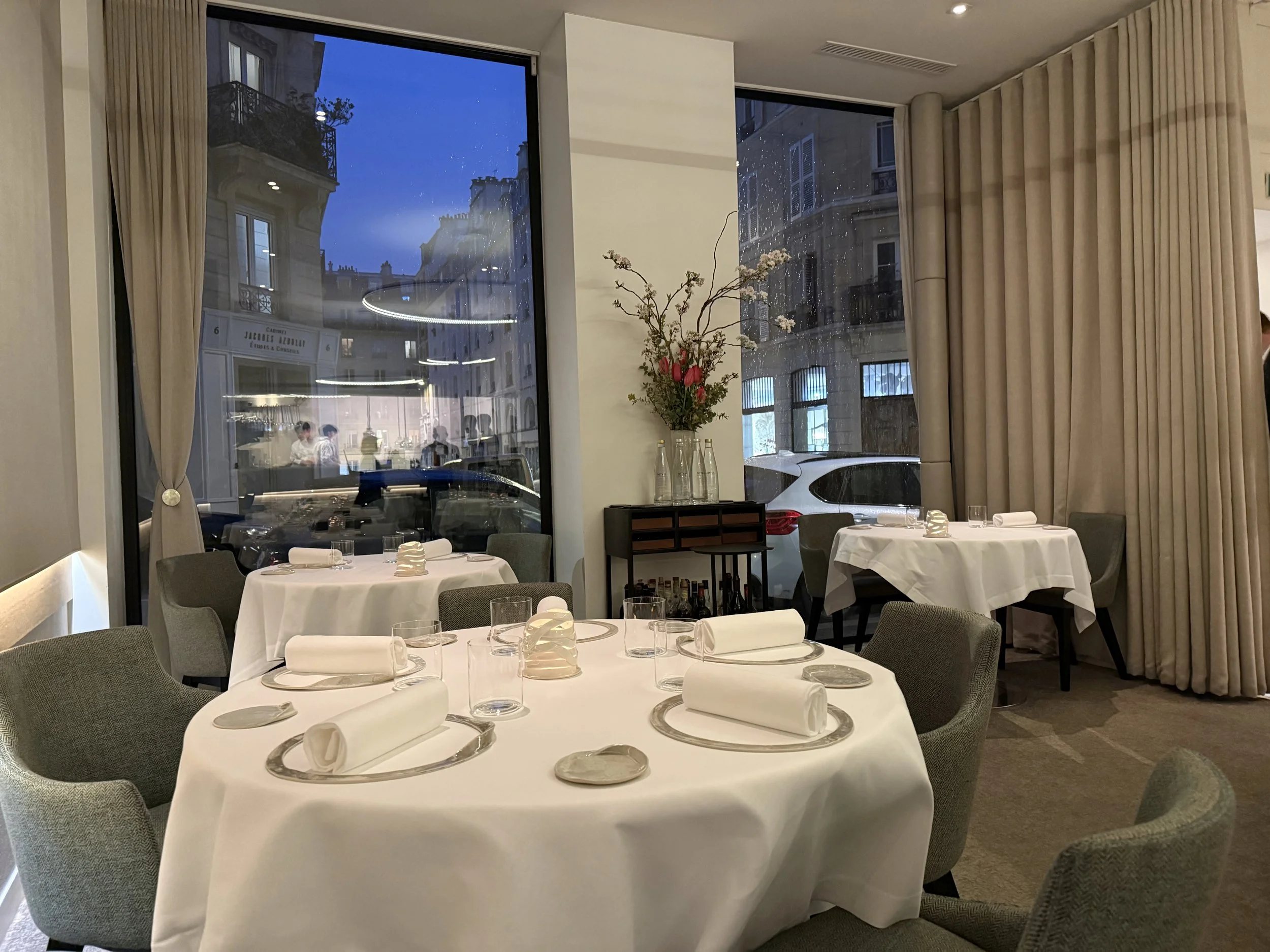
Window facing the street, with a reflection of the kitchen in the back
Rating: 15/20
Where: Paris, France
When: Dinner for 1 on 25 March 2026
Cost per Person: Tasting menu 145-245 Euro ($165-$285), Wine Pairing 60-100 Euro ($70-$115)
Accolades: 2 Michelin Stars
Why: French cuisine that focuses on only a few ingredients each dish
Paris' late March weather was definitely indecisive. A balmy Tuesday full of sunshine was followed by a Wednesday drenched in rain and the occasional hail, with windchill temperatures dipping below freezing. Maybe not the best conditions in which to chance a twenty minute walk to dinner - sans parapluie -, but I miraculously avoided getting drenched.
My destination that night was the newly two-Michelin-starred “Alliance”, a restaurant located on a quiet street near the southern bank of the Seine, not too far from the Notre Dame. It was the oldest among Paris' newly two-starred restaurants, having just celebrated its 10th anniversary of opening. The eponymous “alliance” referred to the collaboration between Japanese chef Toshitaka Omiya and French service director Shawn Joyeux. Mr Joyeux greeted all arriving guests, and then hastened to close the door to keep the gusty wind outside.
While the restaurant’s chef hails from Japan, his cuisine at Alliance is 100% French. But the dishes had some element of what one might call Japanese restraint: many were quite focused, with no more than three major ingredients.
The interior design of Alliance was similarly minimalist, with a modern elegance. Eight tables covered with white table cloths shared a compact room that came without much decoration. Notable were the two large sets of windows at either end of the room: one looked out on the street, while the other peered into the restaurant's kitchen, providing a view of chef Omiya at work. (A private dining room was located across the street.) Minimalism was on the table as well: the charger “plates” were actually just rings, serving the purpose of organizing the table without being actual plates (see picture above).
Having spent the previous night at another two-starred restaurant in Paris, it was interesting to see how different the clientele were. Whereas Virtus' bistro-like setting in a off-the-beaten-track location had attracted a mostly French-speaking crowd, Alliance clearly had the foreigners in the majority. That was no problem for the staff, whose English was impeccable. The restaurant was also noisier. At the beginning of the night, I noticed soft jazz playing in the background, but later on, conversations provided the soundtrack for the room. One guest even loudly called her son on a speaker phone for help in translating the server's description of the menu. Definitely not a French bistro vibe...
Alliance served a tasting menu that consisted of either four, five or seven courses (145/175/245 Euro, about $165/$200/$285). It was a “carte blanche” menu, so no descriptions of the food were given ahead of time. But the server offered that the menu could be adjusted according to dietary likes and/or dislikes. I went for the unadulterated seven course menu, adding an optional asparagus/black truffle course for 50 Euro ($60). This extra course was advertised as being available only rarely: there is only a brief time when both truffles and asparagus are in season.
A wine pairing was on offer as well, priced at 60, 80 or 100 Euro ($70, $90, $115), depending on the number of courses one had chosen for the tasting menu. Wines for the optional courses were served without any increase in price - a nice gesture. The wines matched the food well, and were fine, but not outstanding. What was remarkable though were the “descriptions” given by the sommelier. Totally unrelatedly, I had met a fellow food traveler just before this dinner, and he had remarked that the descriptions given for wine pairings were often too long for him, taking him out of the dinner experience. Well, the descriptions at Alliance had the opposite problem. One wine was introduced simply as being “a bit different”. Another as “a red wine, very fruity, from Merlot”. It wasn't the first time that a server might have concluded that I was clueless about wines (not sure how?!), but it was definitely the first time that someone felt it necessary to point out that the wine in front of me was indeed “red”. Oh well... I get that preferences for the length of wine descriptions can vary - but these felt way too short.
Similar to my dinner at Virtus, the courses seemed to arrive just a little bit too fast. But given that this now wasn’t an isolated experience, I'm willing to conclude that the pacing might simply be a Paris thing, or rather that my expectations didn't match the local customs.
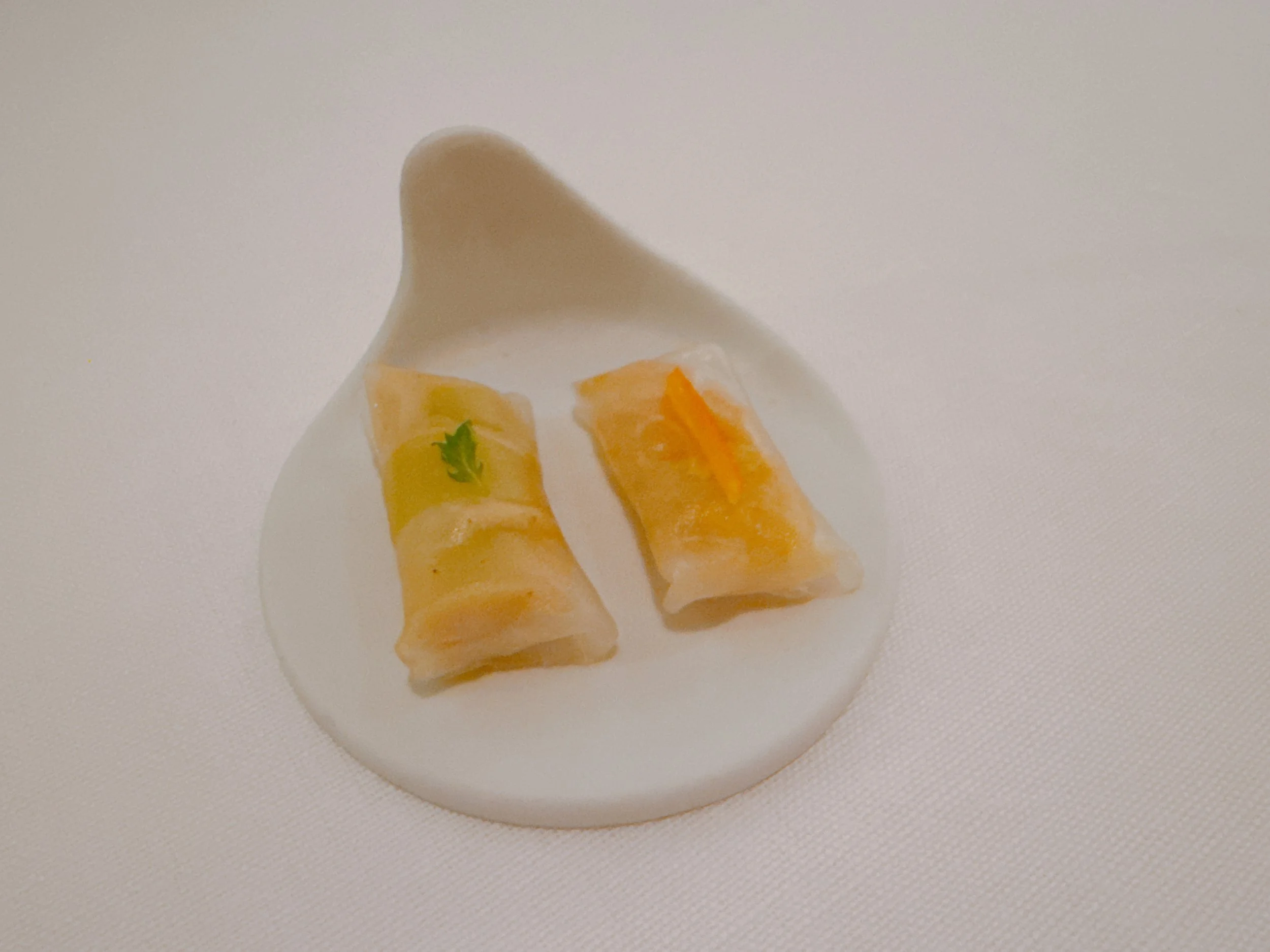
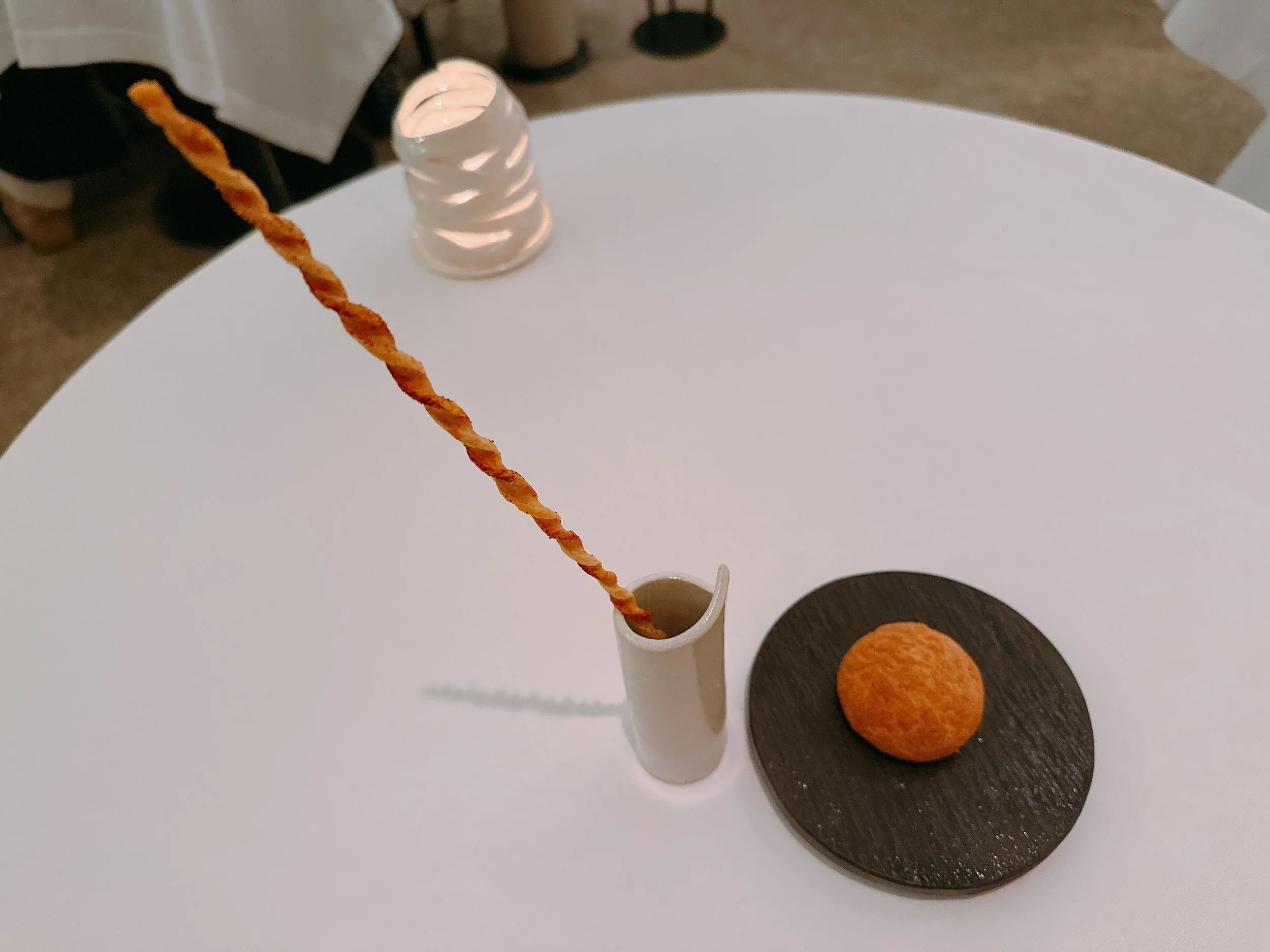
Since the wine pairing started only with the main part of the tasting menu, there was an opportunity to order an aperitif to go along with the appetizers. The first pair of them looked like little dumpling rolls. One was topped with a little leaf and filled with leeks. Its nicely done, chewy wrapper enclosed a filling that was a bit light on taste, but had enough acidity and freshness to make for an elegant bite 17. The other roll was prepared with blood oranges and endives, which made for a crunchy, somewhat bitter filling 15.
A very thin “spiced” puff pastry stick had actually just a hint of spices 14. A Parmesan gougère was served warm, had a light cheese flavor, and was quite airy - in fact, it was hollow on the inside. No heavy cheese filling here 16.
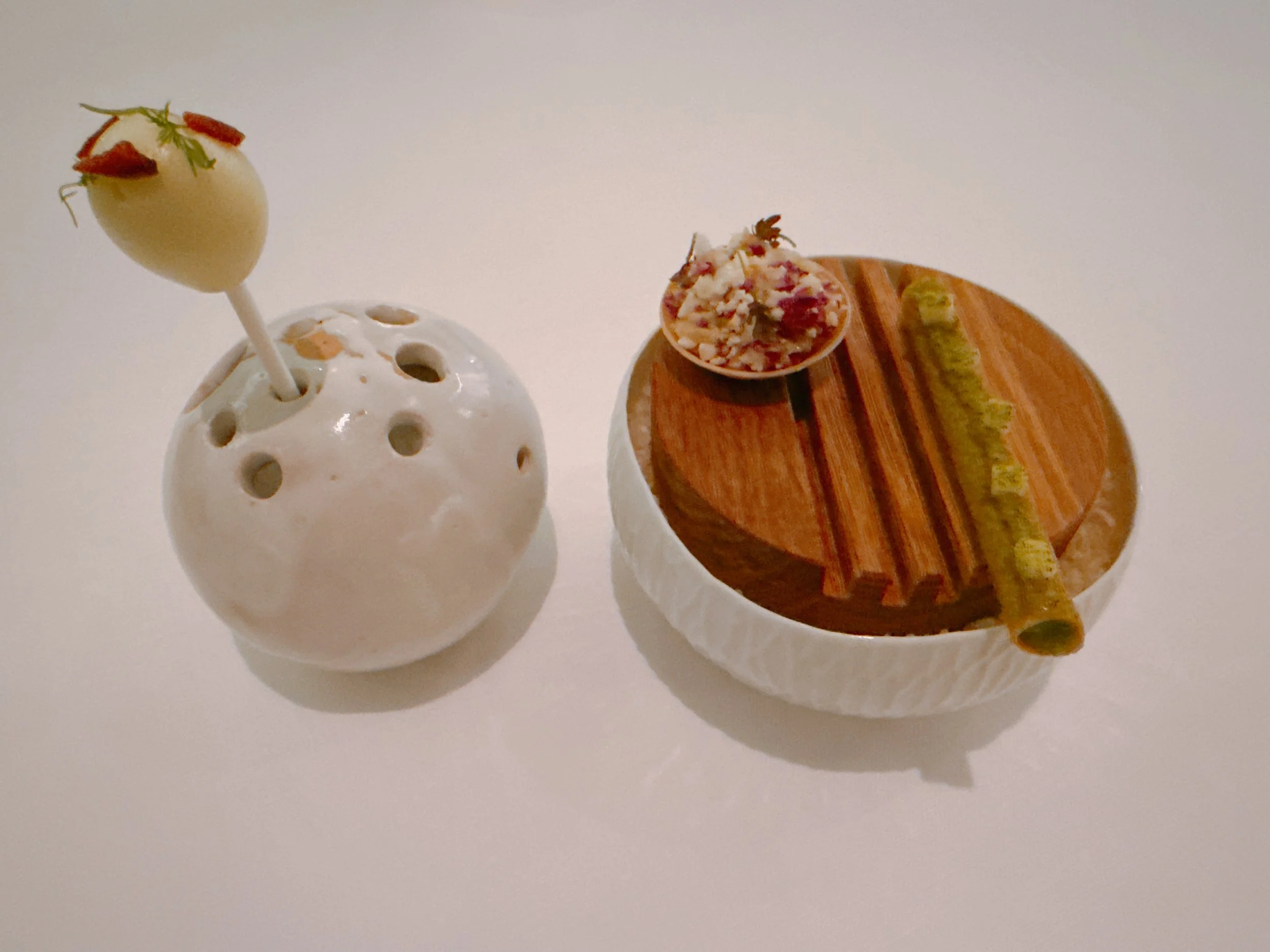
Three more bites arrived soon thereafter. A “cigar” made from broccoli and capers had a very lightly flavored filling - it would have been hard to guess what the ingredients were. There was no acidity either - apparently, these were not pickled capers 14. A little tartlet was filled with various kinds of cauliflower and some mustard seeds. The cracker shell here was very crunchy, on the verge of being too hard to eat. The cauliflower was almost raw, with a crumbly texture and only a faint flavor 14. Finally, there was a lollipop made with kohlrabi, apple and dill. It had a foamy exterior, a crunchy center (the kohlrabi, I presume), and a hint of dill flavor - easily missed if one wasn't looking for it 15.
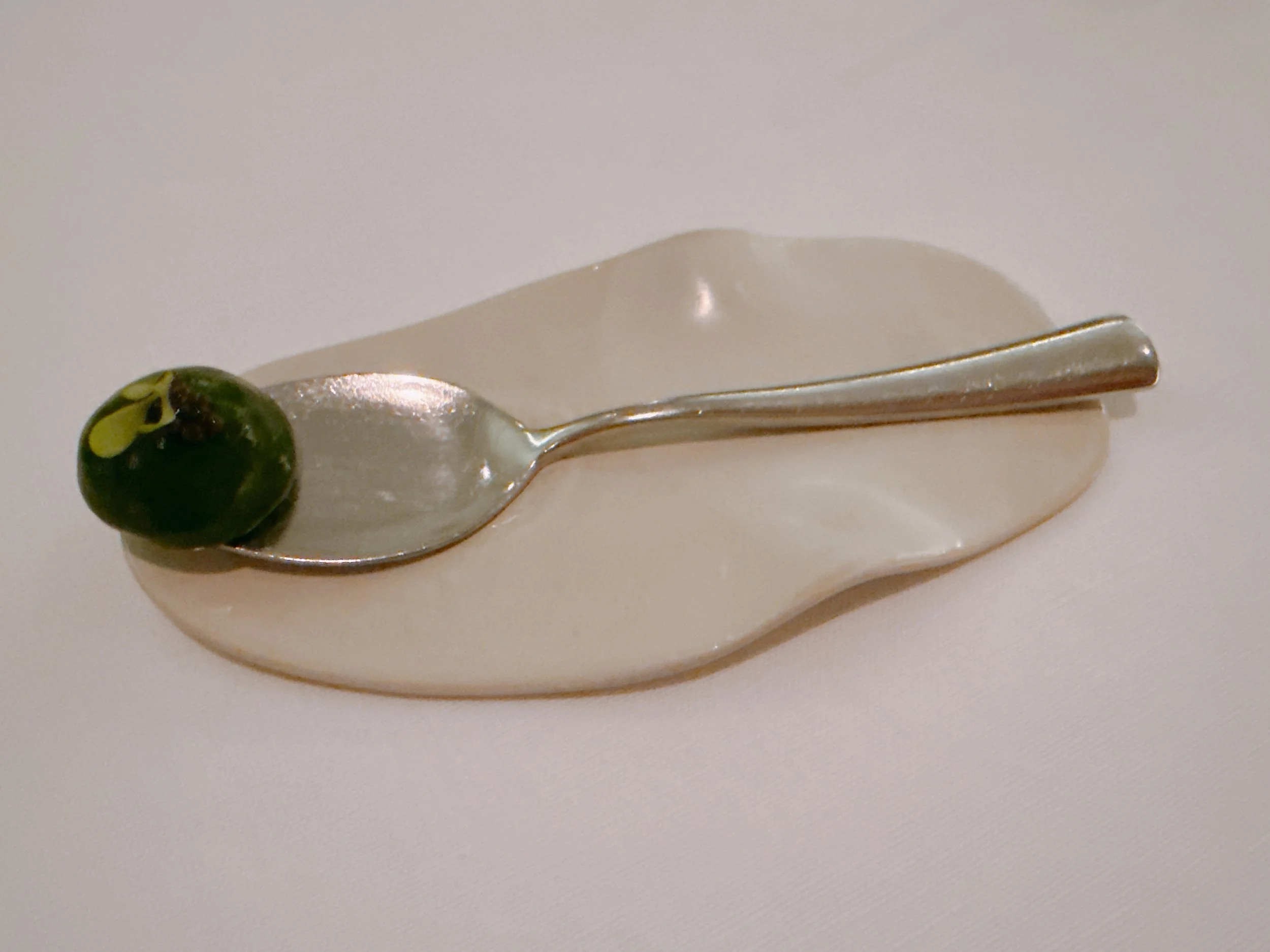
The final amuse bouche was served on a spoon: it was a single bite made from watercress, appearing both as a gelee and a mousse. A dollop of caviar sat on top. Strangely enough, this dish had practically no flavor. There was a hint of a spicy aftertaste from the watercress, but otherwise this was just a taste-free foamy mousse 11.
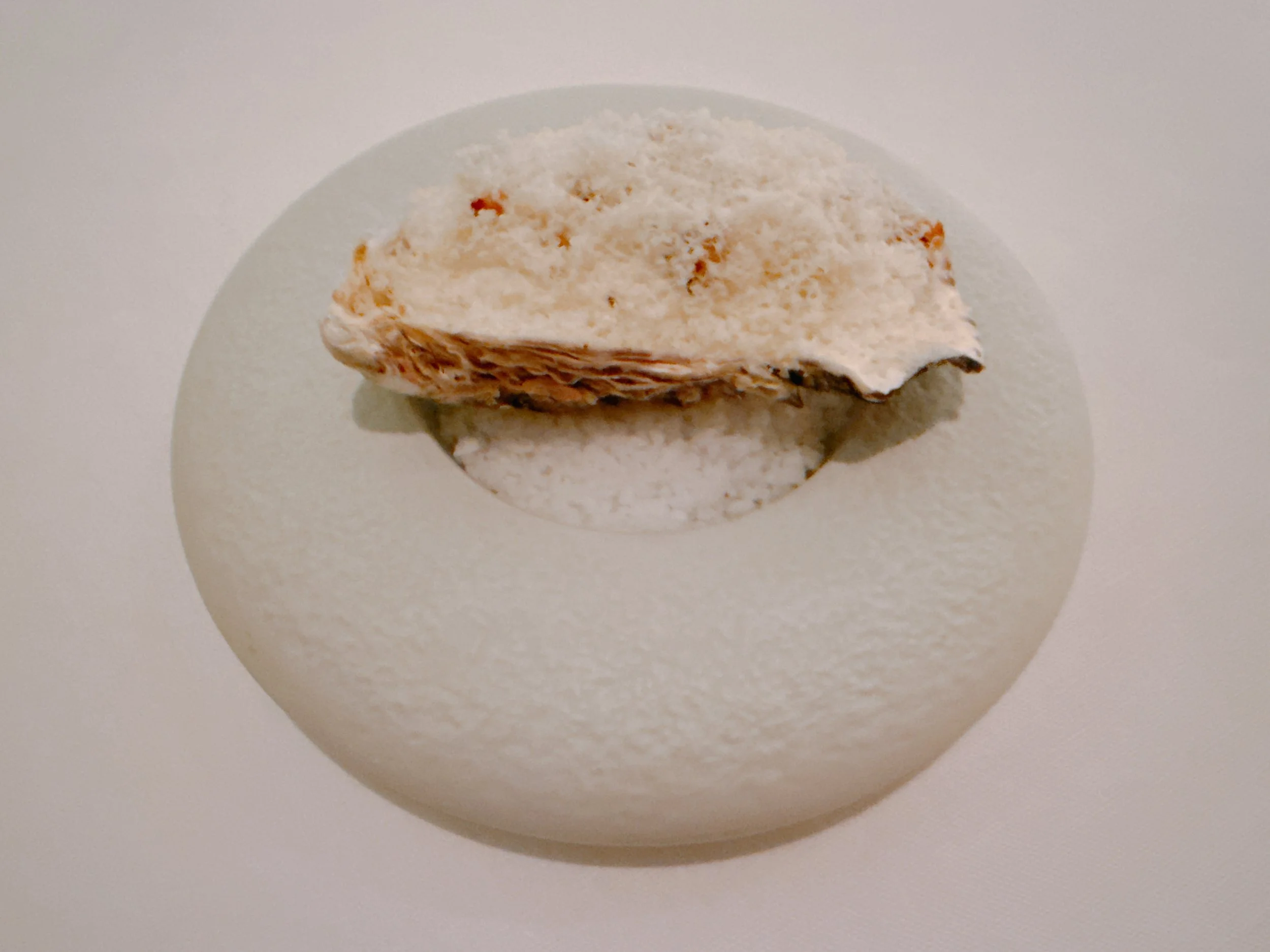
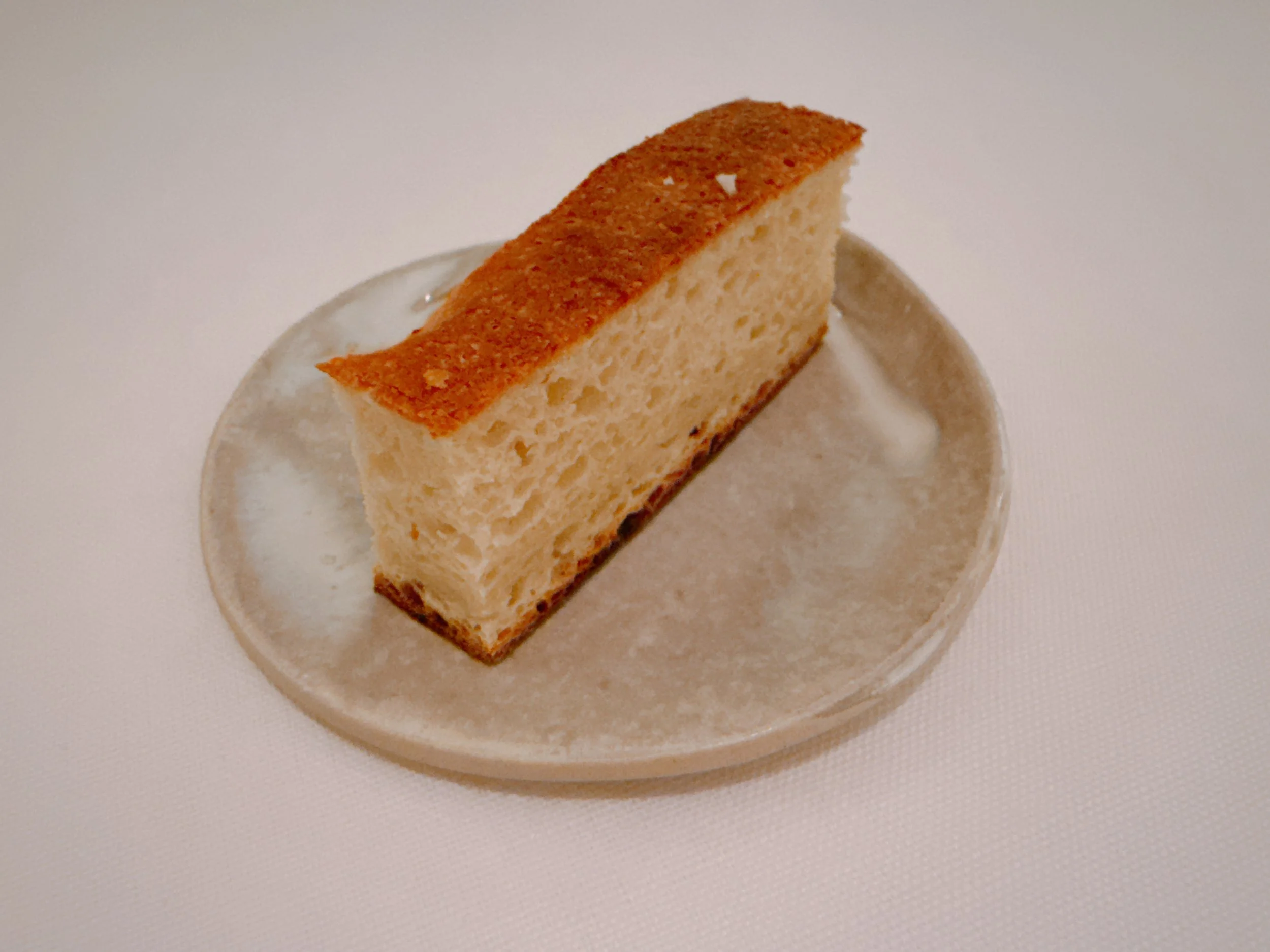
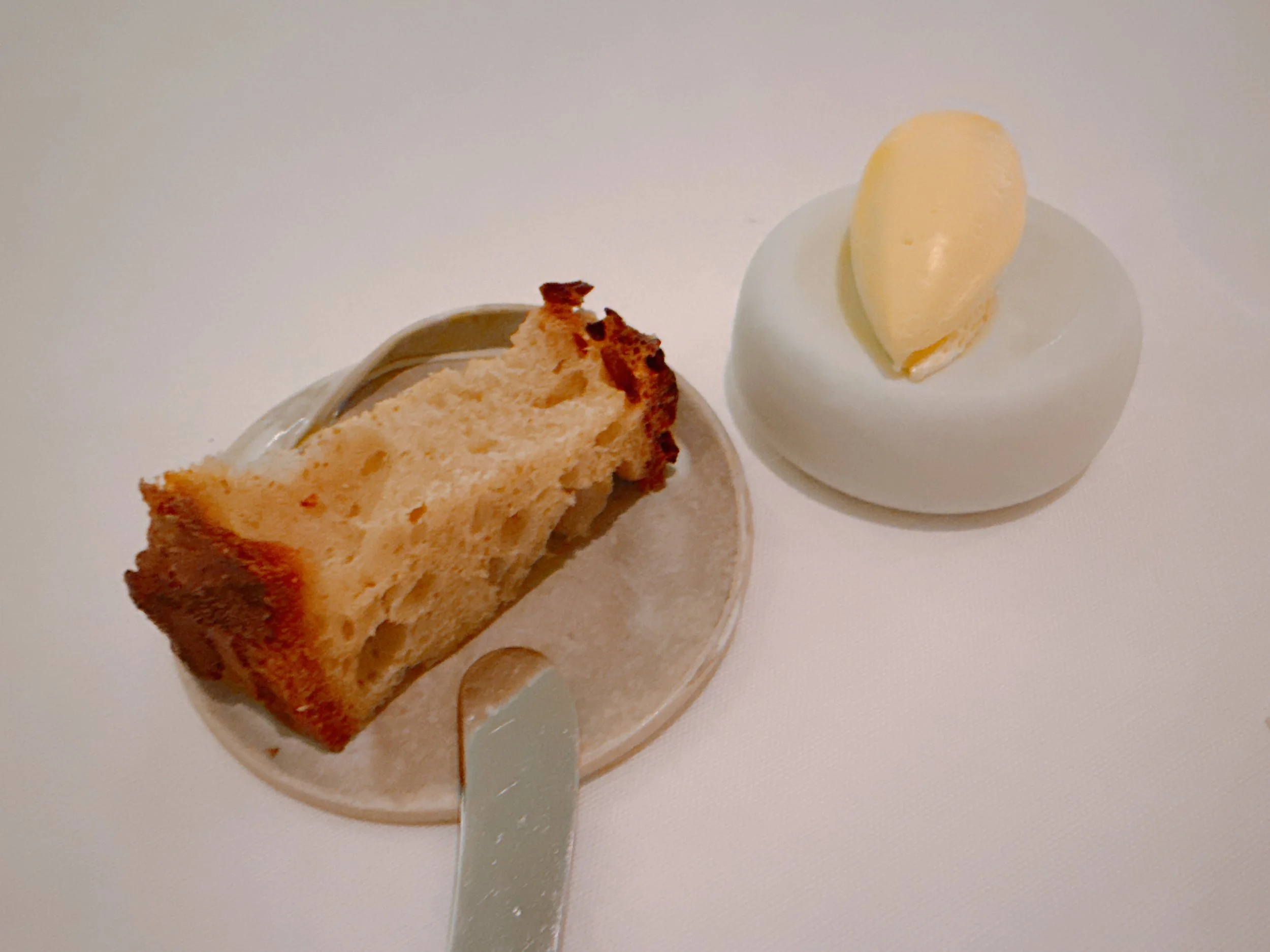
This brought us to the first official course, and the start of the wine pairing. The dish in question was a poached oyster, served in its own shell with a blue cheese foam, walnuts and pears. The oyster was of considerable size and had a light seafood flavor, but was unfortunately also a bit chewy. Overall though, the blue cheese and semi-crunchy walnuts dominated this dish. Not a bad combination 15. On the side came a warm slice of foccaccia bread. It was pretty neutral in flavor and quite crunchy, even on the sliced surfaces - meaning that it had been toasted after slicing 13.
For the remainder of the dinner, we were served slices of smoked hay bread, along with a butter dressed with olive oil. Arriving at room temperature, the bread's crust was chewy rather than crunchy, and it had a pleasant, light flavor 14.
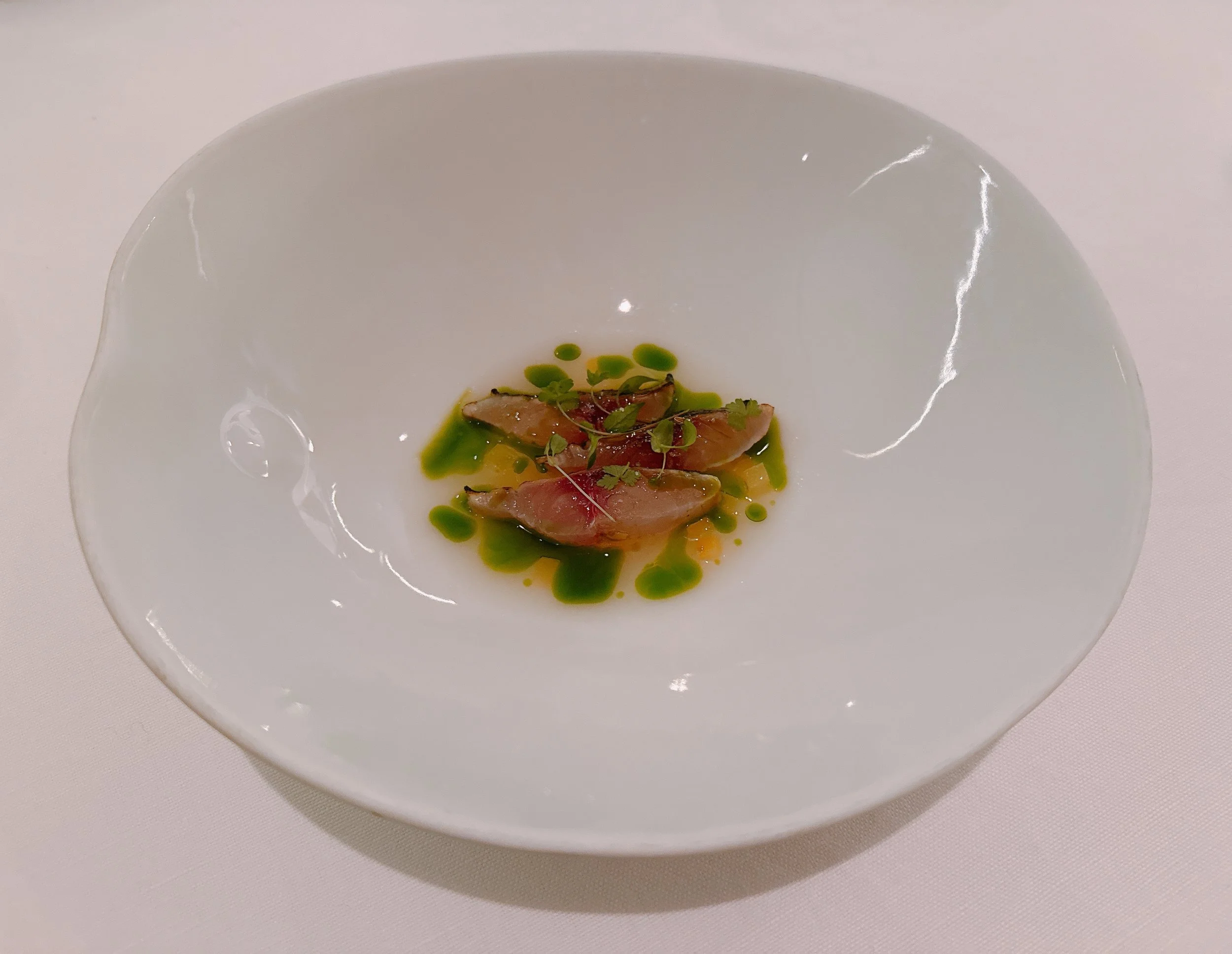
The second course of the night was a marinated horse mackerel, served with turnips and possibly a hint of horseradish. The fatty fish had an intense flavor that included a nice fishiness. The turnips were much lighter flavorwise, but added a bit of crunch. The horseradish was very light. Definitely a dish that let the main ingredient shine 16.
Next was a preparation based on artichokes, which appeared both as leaves and roasted as part of a mousse. On top of the dish were some coriander leaves. The artichoke leaves (hidden under the mousse) only had their inherent flavor, which was not very strong. More compelling was the lightly acidic, creamy, smoky mousse. It had plenty of flavor, which I appreciated, but was also pretty heavy, which I didn't appreciate quite as much, especially since there was so much of it. I couldn't taste the coriander leaves in this dish - the mousse was so dominant in flavor 15.
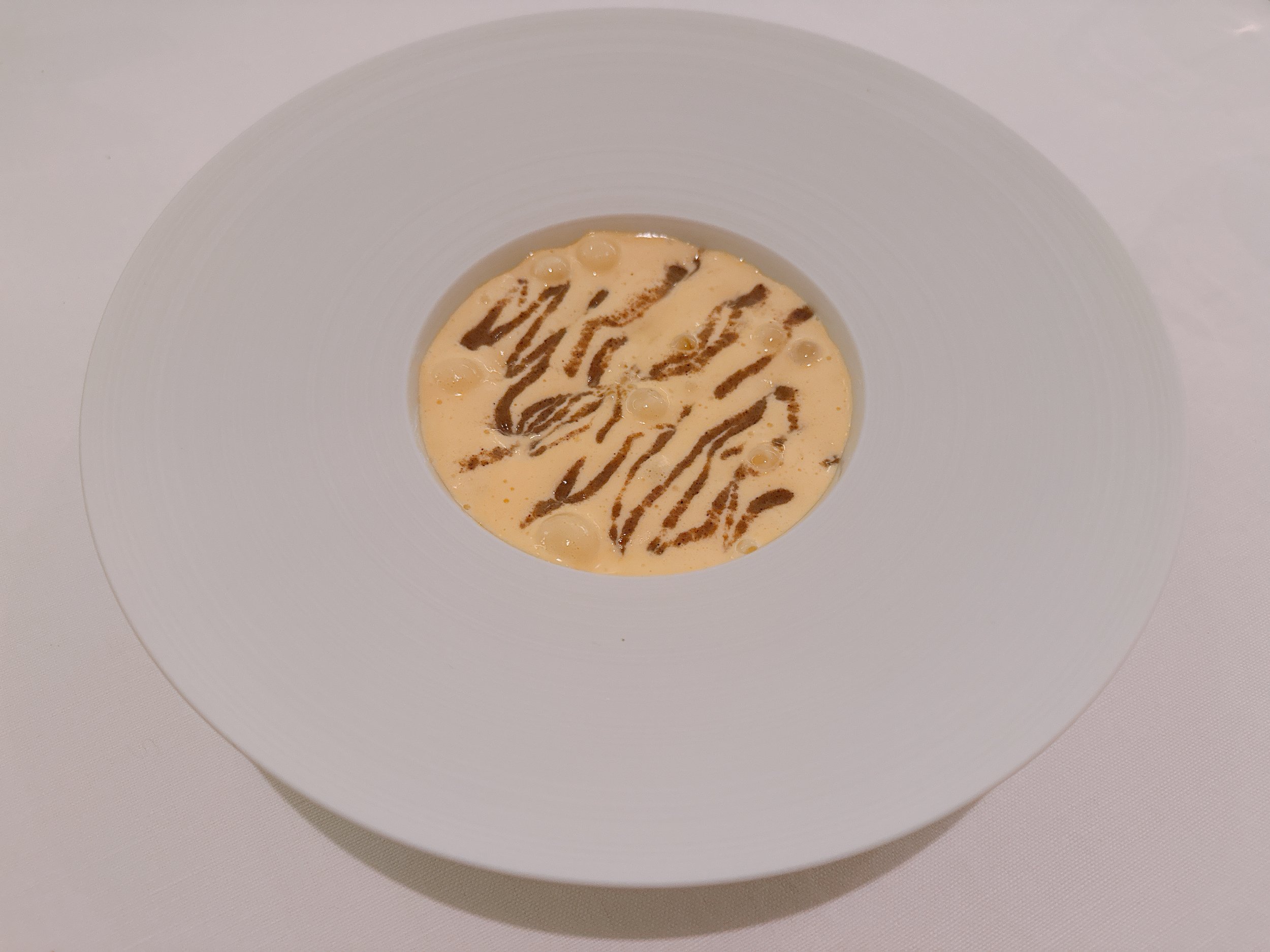
Then it was time for the optional course. Green asparagus pieces were topped with a white sabayon that had been drizzled with a black truffle sauce. Tableside, a asparagus velouté was added, disappearing below the sabayon - a bit like the sauce poured into a soufflé. There were some similarities to the preceding course - both had green vegetables hidden under a moussy sauce. And in both cases, most of the flavor came from the mousse (or sabayon in this case). The crunchy fresh green asparagus pieces didn't have too much flavor by themselves, and even the truffle taste was pretty light. But the sabayon was quite good, and I actually preferred this dish slightly over the artichoke course 15.
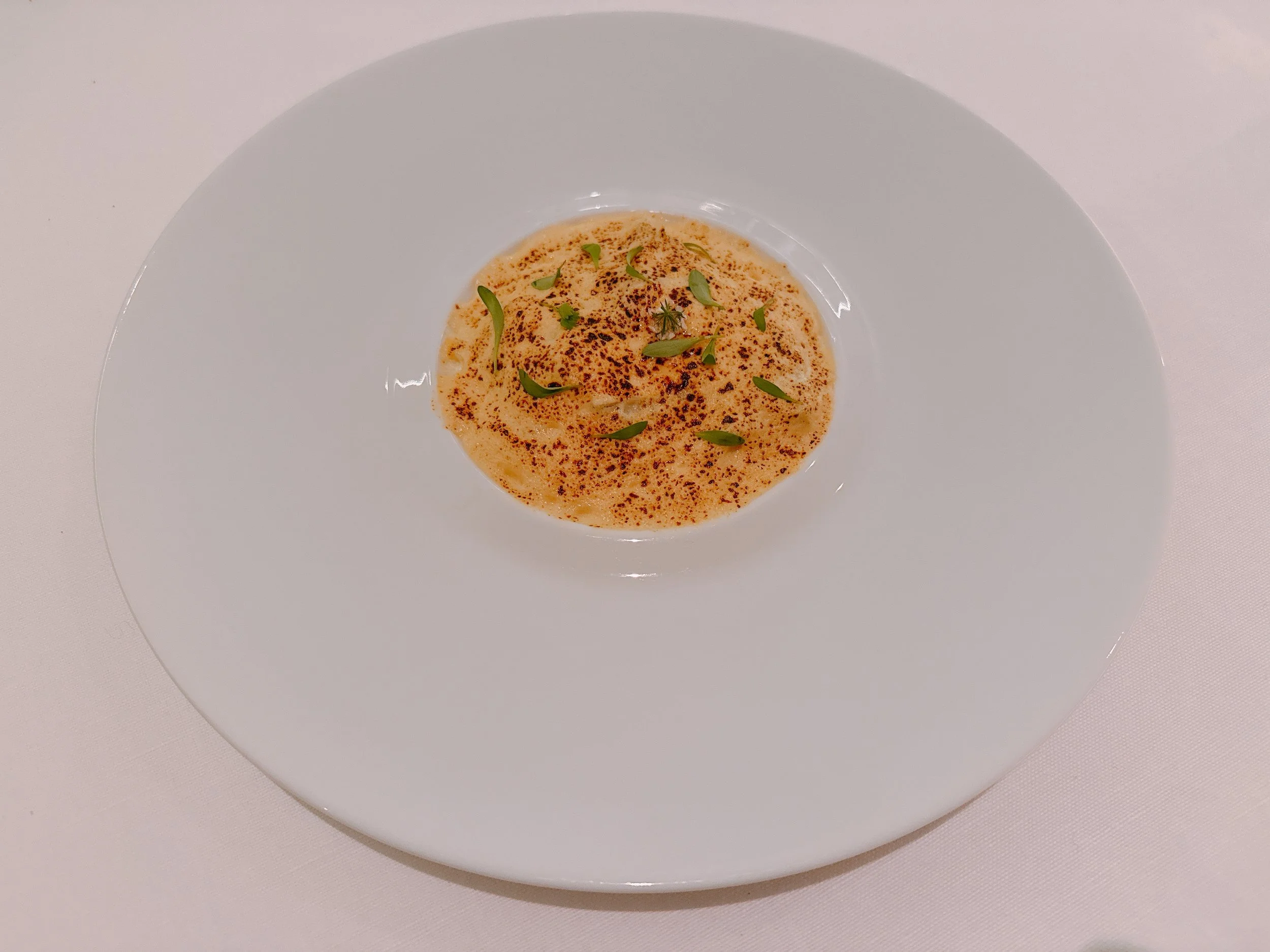
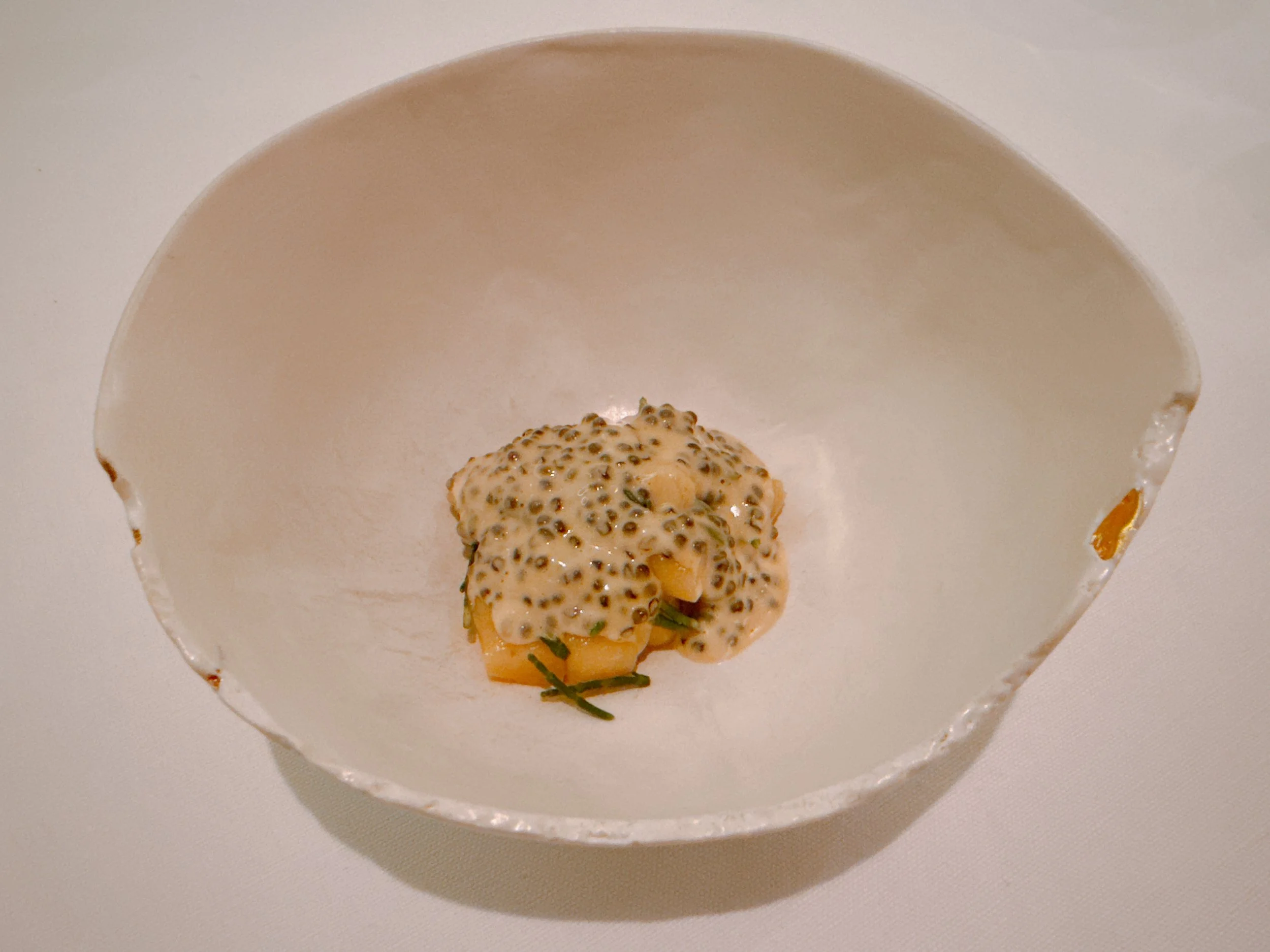
The next dish was a preparation of potato gnocchi. They came with a sauce made from dry white wine and caviar; some green spears of salicornia completed the dish. The pasta was nicely done: creamy in texture, and not overcooked. However, like many gnocchi, these were still on the heavier side. The warm sauce was a nice, flavorful addition to the dish, but it was hard to taste the caviar in it. The crunchy greens slightly lightened up this otherwise heavy-ish dish 16.
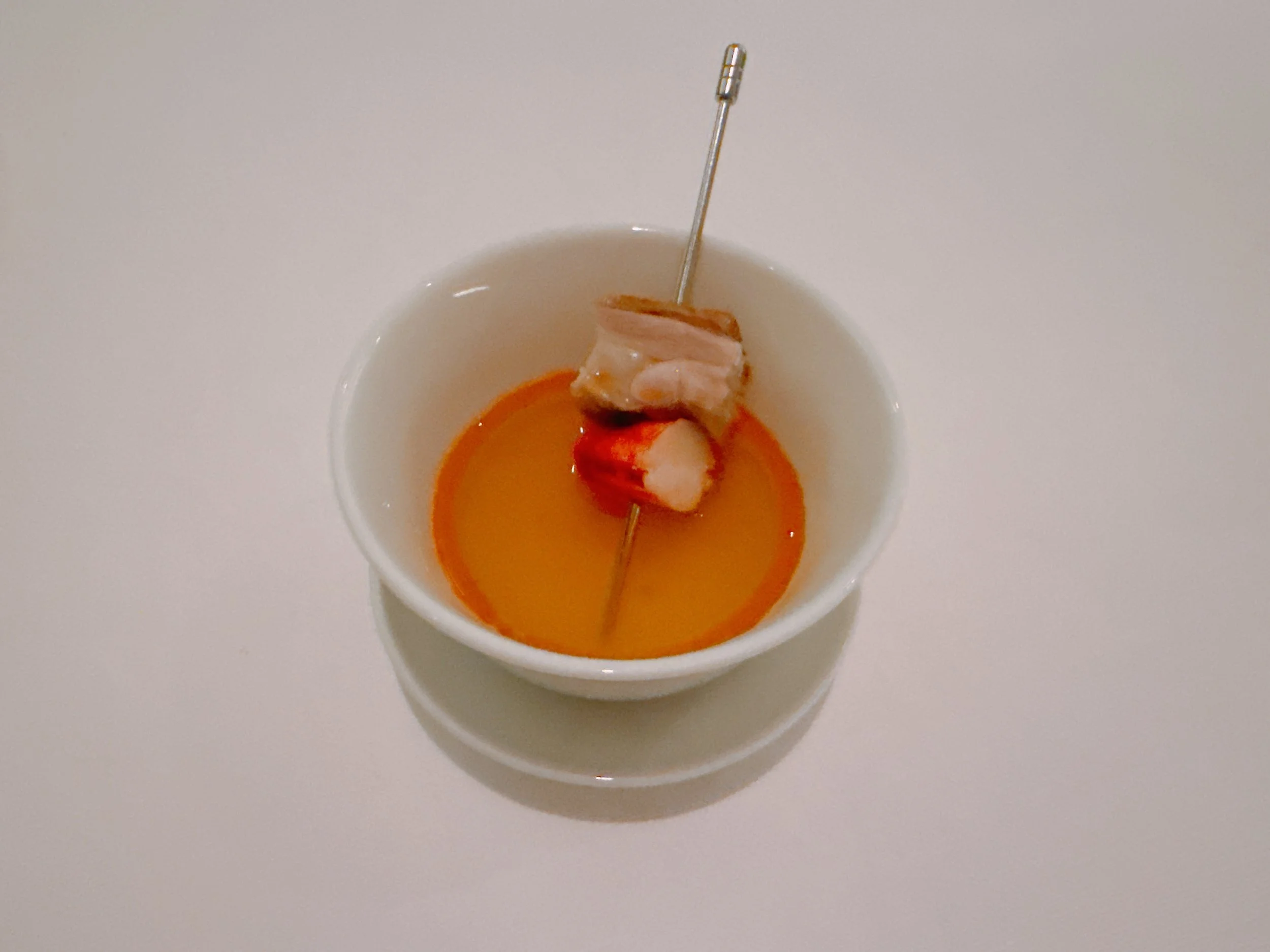
Following was one of the signature dishes of the restaurant - chicken. What made it special was that prior to cooking, lobster roe and lobster butter were added under the chicken's skin, giving it a light lobster flavor. The chicken was served in two parts. First, there was a cup of lobster/chicken broth along with a skewer holding pieces of lobster and chicken. I tried the skewer first, and the lobster was fine - juicy, but also a bit chewy and not too flavorful by itself. The chicken had more flavor and a crunchy skin. But the best part of the dish was the intensely flavorful broth. Maybe I should have added the lobster and chicken pieces to the broth before eating them? Averaging the phenomenal broth (17 or 18 by itself) and the two less compelling pieces of meat (14), this was a 16.
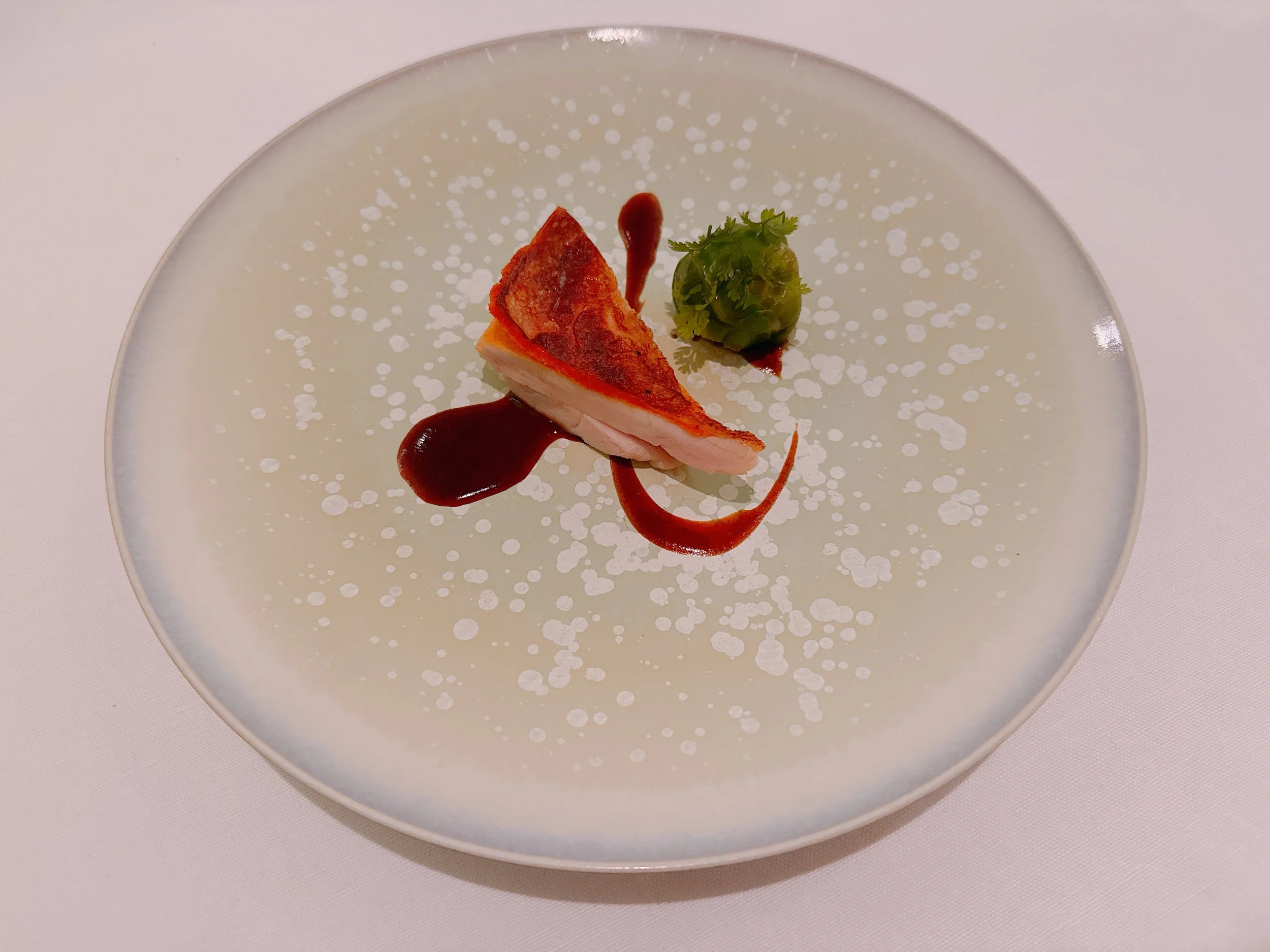
Next came the more substantial part of the signature dish. A skin-on slice of chicken was accompanied by a cabbage leaf filled with chicken leg meat, and a sauce made from lobster shell. The chicken was tender, and had a very light lobster flavor. The shredded chicken leg had more flavor, and a texture slightly reminiscent of sausage. All quite good, but maybe not as mind-bending as one might expect from a signature dish 16.
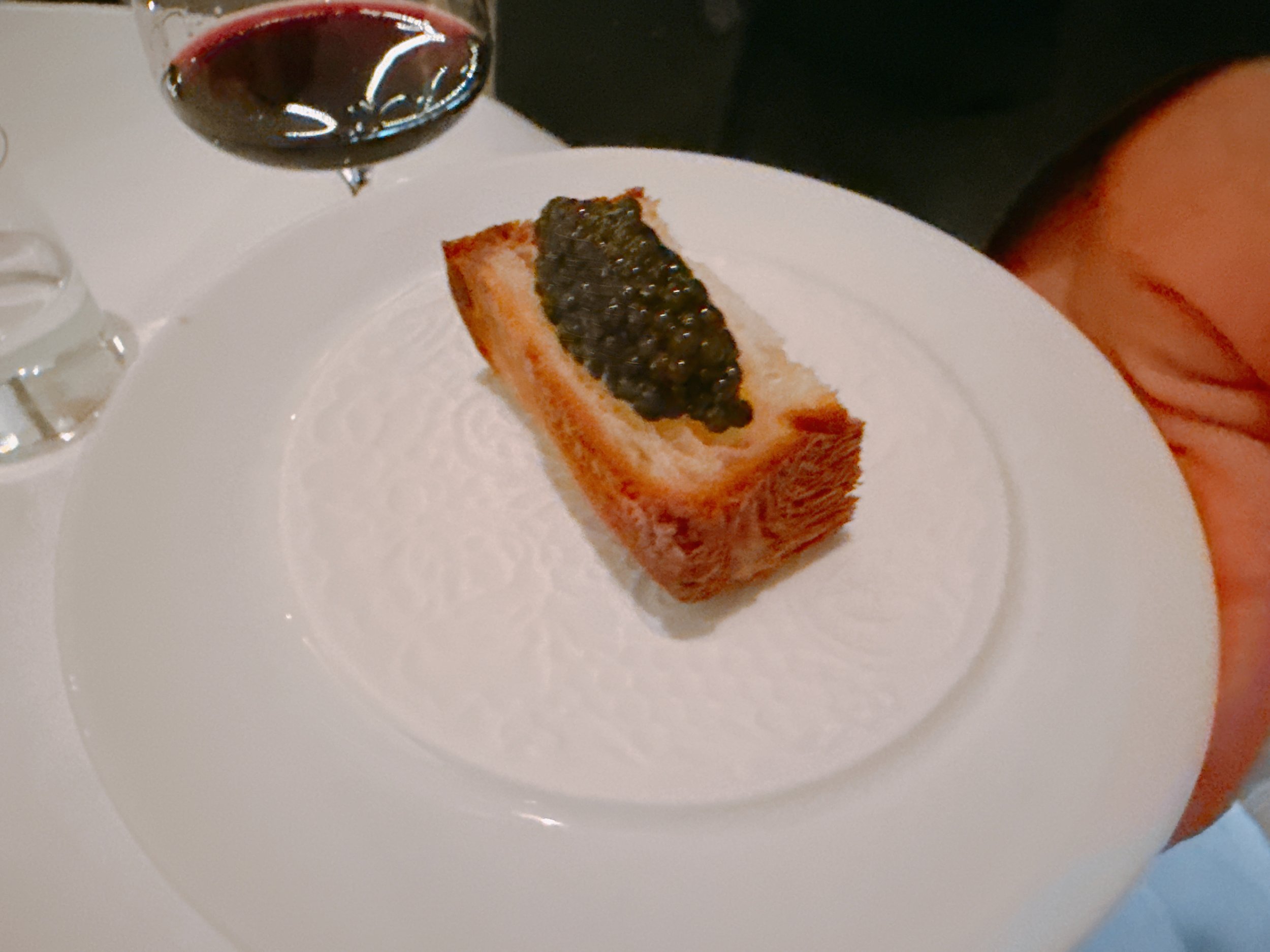
The following bite was a bit of an intermezzo: a piece of croissant topped with caviar. Not bad: one first tasted the salty caviar, and that was followed by the crunchy, buttery croissant. Somewhat hard to rate since it was literally just the combination of two components, but definitely enjoyable 16.
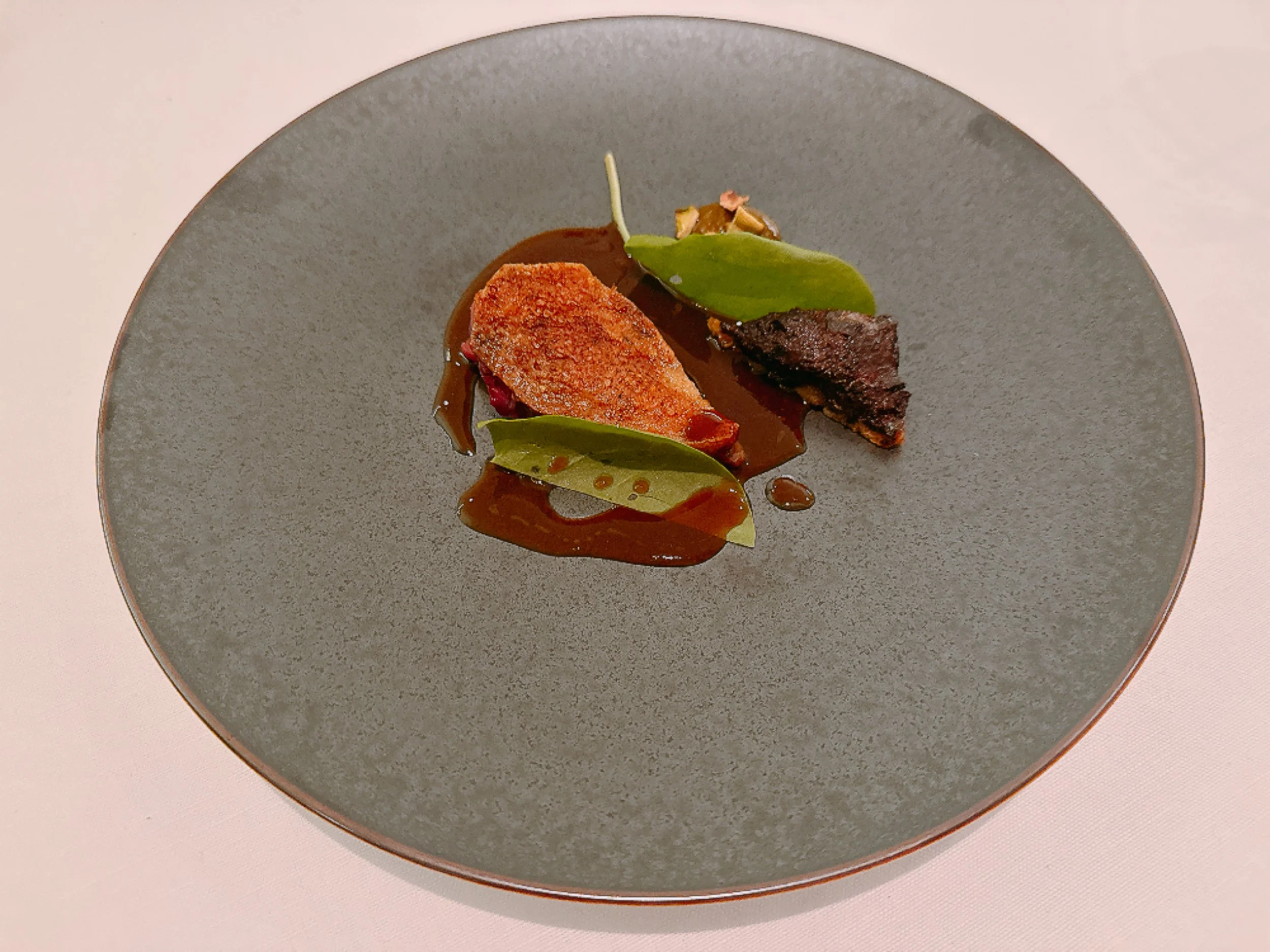
The final savory course featured pigeon, served with pistachios, sorrel leaves, and pigeon jus. On the side was a cracker seemingly topped with pigeon liver. I'll freely admit that pigeons aren't exactly my favorite meat. Had I known, I probably would have switched this dish out for something else. The meat was cooked fine, and there was only a thin fatty layer under the skin. The pigeon had a noticeable bite, without being chewy. The sour sorrel provided a nice contrast to the more earthily flavored remainder of the dish 15. (Maybe 16 if one likes pigeon more than I do.)
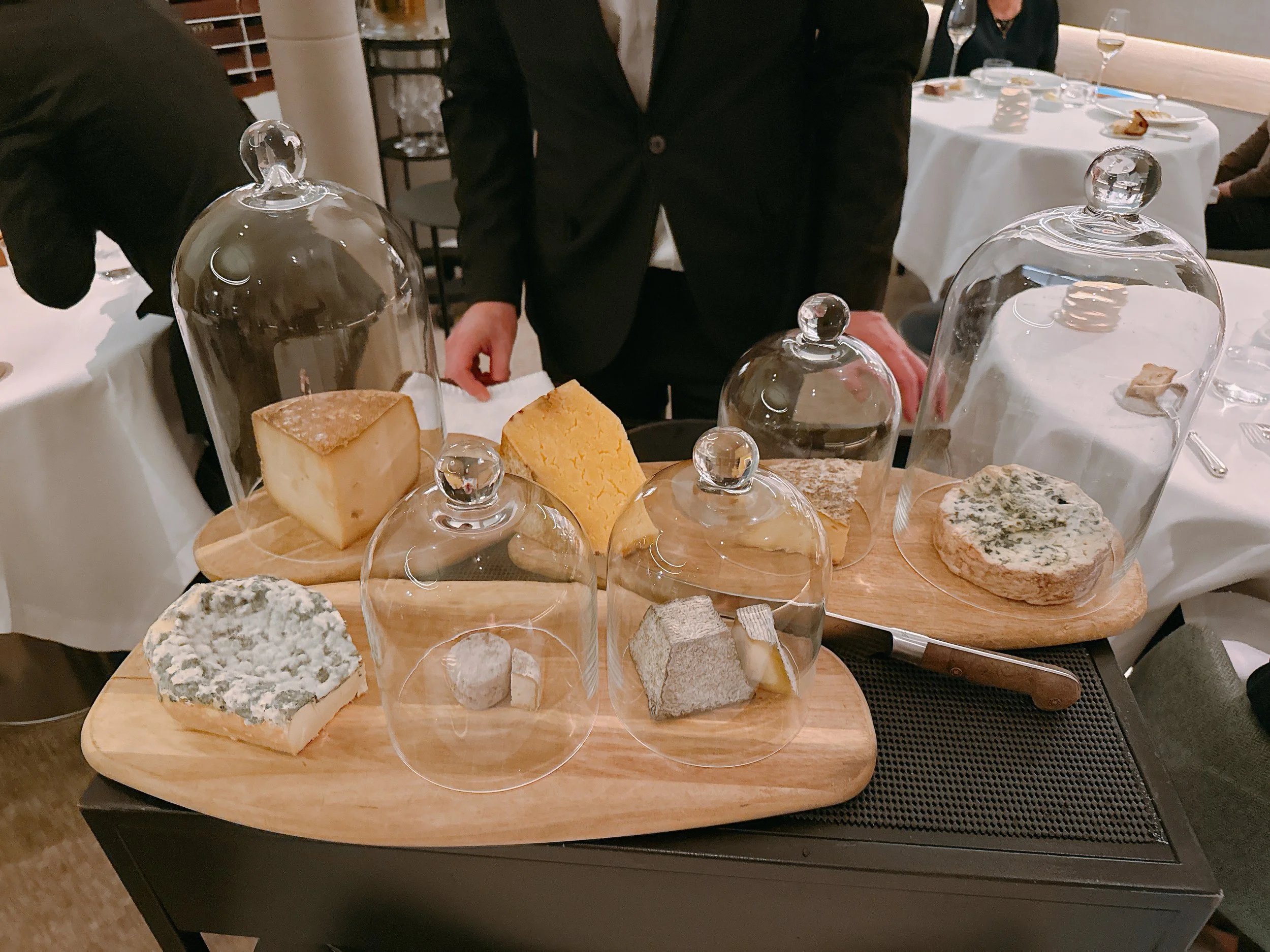
At this point, it was possible to add a cheese course, with cheeses selected from a trolley (for 25 Euro / $30). There were “only” seven different kinds of cheese, so I actually managed to sample them all. They were a decent mix: some were creamy, some almost dry, and I was instructed to eat the non-goat cheeses (including a blue cheese) before graduating to the goat's milk cheeses. Not bad, but also pretty basic for a cheese course in France. Not rated since cheeses can vary so much.
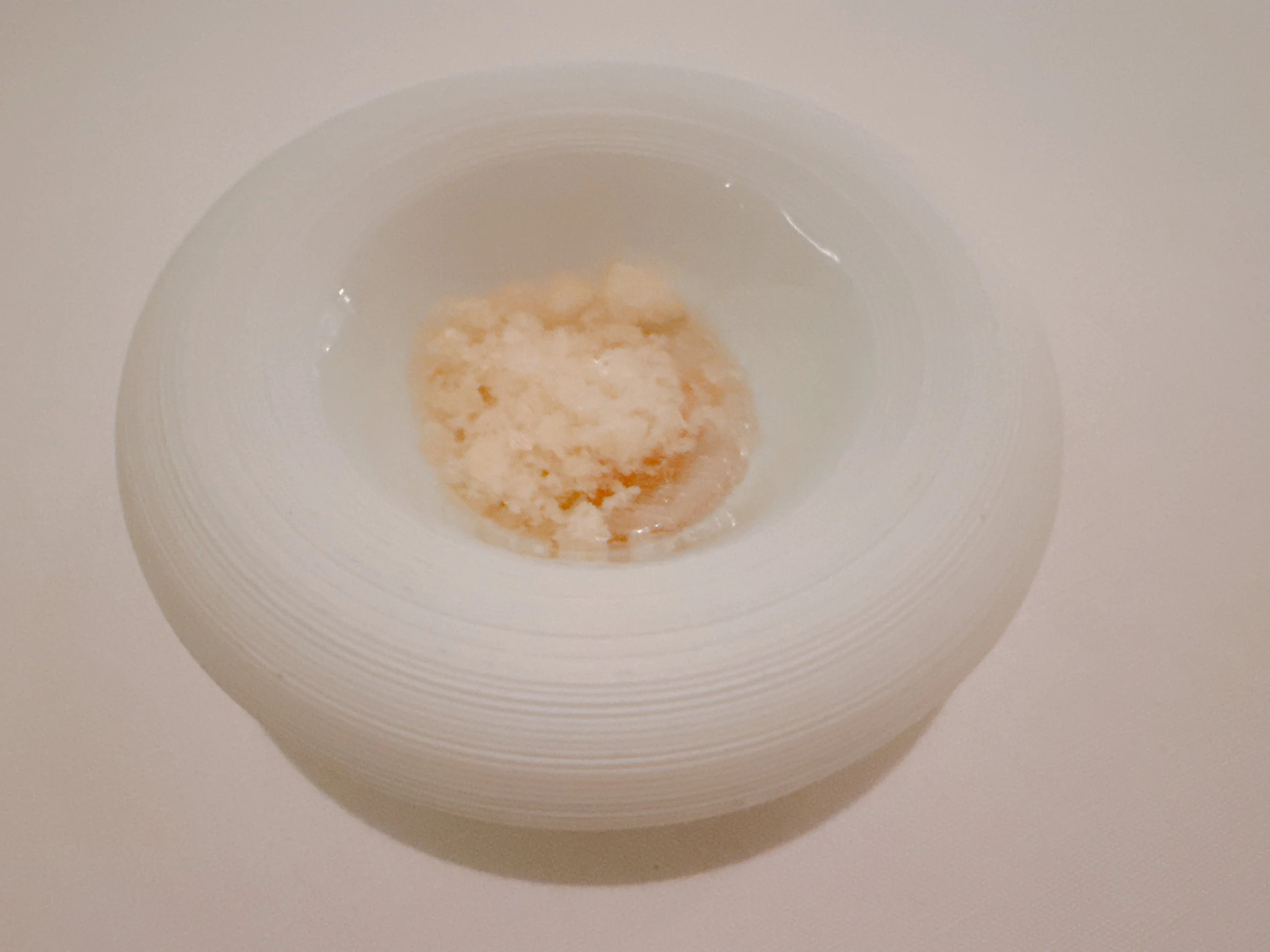
This brought us to a palate cleanser before the dessert. A white beer (or maybe pear?) granite was served over citrus fruit: limes and grapefruit. These were present in multiple forms: as jellies, as zest, and as actual fruit. Overall, this provided a welcome contrast of flavors. There was the sweetness of the jelly, of the granite, and of the sugar disc separating the granite from the fruit. And then there was some bitterness from the grapefruit and from the citrus zest. A light and focused dish, making for a good palate cleanser 16.
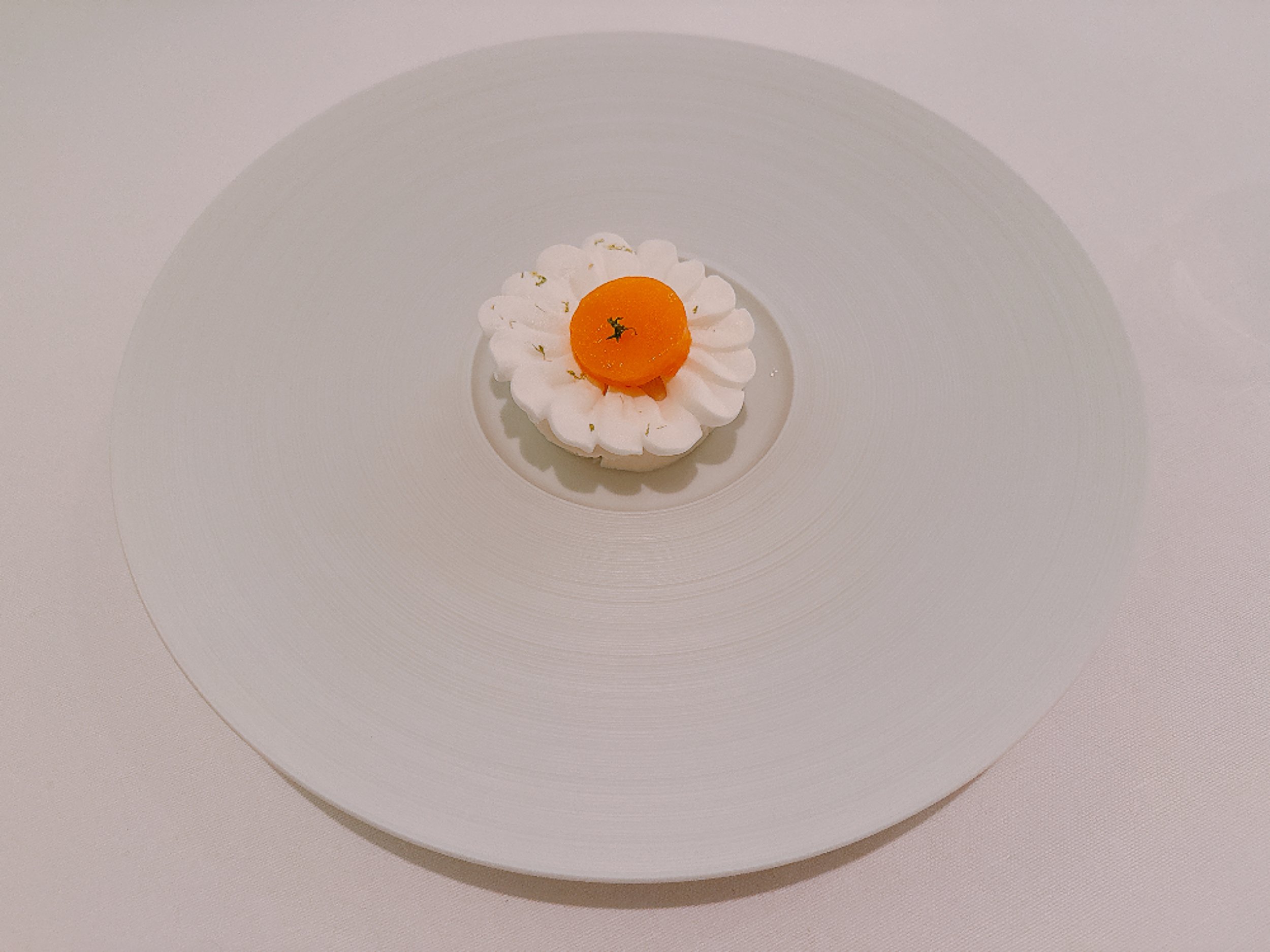
The main dessert was a combination of fruit (mango, pineapple, clementine) and a lemon thyme meringue. The mango in particular was very sweet, and the meringue added a slightly herbal note. A light and fruity dessert 16.
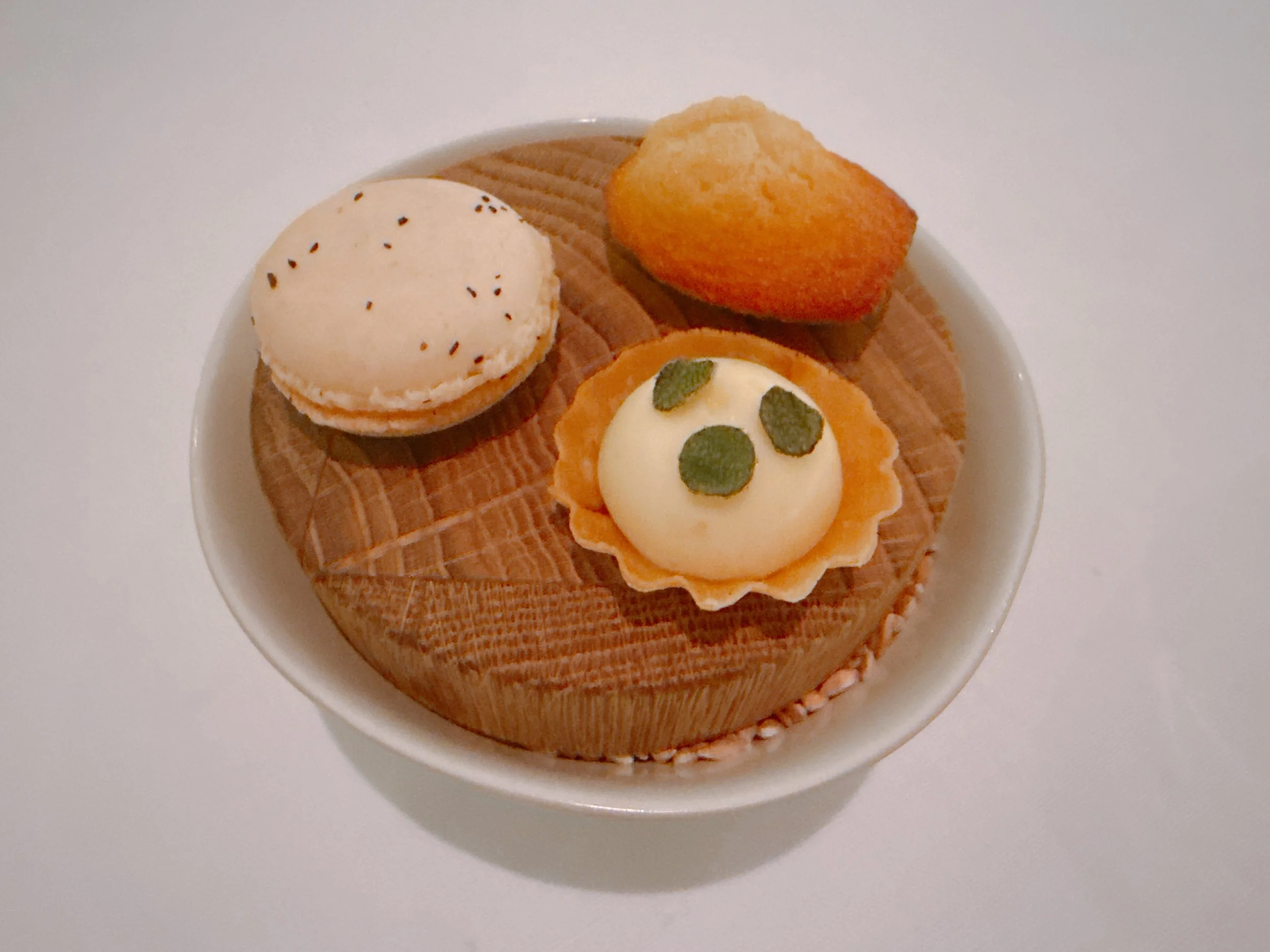
Three petit fours concluded the dinner. A mini apple pie seasoned with sage had a light crunch and a bit of acidity, but I couldn't taste either the apple or the sage 14. A white sesame/vanilla macaroon was nicely executed and had a strong sesame butter flavor 16. Finally, a caramel Madeleine had an almost creamy texture. Yum 16.
Overall: A nice dinner of French cuisine, with very focused dishes - there were hardly any unneeded flourishes here. While some appetizers lacked a bit in flavor, the rest of the dinner was consistently very solid. Together with the good service, not a bad choice for a night out then. My issue here is more with the two Michelin star rating. At this level, I’d have expected at least a few outstanding dishes, and not “just” a series of “solid” ones. But as Andy Hayler would put it - that's really Michelin's problem, not the restaurant's 15.