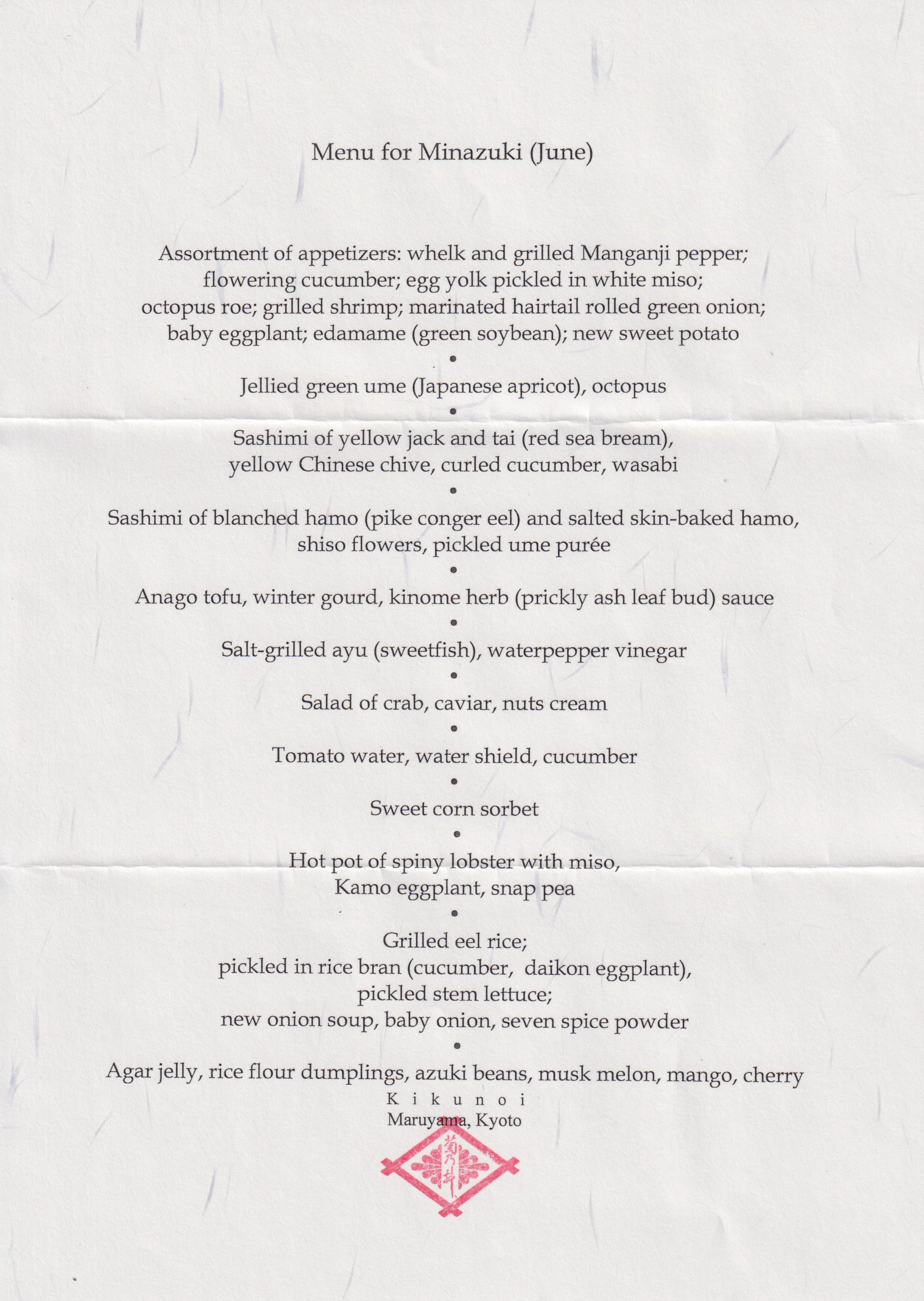
Kikunoi Honten - Kyoto
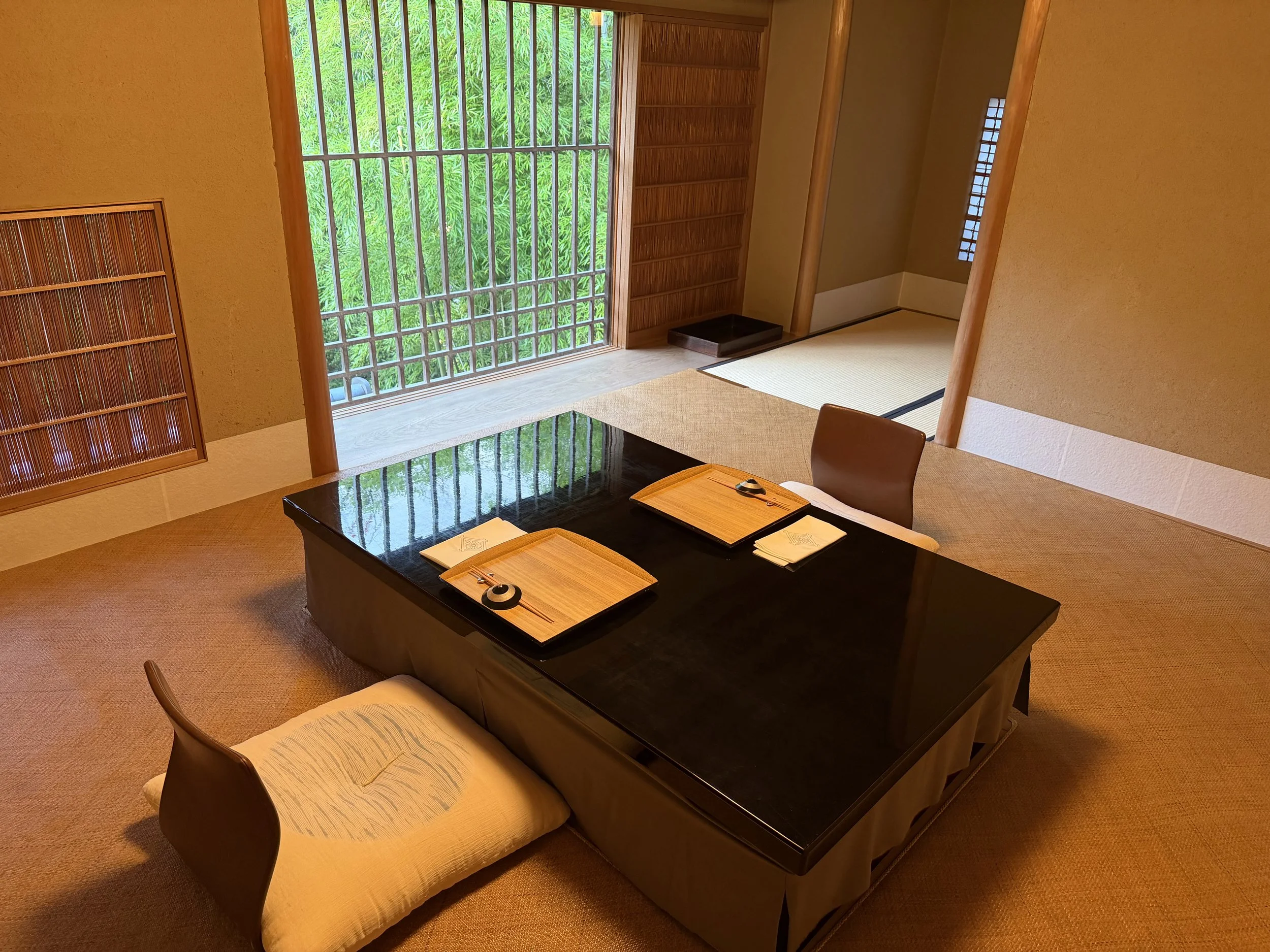
Room with a view (behind bars)
Rating: 14/20
Where: Kyoto, Japan
When: Dinner for 2 on 18 June 2026
Cost per Person: Tasting menu 22000-77000 JPY
Accolades: 3 Michelin Stars, Tabelog Bronze Award (2026)
Why: Kaiseki presented in a classic setting; good service
“Kikunoi Honten” is a restaurant serving kaiseki cuisine in Kyoto, helmed by third-generation chef Yoshihiro Murata since 1993. The restaurant has received three Michelin stars in every edition of the Kyoto Michelin guide, starting with the first one in 2010. These days, the chef splits his time between his original restaurant in Kyoto and an off-shoot in Tokyo that currently holds two stars. Not many chefs have five Michelin stars to their name, so we were definitely curious to visit his restaurant. I had been here once before in 2019, but - for lack of notes - didn’t remember much about the meal.
Kikunoi is located at the end of narrow road near Kyoto's Gion district. Thanks to the cul de sac, there is virtually no foot traffic here, just the occasional taxi ferrying guests to and from the restaurant. Inside the restaurant's wooden building are several private dining rooms; ours was just upstairs from the main entrance. The seats had backrests and there was a lowered floor under the table, so there was nothing to worry about for inflexible Western legs. The room's single window faced the driveway, but thanks to being on the upper floor, we simply saw green trees swaying in the breeze. Not quite the serenity that we had enjoyed at Miyamaso one day prior, but it was definitely a relaxing setting.
The restaurant offered several tasting menus, distinguished by their price. As usual in these situations, paying more means that (in theory) one gets more high quality ingredients - the length of the menu generally doesn't change much. The Japanese version of the restaurant's website listed the available prices as 22000, 33000, 55000 and 77000 JPY (about $135, $205, $340, $480, respectively). However, the restaurant's preferred online booking platforms didn't seem to offer the 22000 JPY menu, but “compensated” by adding hefty booking charges instead. If one has the option, a hotel concierge might be a better route to a reservation. In any case, we chose the 55000 JPY menu. There was no dedicated beverage pairing on offer, but it was easy to ask for sake or wine recommendations - the alcoholic beverage list was reasonably extensive. In my case, I ended up with two small bottles (180ml) of two different house sakes. These were totally serviceable, but far from the best sake that I've had - although it was hard to complain when the prices were 1600 and 2800 JPY per bottle ($10 and $17).
As a welcome change from the other kaiseki restaurants that we had visited on this trip, Kikunoi gave us a printed English menu at the beginning of the meal. Our servers' descriptions unfortunately did not go much beyond what was on the printed page. That said, their English was definitely good enough for the customary dining interactions, and we were able to ask questions about ingredients not mentioned in the menu.
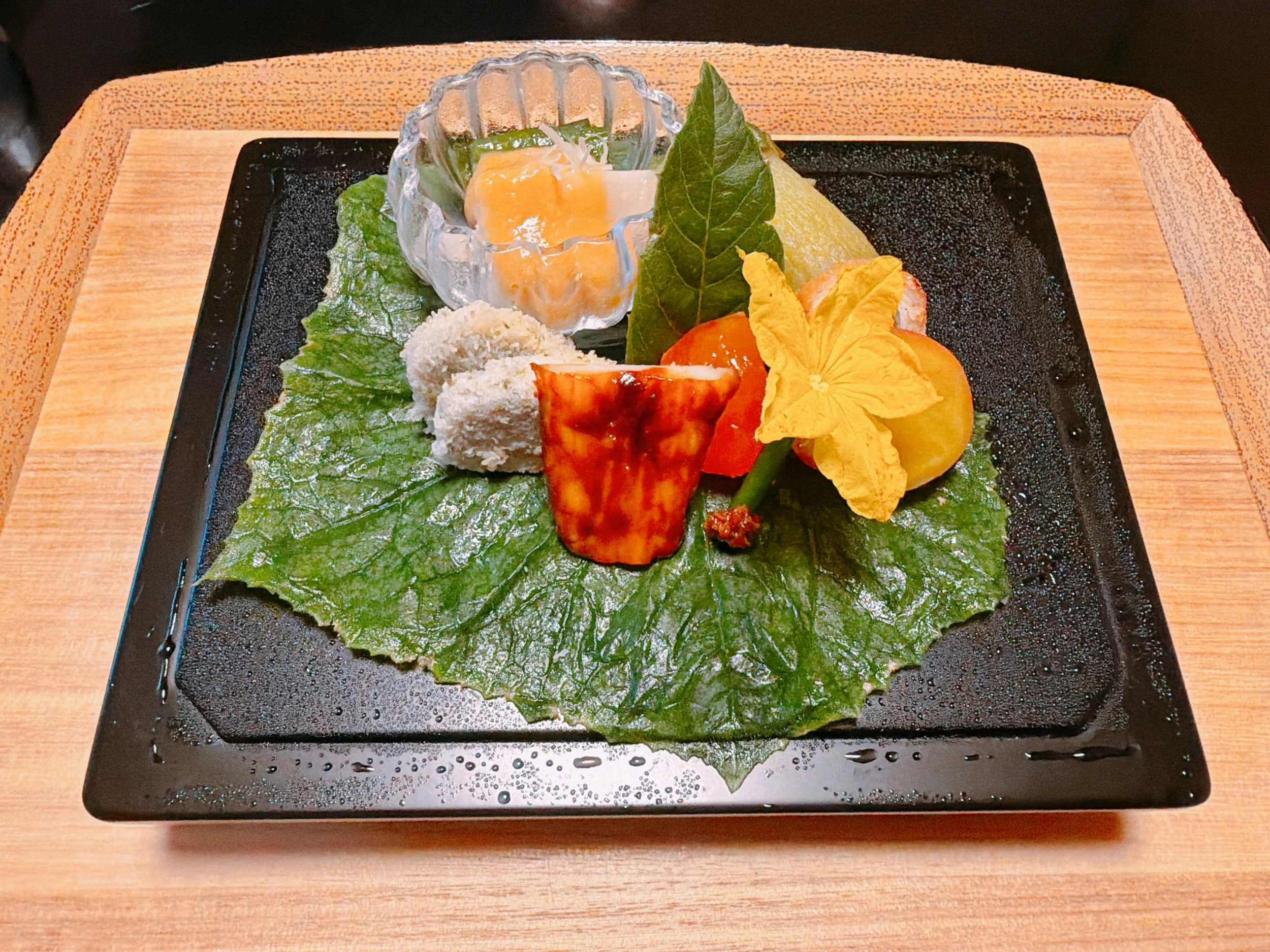
Our dinner started with a complimentary pour of plum wine. Quite lovely and sweet, but unfortunately just a token amount. This welcome drink was soon followed by the first course: a hassun, an assortment of small seasonal appetizers. I tried them in the order that they were described in the menu, but the exact sequence probably didn’t matter. Well, it was probably a good idea to eat the sweet potato dish last, since it was quite sweet.
Whelk (a type of sea snail) and grilled manganji peppers came with a miso-ginger sauce (in the glass bowl). The sauce was very flavorful and even a little bit spicy. It went wonderfully with the whelk that had a tender texture and some remaining bite, and with the distinctly flavored pepper. A great beginning, but unfortunately (spoiler alert!) also the best thing that I would eat for the rest of the night 18. A bright yellow cucumber flower with a little attached cucumber was seasoned with a brown miso. This little bite was quite aromatic thanks to the miso sauce, but it didn't really taste of cucumber - probably since there wasn't enough to leave a notable impression 16. Octopus roe (the breaded looking, greenish half-circles on the left in the picture) were quite crumbly in texture and only had a very subtle seafood flavor 14. Marinated grilled shrimp (front center) also didn’t taste of much - they were more savory than the “typical” cooked shrimp that tend towards being sweet 14. A marinated hairtail fish was rolled around a slice of green onion (the white object behind the flower). This fish had a mealy texture, and the onion almost didn't taste of anything 13. A baby eggplant (back right) was juicy, but again had only light flavors 14. Two edamame beans were pretty plain, having at most a hint of salt 12. And finally, there was a slice of a young sweet potato (yellow, right behind the flower). The potato was extremely sweet - much too sweet when compared to the other bites here 13.
Our next course arrived while I was still working on the previous one. Sometimes I wonder how restaurants get the timing in tatami private dining rooms right, since from their point of view it's a bit like Schrödinger's cat - with less poison and better food, that is. Well, whatever the restaurants that we had visited before were doing, Kikunoi wasn't doing the same, since especially at the beginning, dishes sometimes appeared too early and sometimes only after long waits. Matters improved after the first few courses, thankfully.
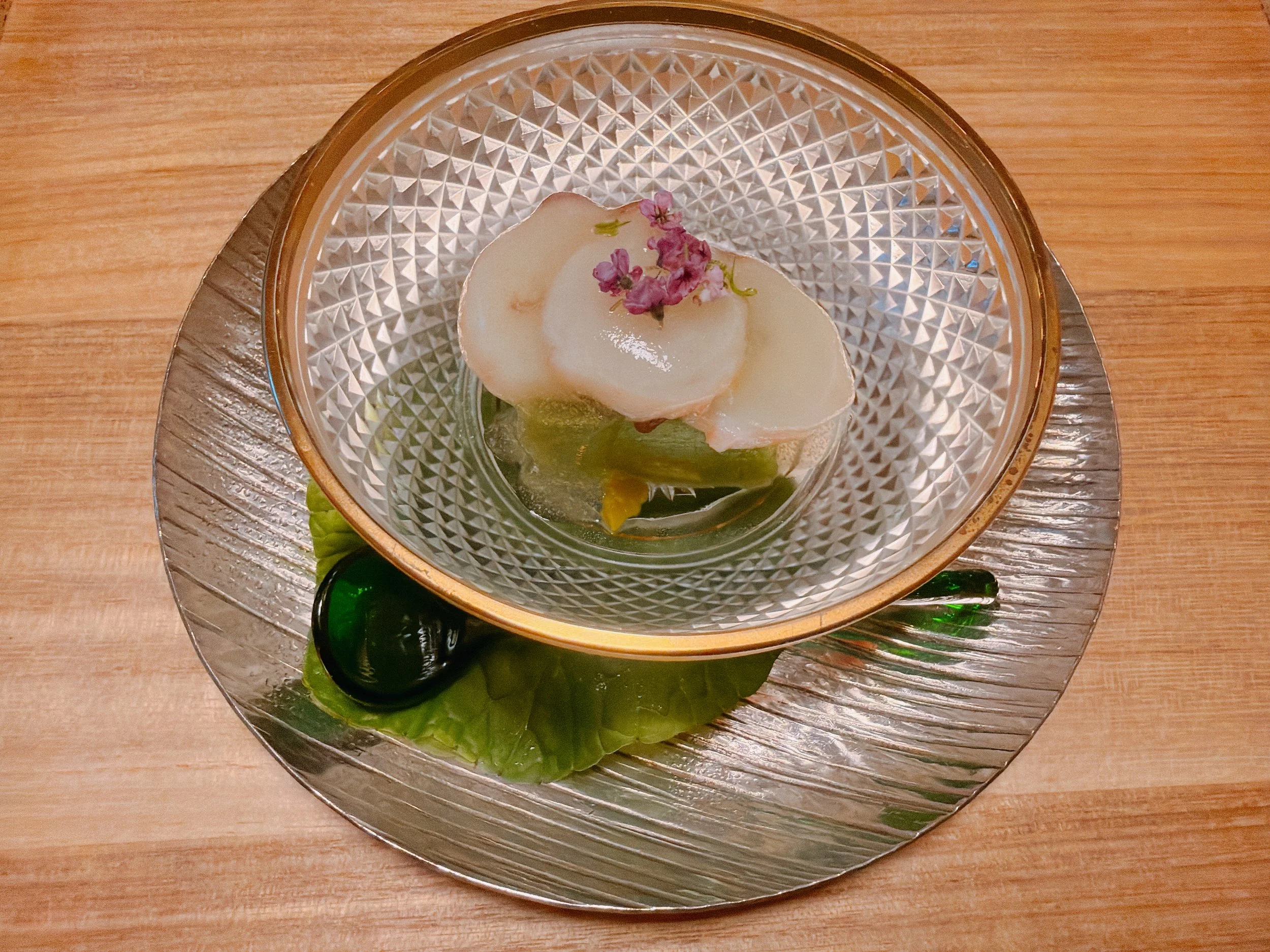
But back to the food. A glass bowl contained three slices of octopus that sat atop some jellied green ume (Japanese plum), all served cold. Let's start with the good: the octopus was quite nice, with some bite, but still relatively tender. The lightly acidic, slightly fruity sauce went well with the seafood (maybe a 15 by itself). The ume on the other hand verged on being inedible - it was extremely sour, sitting on top of an acidic sauce that contained citrus pieces that provided even more tartness (generously, a 12). On average 13.
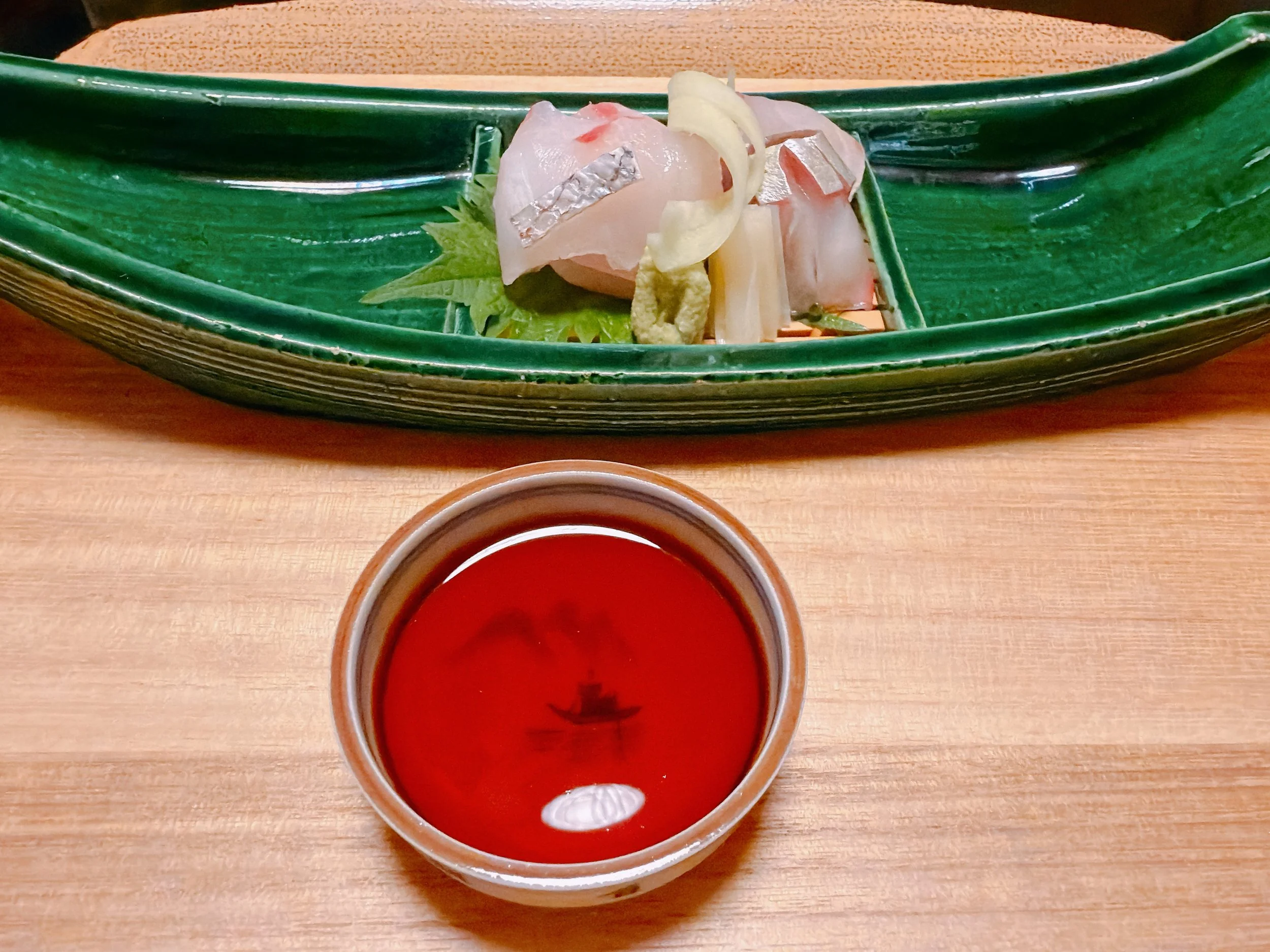
The following two courses were both introduced as “sashimi”, but only the first one matched the textbook description. In a boat-shaped dish were slices of raw tai (red seabream), yellow Chinese chives, and a cucumber twirl - all meant to be dipped in soy sauce, potentially with a bit of wasabi. In addition, there was some yellowtail that had already been seasoned with a ponzu jelly - no need for soy sauce here. Admittedly, I'm rarely in love with tai sashimi - the fish often doesn't have much taste, and it can be pretty chewy. Unfortunately, this one was one of the worst examples I've seen so far, being not just chewy but almost sinewy in texture. Not a cut that one should serve in a restaurant of this caliber (12 or so - the lovely wasabi mollified me a bit). The yellowtail also wasn't the most tender cut, but I'll happily take an average yellowtail over questionable tai. Plus, the ponzu jelly was very well done and added significant amounts of flavor to the fish (15). The chives were quite crunchy, the cucumber a bit less so, but both added some freshness to the dish 14.
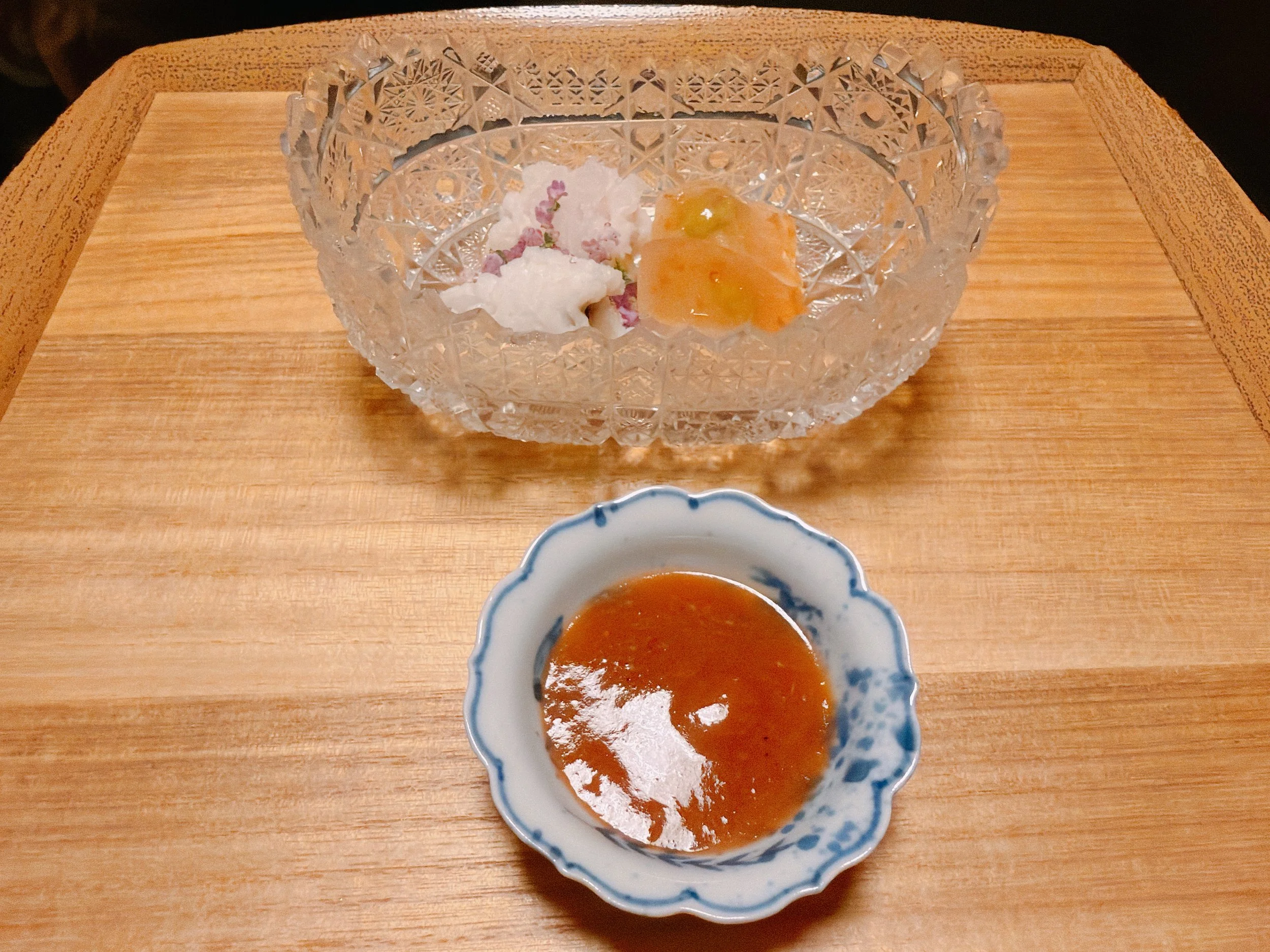
Next, we received a “sashimi” of hamo (conger eel). In my mind “sashimi” means that the fish is raw (or nearly so), but this was definitely cooked conger eel - as evidenced by the fact that it was still warm. Anyway, the eel appeared in two forms. A lightly blanched version (left in picture) was topped with a few shiso flowers and was ready to be dipped into a pickled ume purée. To its right was a baked eel with a wasabi/ume topping. The blanched eel was very fresh, and had a very light eel taste that went well with the fruity sauce (14). The baked eel felt not as fresh, with a firmer texture, and the wasabi in the topping was virtually undetectable (13). Underwhelming 14.
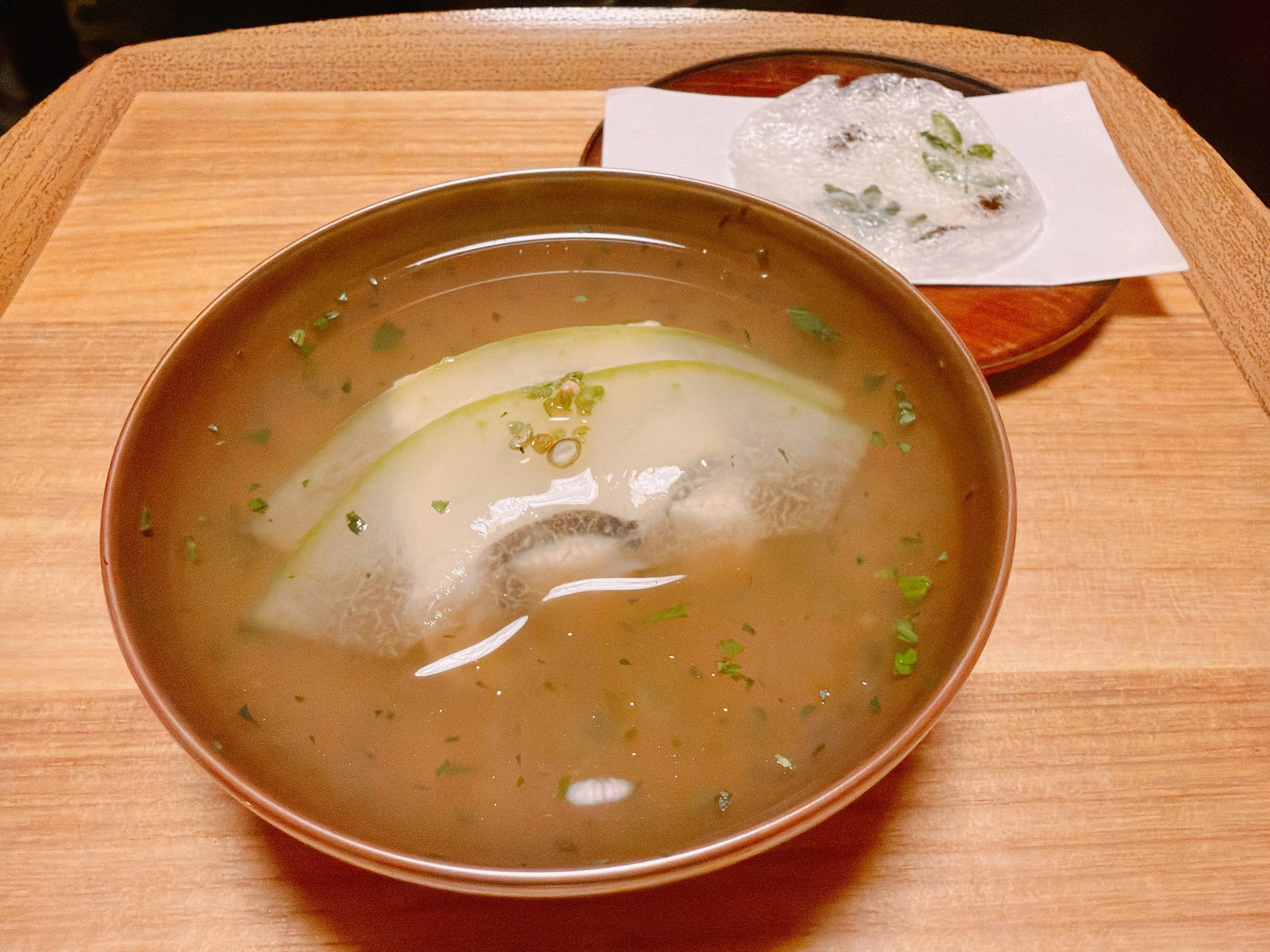
Then it was time for a soup - but not the clear kind often seen in kaiseki cuisine. Here, we got a broth seasoned with kinome leaves that contained an “anago tofu”, that is, a tofu incorporating large pieces of sea eel. On top of the tofu were slices of winter gourd. Sitting on a separate plate was a rice chip filled with kinome leaves and black miso powder. This chip was meant to be added to the soup after the tofu and winter gourd were gone. The broth was notably thickened, and had a subtle herbal flavor. The winter gourd was seasoned with a bit of Sichuan pepper, but otherwise only had a light vegetable flavor. The best part of the dish was the eel tofu. Served very hot, its texture was dominated by the eel, which went surprisingly well with the tofu. Its flavor was not strong by any means, but definitely enjoyable. Adding the rice chip to the soup was not a revelation, unfortunately: the chip simply became soft, and its fillings added little taste. A bit more flavor intensity would have improved the soup in my book (although admittedly, the same is true about most soups served during kaiseki meals) 14.
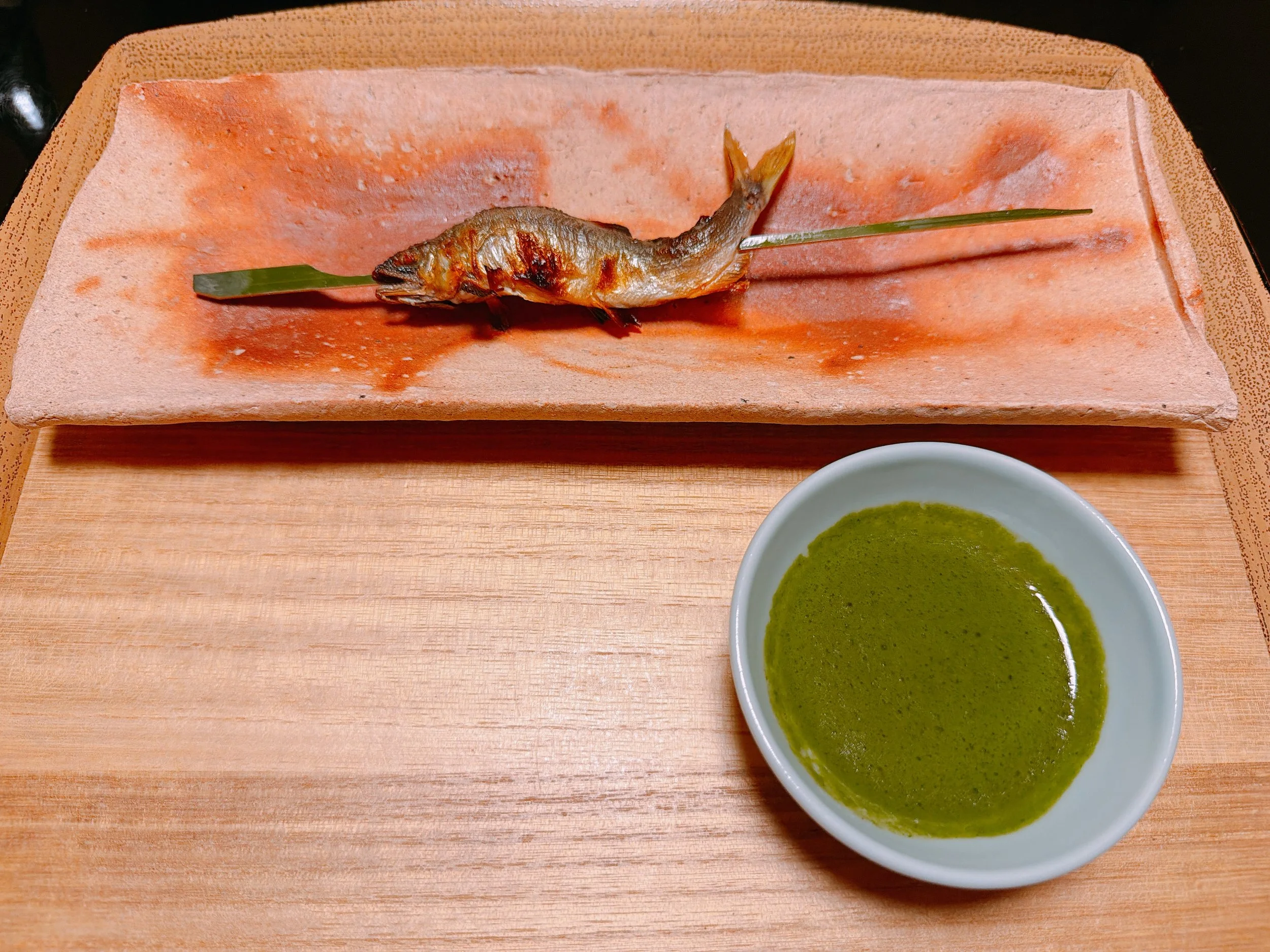
For our next course, a chef came to our room in order to grill whole ayu fish over charcoals. We had been shown the live ayu at the beginning of our meal, but this time, they returned in already grilled form. So it was not entirely clear what the chef was adding here. Reheating them? Grilling them a bit more? In any case, when they finally landed piping hot on our plates, they were paired with a waterpepper/vinegar sauce. The fish themselves did not seem to be seasoned at all - they were crunchy, somewhat bitter, but ultimately not particularly distinctive in flavor. (My dining companion mentioned that one of his two fish ended up being burnt. Mine were fine in that regard.) The sauce was actually pretty nice, tasting both herbal and vinegary (maybe a 16 by itself), but it didn't stick to the fish enough to make a big difference to the its taste. I wish that the seasoning had been more integrated into the dish 13.
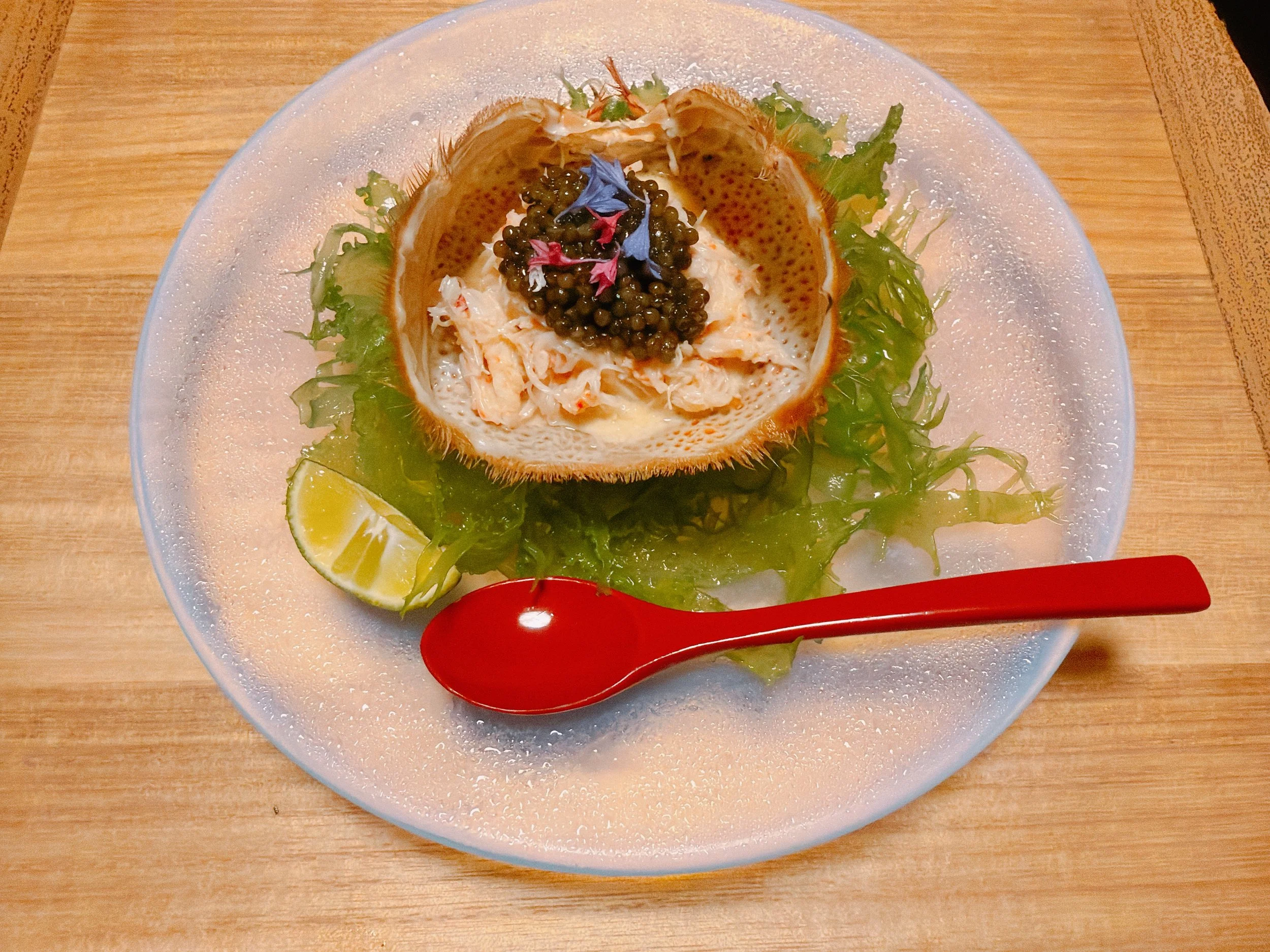
A crab salad was topped with caviar and seasoned with a macadamia nut dressing. Before eating, we were instructed to squeeze some citrus juice on top of the dish. The crab was very fresh, but the nutty sauce actually lessened that aspect of the dish - the crab now tasted dull rather than showing its lovely, subtle sea flavor. The citrus juice pushed a bit in the opposite direction, but this dish would probably have been better if the crab had been allowed to take center stage. The caviar was fine, but totally disappeared among the other flavors 14.
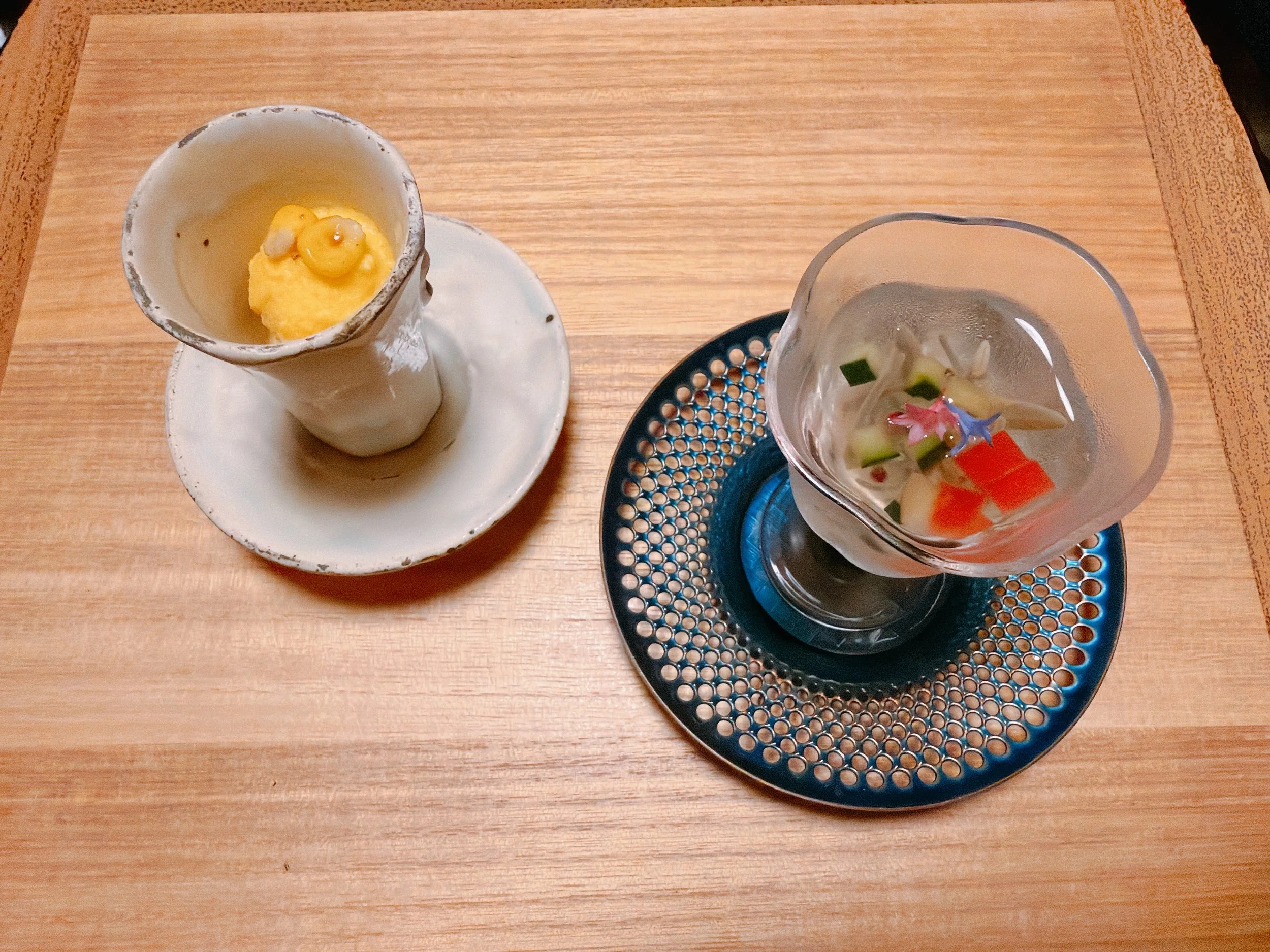
Two palate cleansers (of a sort) were served at the same time. One was a “tomato soup” that consisted of tomato water, water shield leaves, and little cucumber cubes. This was a refreshing dish with crunchy ingredients, but ultimately with only a very light tomato flavor. I had expected something slightly stronger after hearing the words “tomato water” 14. Next to the tomato soup was a sweet corn sorbet. For better or worse, it tasted simply of sweet corn, feeling surprisingly plain. Unfortunately, the sorbet also contained some small ice crystals - a smoother texture would have been better 13.
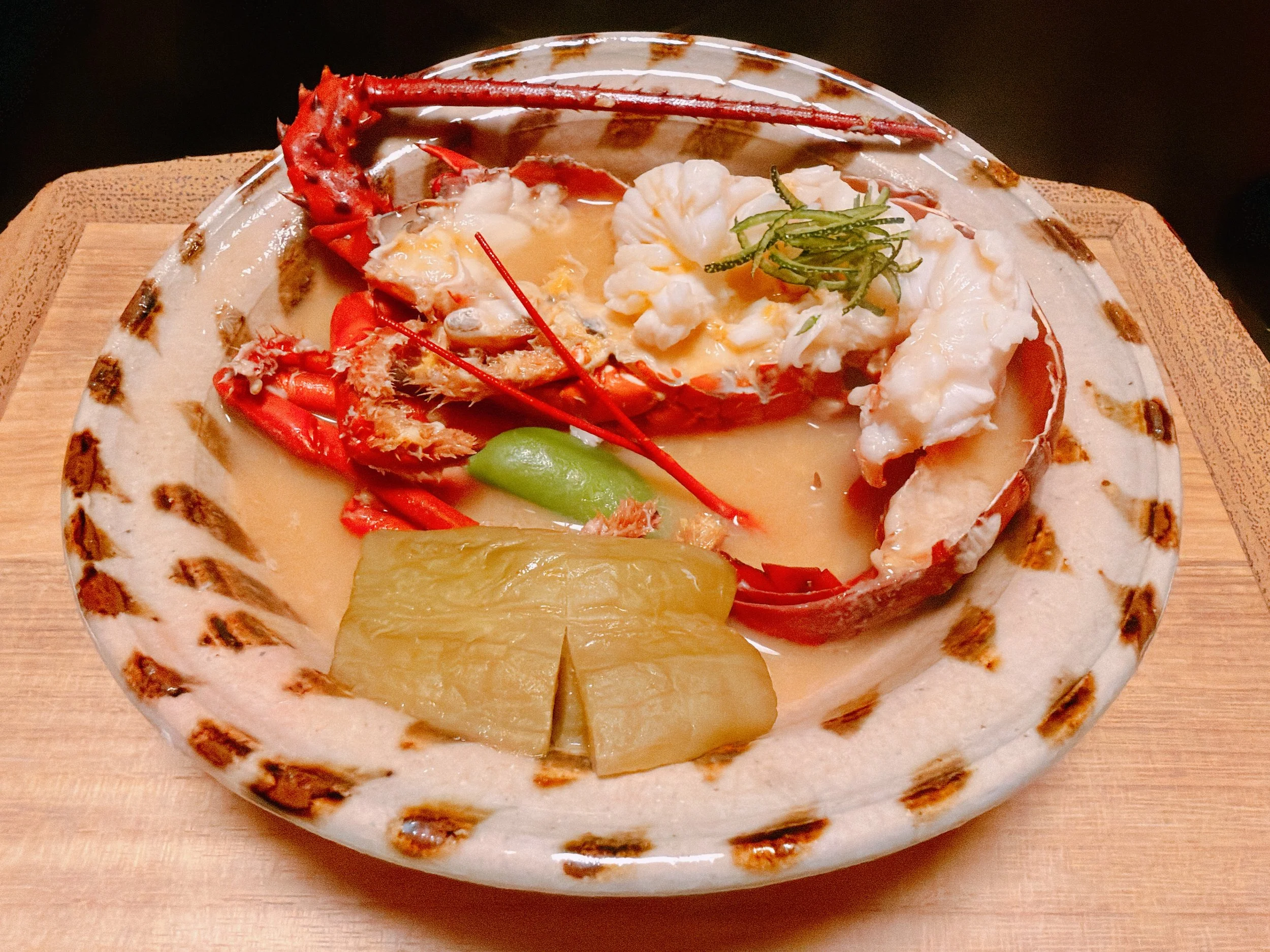
The meal’s main savory dish was a hot pot. In the pot (well, bowl) was a spiny lobster, still sporting half of its shell and topped with thinly sliced citrus peel. Kamo eggplant and a single sugar snap pea added some green color to the presentation. The lobster was very fresh and cooked nicely, making it tender and juicy. The broth was lovely as well, tasting of miso and ginger with a hint of pepper/spice. (Un)fortunately, the broth didn't add much flavor to the lobster itself, so it tasted simply of slightly sweet lobster meat. The eggplant was better: juicy and suffused with the broth. The sugar snap pea was fresh and crunchy 15.
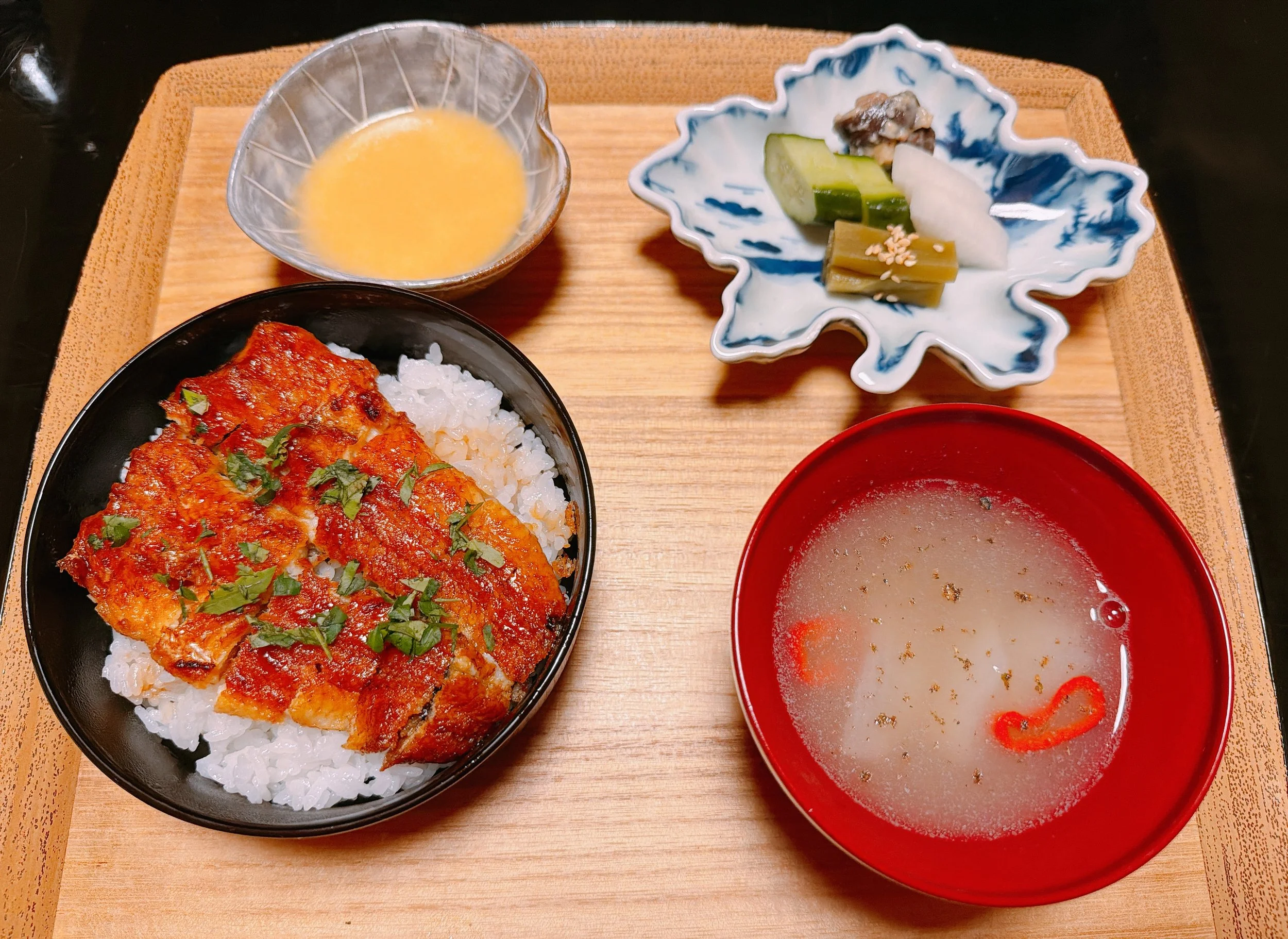
A rice course heralded the end of the savory portion of the menu. The rice was topped with a generous amount of grilled unagi (freshwater eel). There were the usual pickles (cucumber, daikon, eggplant, etc), a mountain yam/egg yolk dipping sauce, as well as an onion soup. Ground sancho pepper was available as a seasoning. The eel was nicely seasoned and went well with the rice. The pickles were a mixed success: the daikon was underwhelming, the cucumber nothing special, but the eggplant had an interesting sweet-and-spicy marinade, and a piece of celtuce had a great crunch and a light mustard flavor. The mountain yam sauce was pretty light in flavor and had a pronounced slimy consistency. The onion soup was quite thick and tasted only lightly of onions. The best part of this dish was the unagi, everything else was unfortunately not particularly exciting 14.
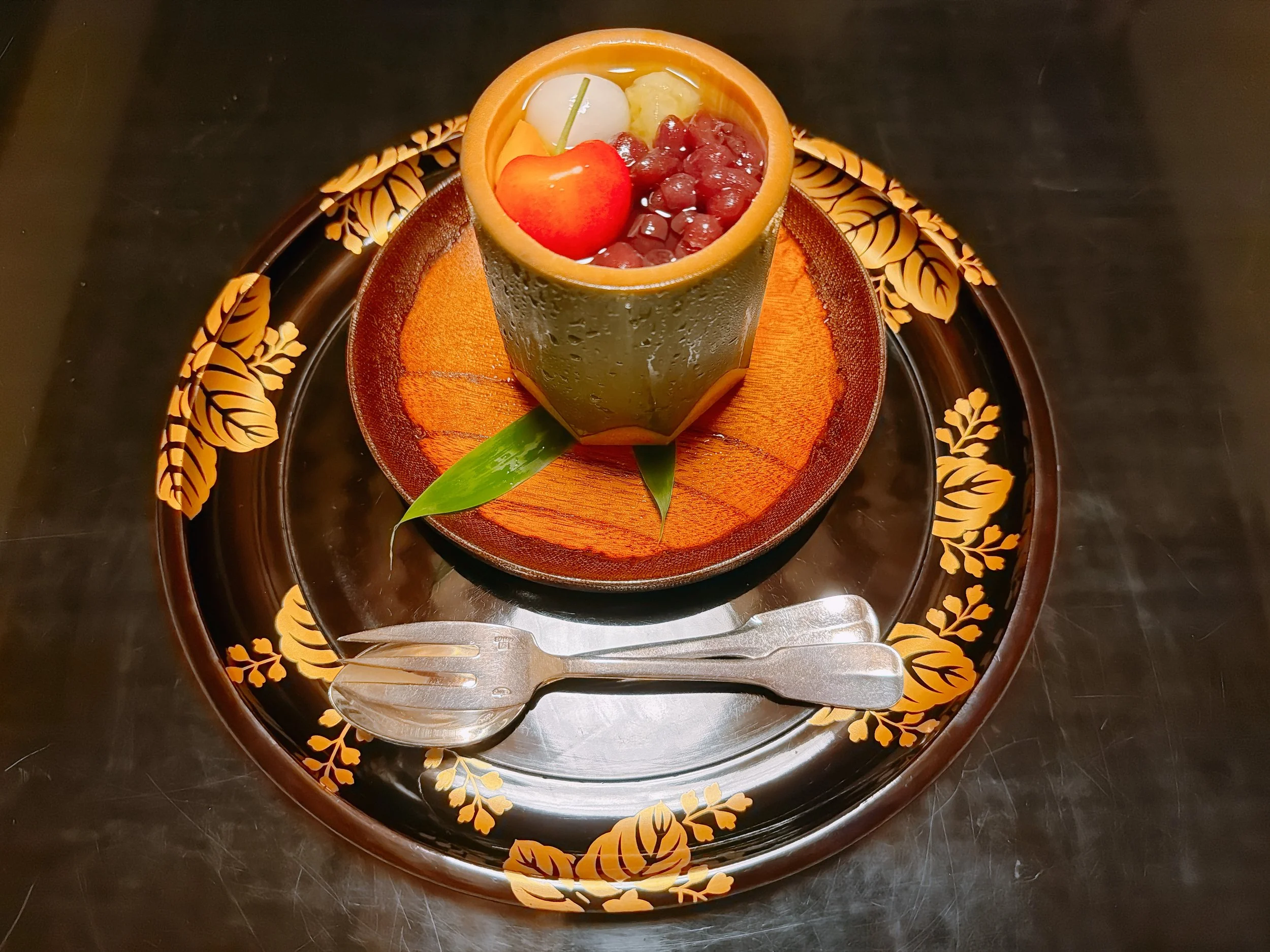
Our dinner ended with two desserts. The first one was a cup filled with some fruit - melon, mango and a cherry - as well as azuki beans, some mochi balls, and cubes of agar jelly. All of this was dressed with a sweet sauce. The fruit were quite nice, the mango in particular was amazing (18). The mochi were sweet with a good texture, but the jelly was somewhat dull. Unfortunately, there was also a lot of it (it's hidden in the picture), so it eventually wore out its welcome 16.
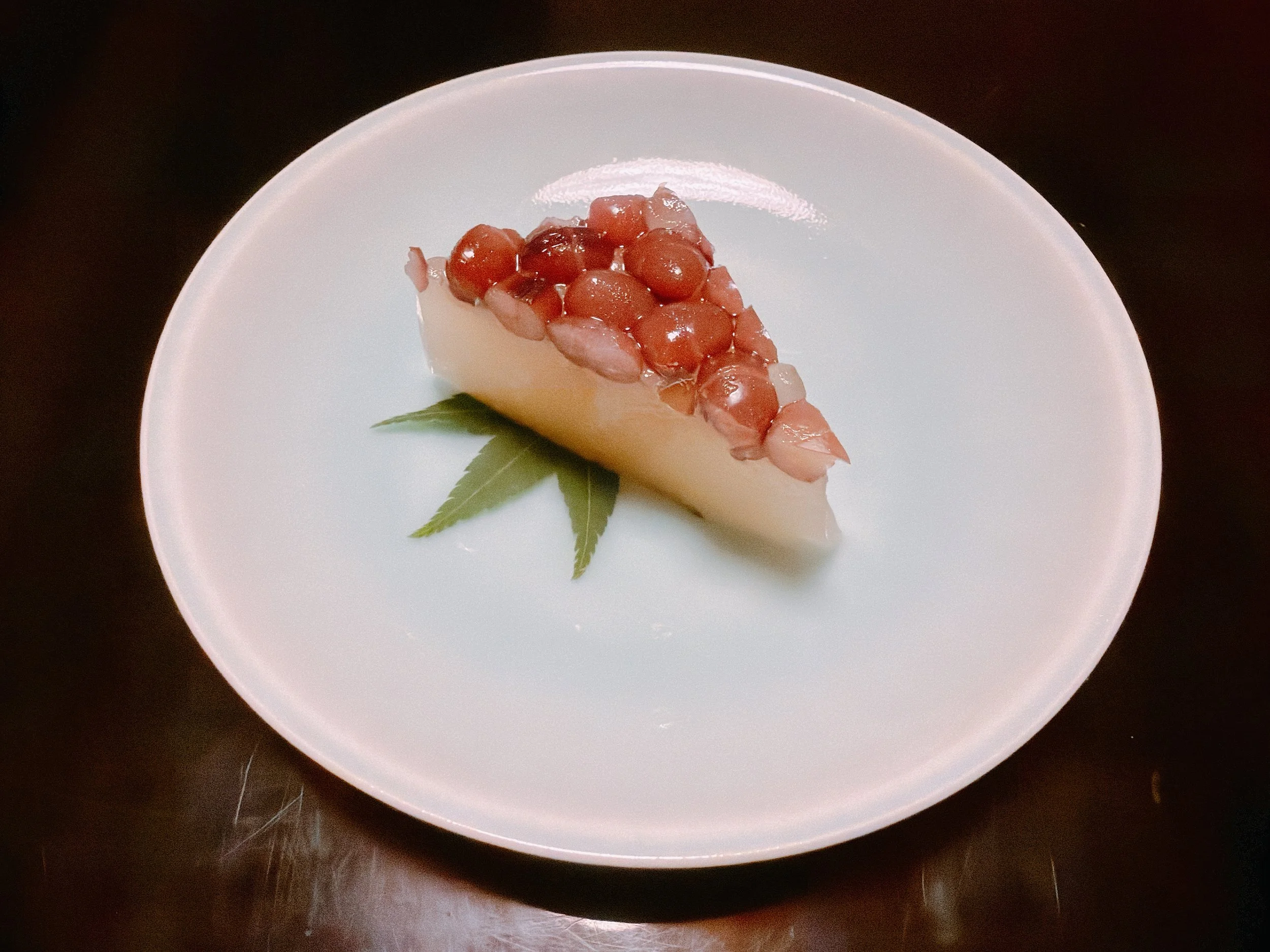
Finally, we received a slice of minazuki - a rice cake topped with azuki beans. I don't have enough experience with this particular dessert to judge how good a rendition it was. The sweet beans added some texture to an otherwise very homogeneous, sweet base 14.
Overall: The food at Kikunoi was quite underwhelming for a Japanese kaiseki meal, especially for a three-starred one. Admittedly, my Western palate might be partially to blame (as the much more positive Tabelog rating would suggest). But there were also some culinary choices that seemed questionable regardless of one's preferences: lackluster cuts of sashimi, dishes that were so strongly flavored that they became almost inedible (the ume jelly), a nut sauce that overpowered the flavor of a lovely fresh crab, burnt grilled ayu, ..., the list went on. The service and setting were both lovely, but food-wise, this was one of the weakest three-star meals that I have had so far 14.