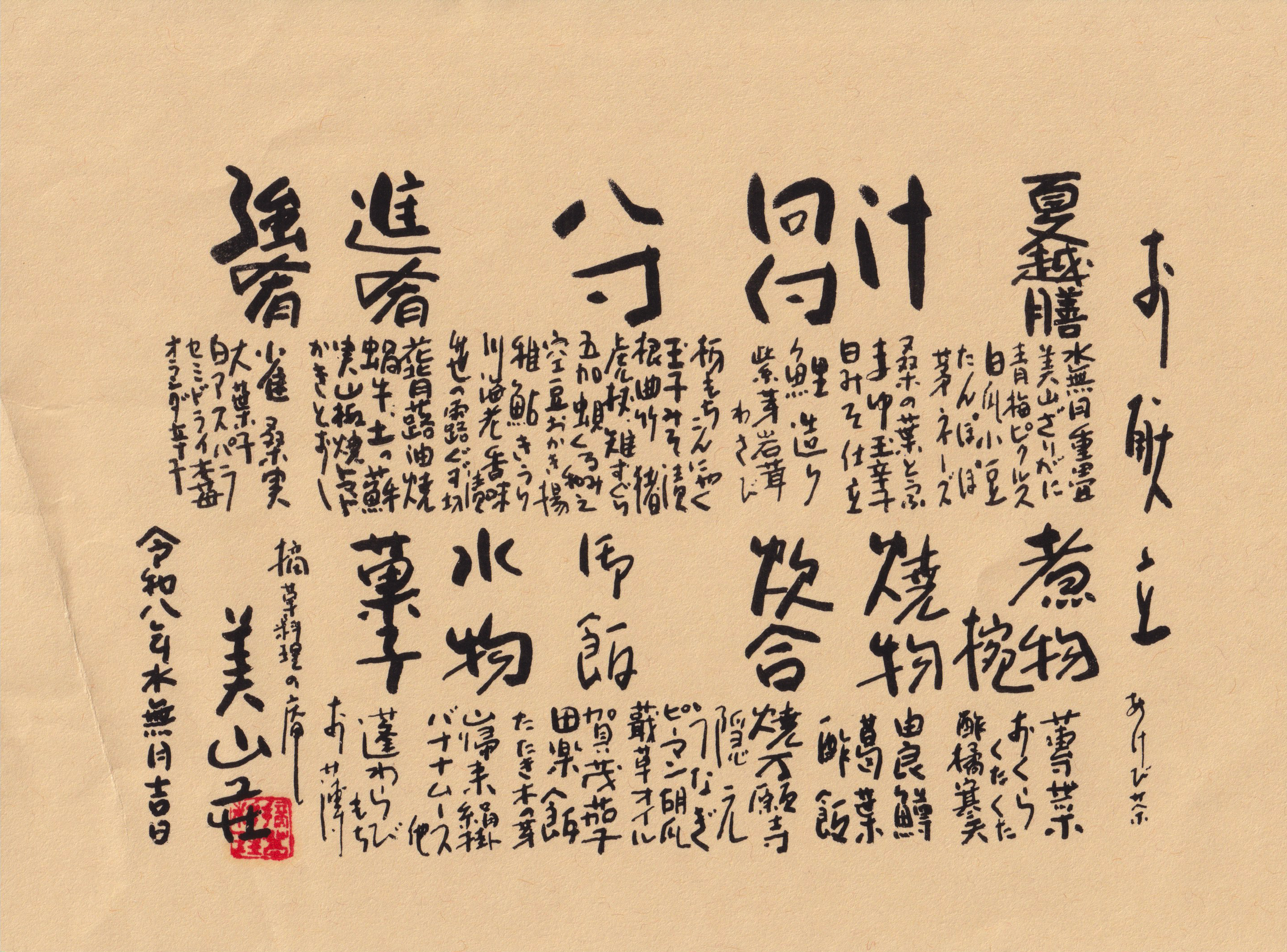
Miyamaso - Kyoto
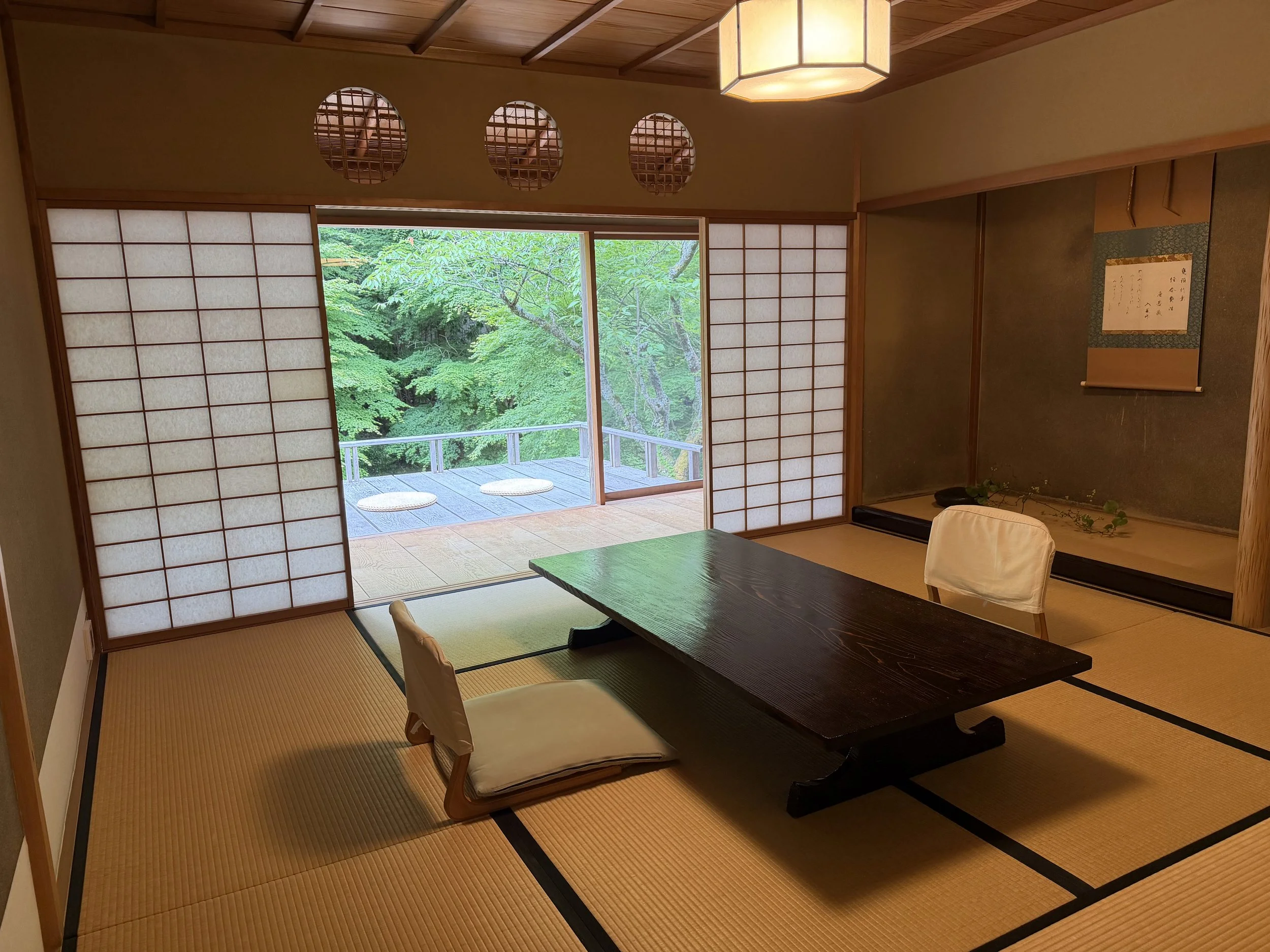
Private dining room with a beautiful view
Rating: 16/20
Where: Kyoto, Japan
When: Lunch for 2 on 17 June 2026
Cost per Person: Tasting menu 22770-33880 JPY ($140-$210)
Accolades: 3 Michelin Stars, Tabelog Bronze Award (2026)
Why: Beautiful, serene setting in the mountains; dishes that artfully mimic nature
Michelin defines a three-starred restaurant as one that is “worth a special journey”. Generally, the implied continuation would be “... because of the food”. This is a story about a restaurant that is definitely worth that special journey, but for the overall experience and not necessarily (just) for the food. Not what I would have expected. But let's start at the beginning.
“Miyamaso” is a Japanese inn (ryokan) located about 90 minutes north of downtown Kyoto. Every evening, the inn serves dinner to the lucky few that are staying overnight in one of its four rooms. For everyone else, the restaurant is also open during lunchtime.
In 2026, Miyamaso came to world-wide notice after Michelin awarded the restaurant its ultimate honor - three stars. The fact that Michelin had rated Miyamaso at all was a quirk of the local geography. Michelin infamously does not cover all of Japan, but rather inspects only a handful of cities. So one might think that being 90 minutes away from Kyoto proper should be disqualifying, but the legal city limits actually extend that far into the mountains. That's how Miyamaso ended up with a Kyoto zip code and - eventually - some Michelin stars.
The first step of dining at Miyamaso is to get a reservation - not always a trivial endeavor in Japan, especially when the restaurant (as in this case) is not on any of the popular online booking platforms. The first option is to stay here for the night. When I inquired, I was told that the inn was booked solid for the rest of the year, but I later saw that there actually are nights available here or there, maybe due to cancellations. For lunch reservations, one has the option of either calling or sending an email. I went the latter route, and the process was surprisingly painless. No credit card was required - probably a sign that the majority of customers are currently from Japan, who have a much better track record at showing up for their reservations than, say, many Westerners.
With our reservation in hand, we just had to take a taxi from downtown Kyoto. Winding mountain roads went through their fair share of tunnels and hairpin turns, and often narrowed to the point where two-way traffic seemed impossible. (Luckily, we never had to actually test this.) Since it was June, there was lots of greenery, trees, and vegetation covering the mountain slopes around us. Rivers and streams cut deep valleys among the mountains, and our road often followed them. After a long scenic drive, we finally reached Miyamaso at the end of a narrow paved road that continued as a dirt path past the inn.
The property consisted of several buildings. We were led to a smaller building opposite the main house, where we found our private tatami dining room. I had considered (but then forgot) to ask for the counter seating that was reportedly available, and was slightly worried about having to sit on a tatami mat for 2 1/2 hours (there was no lowered floor here, but the seats had a backrest). But my forgetfulness was a blessing in disguise: the small seating inconvenience was totally worth the trade-off for the serenity of the tatami room experience. Our room had large floor-to-ceiling windows that faced the stream running next to the inn. We couldn't see the stream itself, but definitely heard the water flowing downhill and saw the leaves of the trees outside swaying in the wind. A room filled with the sound of a mountain steam and a view of a sea of green? My dining companion and I agreed that the setting alone had been worth the journey to get here. Kyoto is already more peaceful and relaxing than, say, Tokyo, but this was even more calm by an order of magnitude.
Miyamaso served three different tasting menus, and one had to pick among them when making a reservation, knowing only their prices: 22770 JPY, 27830 JPY, and 33880 JPY, respectively, which included a 15% tax and service charge (about $140, $175, and $210). I do not know the difference between the three menus, but if similar restaurants are any guide, then the basic structure of the meal essentially remains the same, while the more expensive menus use more premium ingredients. We figured that after coming all this way, we might as well try the most expensive menu, which was still reasonably priced by three-star standards. We didn’t order any drinks during our lunch. However, a small carafe of sake was offered as a complementary welcome drink, and hot tea and water were refilled throughout the meal.
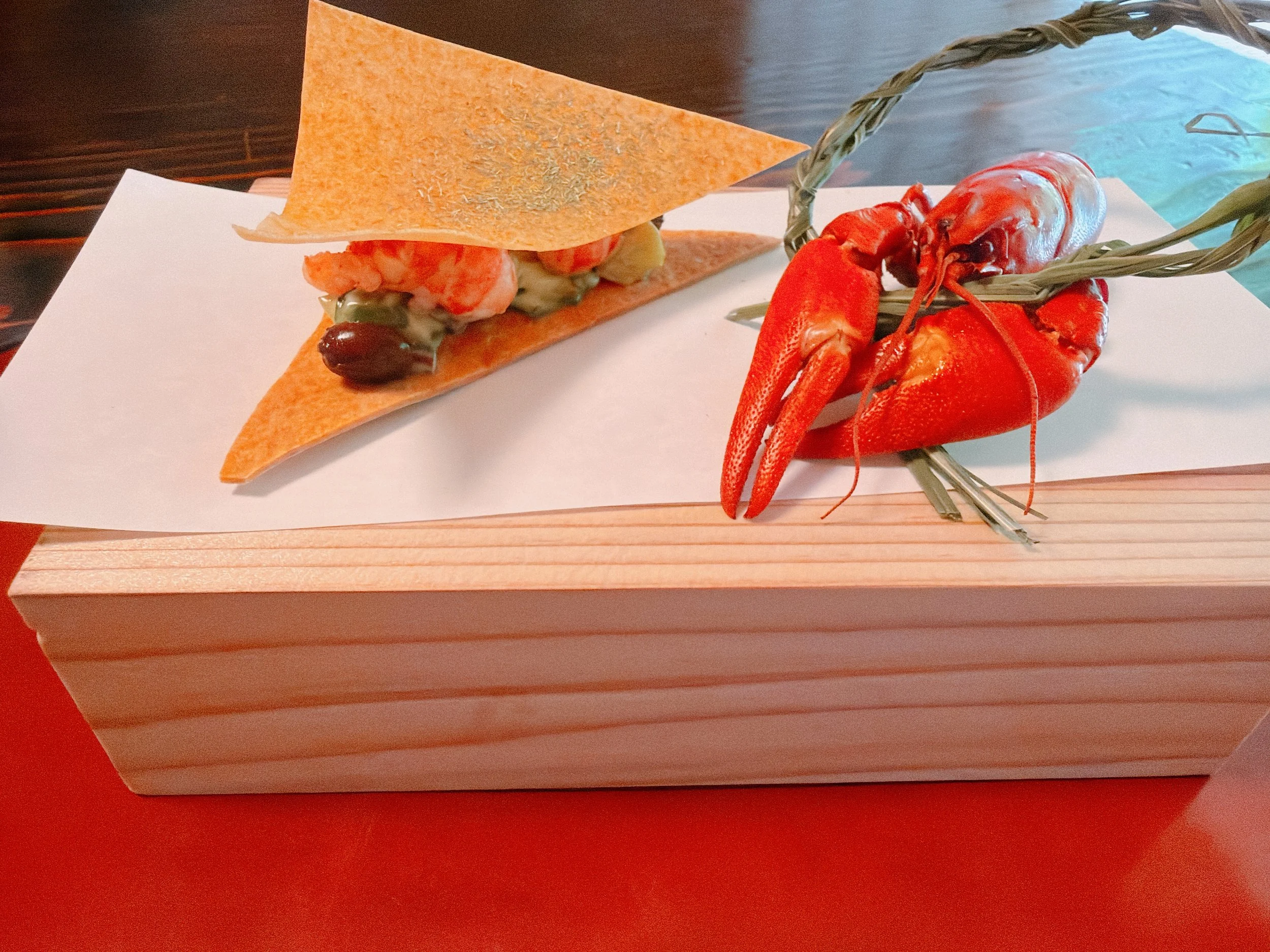
Our first dish actually looked more like a taco than a typical Japanese dish. Sandwiched between two fried chips was a mixture of crayfish, mayonnaise, dandelions, white cucumbers, and pickled ume (Japanese plum). This was quite enjoyable for what it was: the cracker was nicely crunchy, the crayfish fresh, and there was some acidity. But overall, the flavors were pretty mellow. So this was tasty, but not a taste explosion by any means 16.
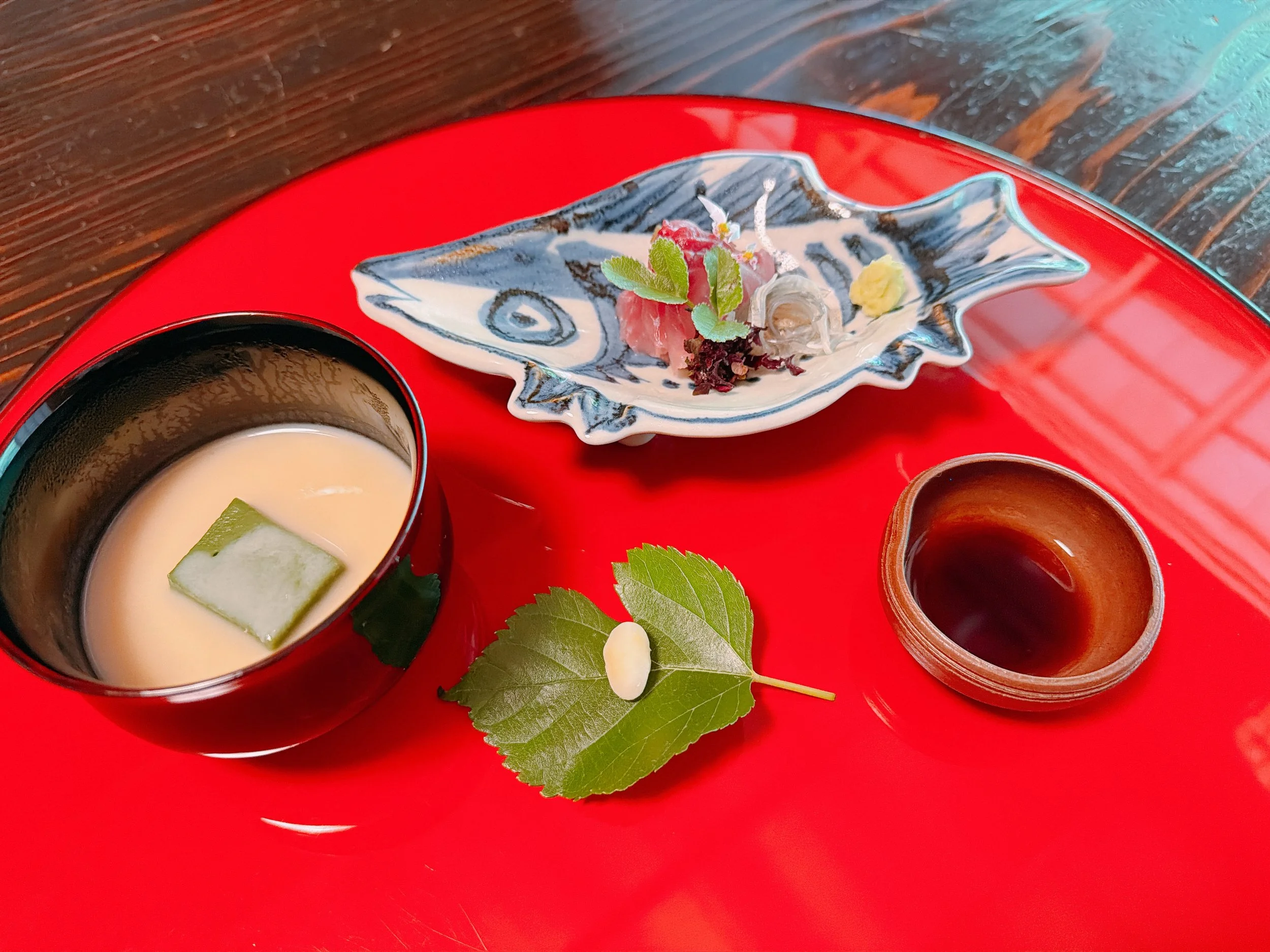
The next course consisted of sashimi and a white miso soup. The sashimi was based on koi, a fish that I had seen many times in decorative ponds, but never on a plate. TIL that they are actually fair culinary game in the mountainous regions of Japan. Next to the raw fish, there was some boiled koi skin, wasabi, micro shiso, and bofu leaves. The koi itself was lean and had a noticeable bite. The potent wasabi and micro shiso were quite spicy, and after an initial shock, this spiciness grew on me. The koi skin had been cut into thin strips and was very tender, but literally didn't taste of anything - this was all about texture. The bofu leaves had plenty of flavor, on the other hand - they were pretty herbal. A good, but not great, rendition of sashimi, featuring an unusual choice of fish 16. The white miso soup was served hot and came with a little “bean” filled with Japanese mustard that we were instructed to add to the soup which also contained a tofu made with mulberry leaves. The soup was quite good, its flavors well-integrated but a bit less intense than what we had the previous day at Isshisoden Nakamura. The tofu had a very light herbal flavor and was decent, but the main attraction here was clearly the soup itself 17.
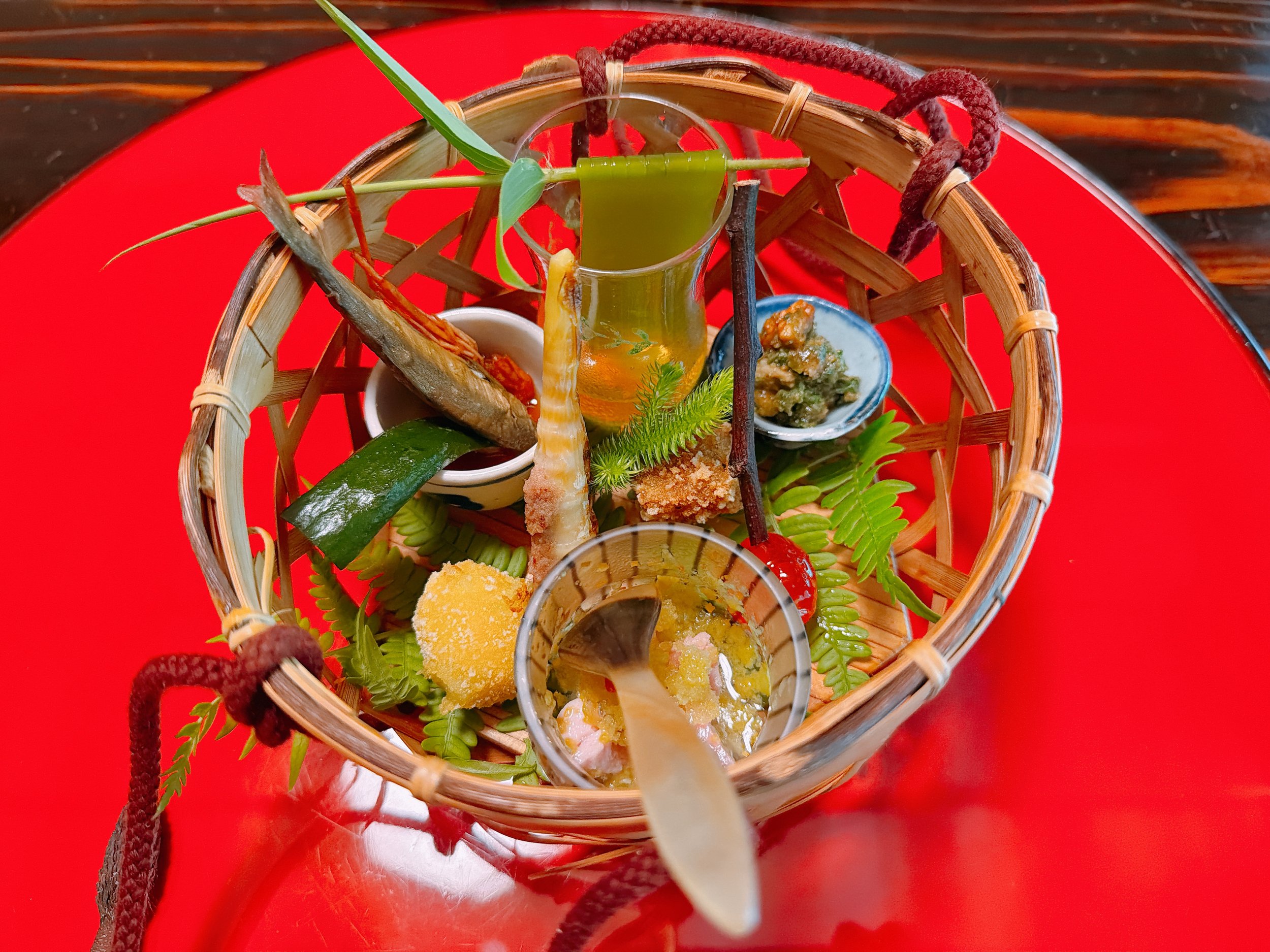
What followed was essentially the hassun course in kaiseki cuisine: lots of little dishes featuring seasonal ingredients. The first one that I tried was a play on kuzukiri, a traditional dessert from Kyoto that is based on thin noodles made from kudzu root. In this case, the fresh green pasta was served with a slightly acidic savory sauce (in the back of the picture). A light dish with clean flavors 17. Next was a dish that was made with walnuts and ukogi (aka “mountain grass”, as our server put it). The flavor of this grass was not very intense, meaning that the crunchy dish tasted mostly of walnuts 15. Konnyaku, a kind of yam cake, was served breaded and deep-fried. The crunchy breading covered a chewy center 15. A bamboo shoot was covered with a boar meat sauce. While the bamboo by itself wasn’t too memorable, the meaty sauce was a nice addition 16. Another deep-fried bite was a croquette made from fava beans. It had a soft texture and a creamy/mealy filling that was quite sweet. Less distinctive than the preceding bites, unfortunately 14. Egg yolk had been marinated in white miso for three days and was served on a stick. The almost-red-colored yolk had a very thick consistency - it had almost become solid. Its flavor was quite pleasant, however 16. Granita made from mountain vegetables was served with red currants and pheasant meat. The whole came with a very sweet (arguably too sweet) sauce, and the meat was not gamey at all, making it not too different from, say, chicken 15. Finally, a small cup contained fried ayu (sweetfish), a deep-fried river shrimp, and a cucumber stick. The fish was lightly bitter and flavorful, and the shrimp was even more bitter and consisted of more shell than meat. The crunchy cucumber was a nice denouement after the fried seafood. All three pieces came with a very flavorful sauce that had some umami and was very salty 16.
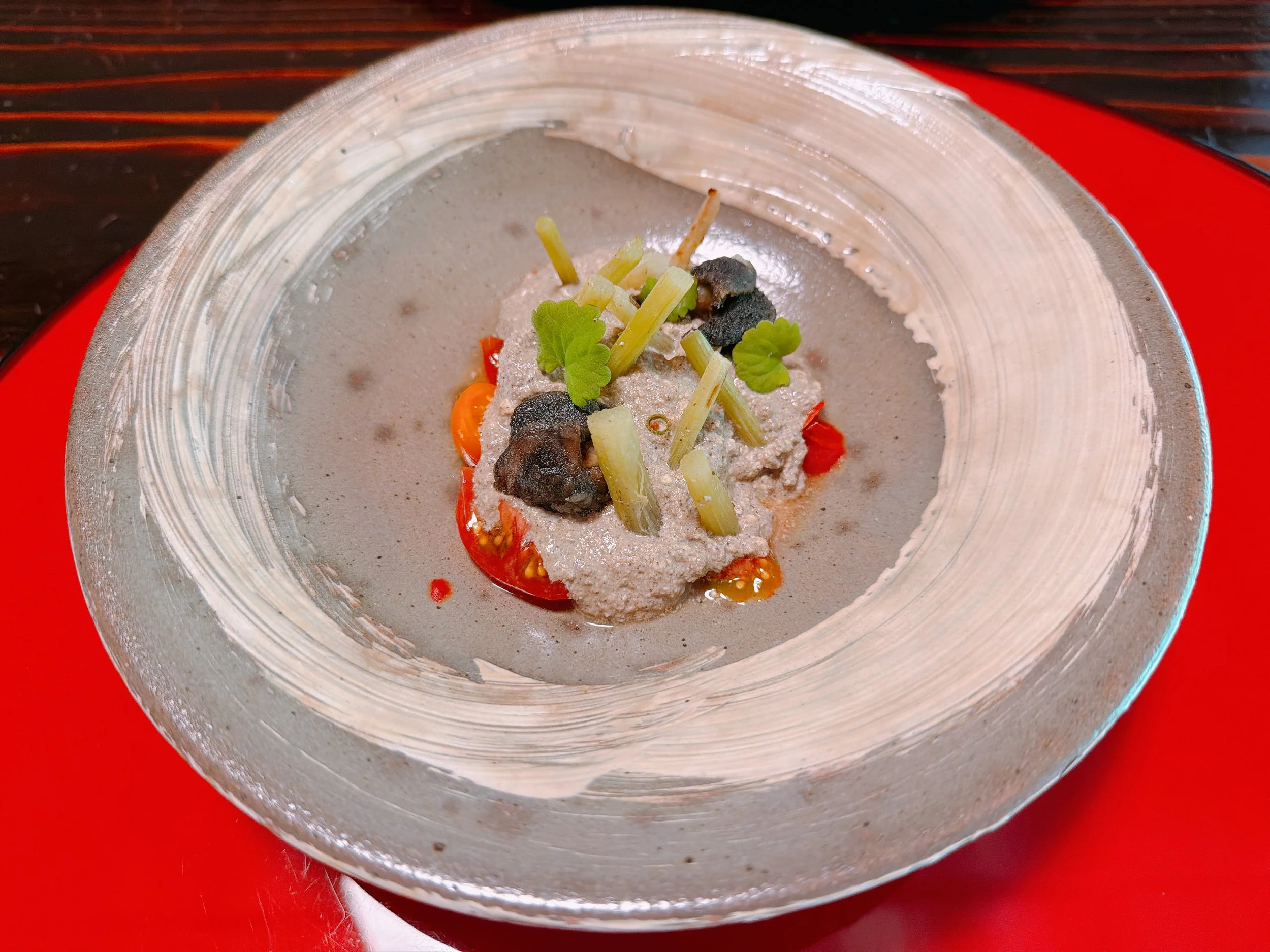
There was a common theme among the next few courses: their presentations mimicked nature. For example, they looked like a forest floor or a pond, and they used ingredients that (loosely) matched that visual theme. The photos do not really do the dishes justice - seeing them in reality was definitely more impressive.
We continued with a dish that consisted of warm, baked tomatoes covered by a soy-based traditional Japanese cheese. The cheese was in turn topped with escargots and Japanese butterbur roots, the latter placed upright. This dish resembled a forest floor: the cheese looked a bit like the ground, the butterbur resembled growing plant stalks, and the escargots starred as themselves - possibly planning to nibble on the butterbur. Gimmicky? Maybe, but looking out the windows at the trees, this dish felt more in tune with nature rather than contrived. Unfortunately, the dish was not quite as exciting from a taste perspective. The warm tomatoes were not particularly compelling, the white sauce had only a light cheese flavor, and the escargots were a nondescript meaty addition. I didn't quite know what to make of this - was this a warm salad, a cheese dish, or something else entirely? The different components didn't quite come together, and the dish wasn't very opinionated flavor-wise - it didn't clearly signal what it was about or what it was trying to be. Rating simply on taste, this might be a 13 or 14, but taking into account the compelling presentation 15.
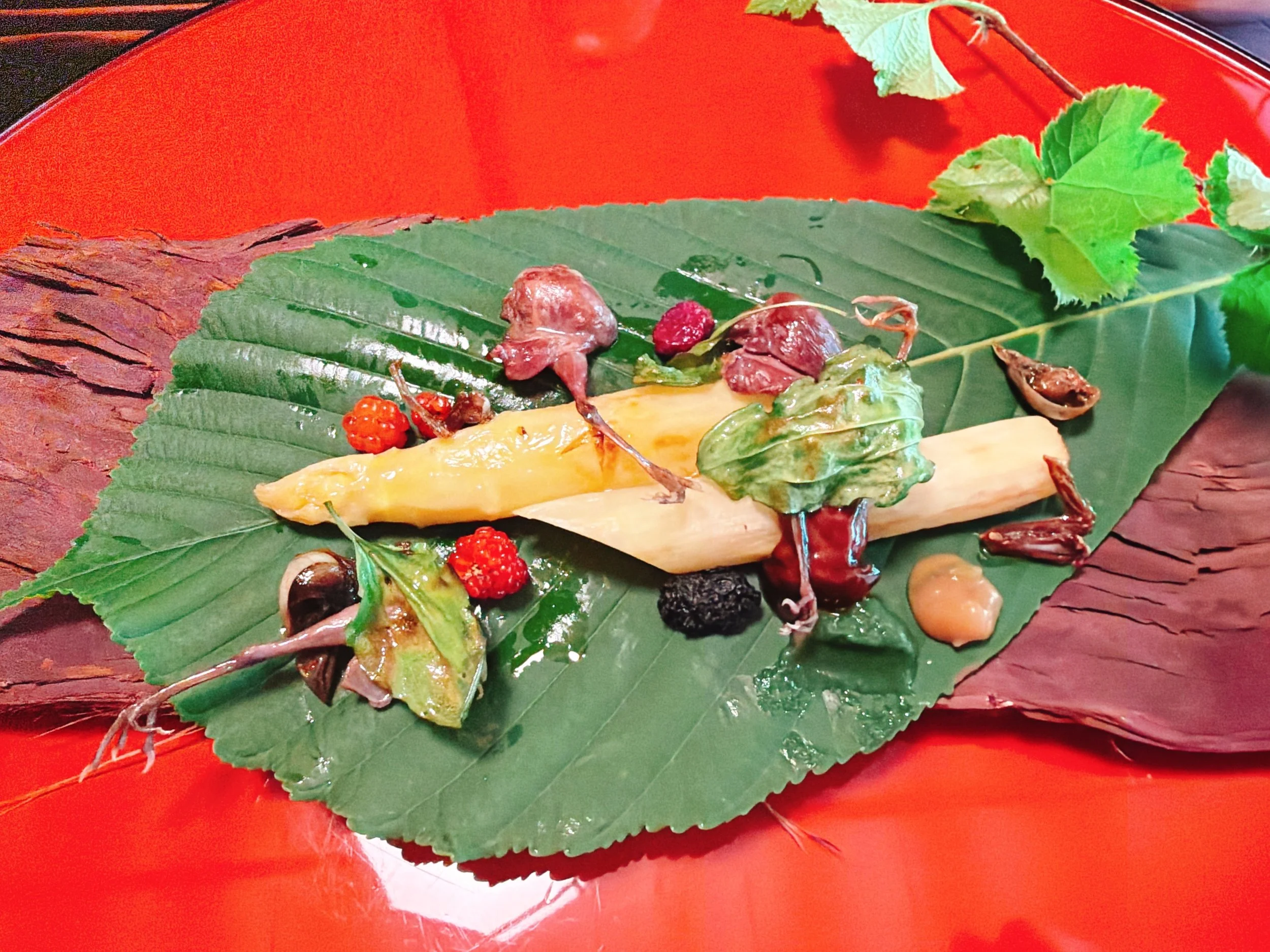
Moving on up from the ground, the next course represented a bush or maybe a tree branch, with ingredients to match. When the dish arrived at the table, a raspberry bush branch was draped over it (moved to the right in the picture). Under the branch was a baked white asparagus, raspberries, mulberries, and a cooked bird - a sparrow, to be precise. This was another first for me - I'd never eaten sparrows before. (And I now see the proverb of “a sparrow in the hand is better than a pigeon on the roof” in a totally new light. I’m not sure that I wanted to.) There were some sparrow legs with meat attached, some deep-fried wing bones (I think), and deep-fried sparrow heads (the latter introduced by our server as her favorite part). Two sauces came on the side: one made of watercress, the other of sparrows. I politely disagree with our server: the best part of this dish for me was the leg meat that had been cooked with a savory sauce. The wild berries were nicely fruity, but the rest of the dish was less impressive. The sparrow heads and bones were merely crunchy and fatty, with maybe a hint of fried meat flavor. The asparagus was juicy but not particularly flavorful. And while there was some flavor to the sparrow sauce, the watercress sauce tasted of almost nothing. An interesting but not overly compelling dish 14.
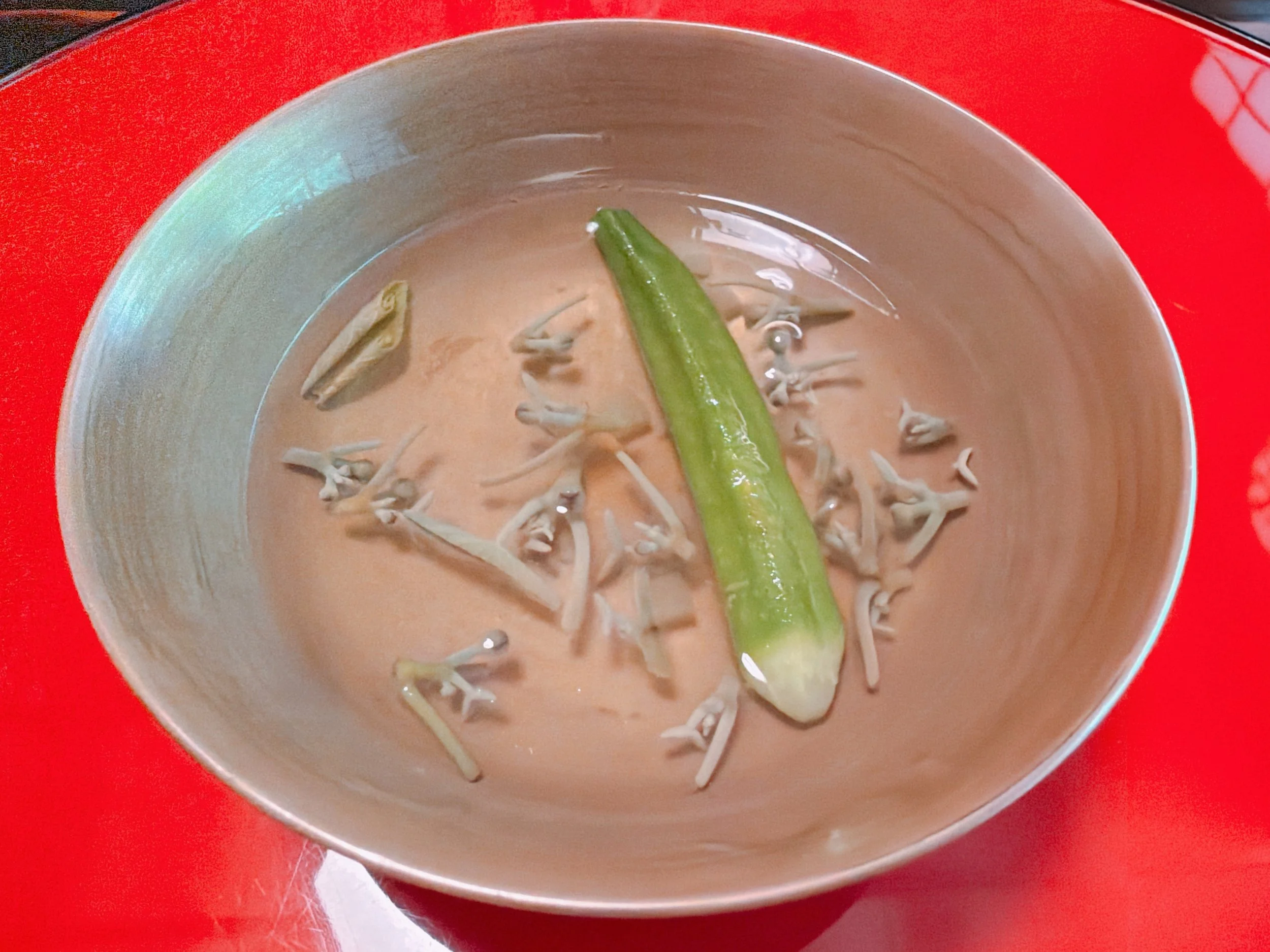
The next dish was a clear soup containing a single okra and watershield greens. Did this look like a pond with tadpoles and a baby frog? In any case, the soup was lightly acidic and contained small citrus cubes that burst with flavor. The greens were crunchy, but the okra (ostensibly the main ingredient here) was unfortunately not particularly flavorful. Mostly for the good broth, a 15.
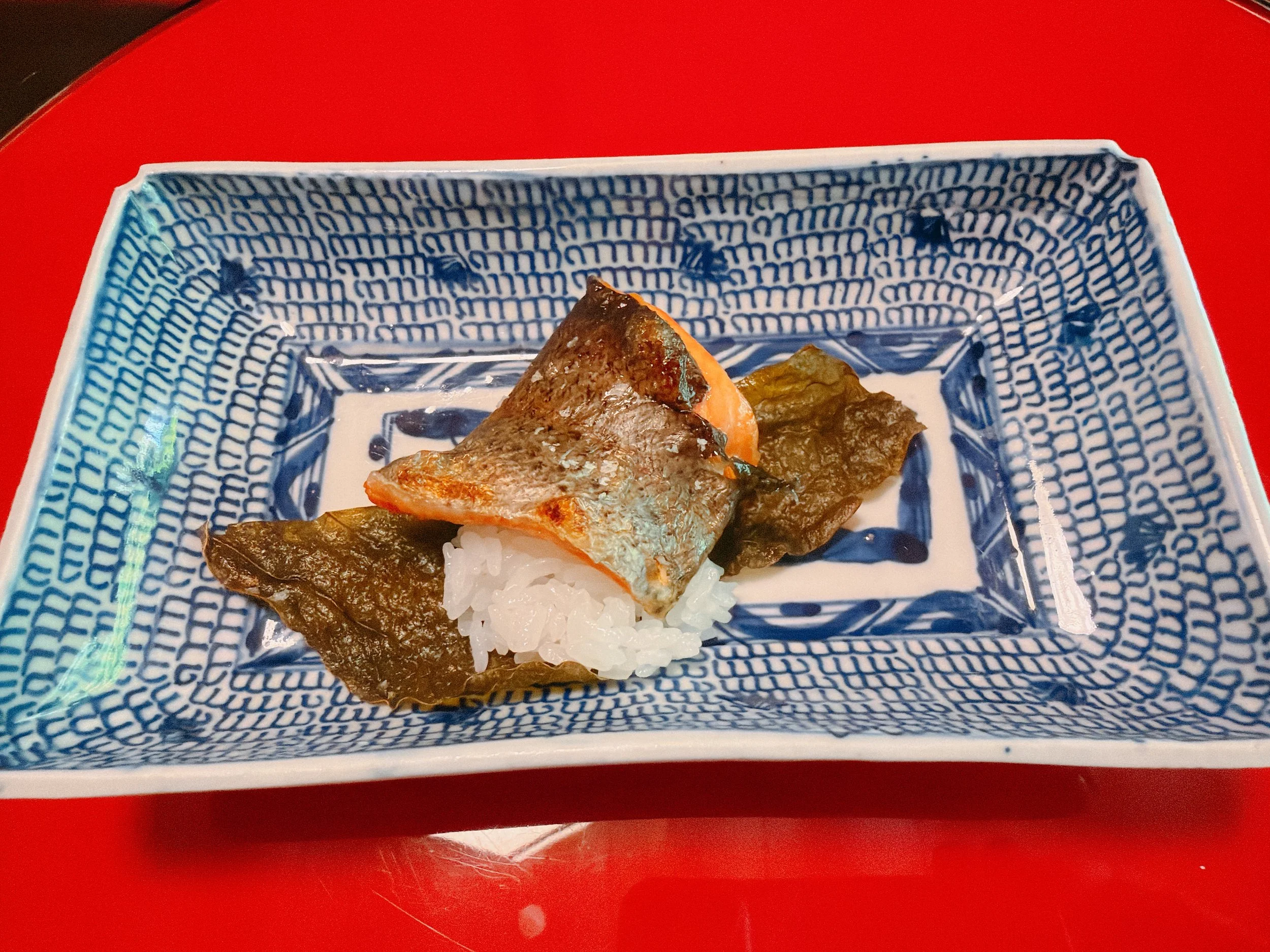
Grilled trout was served over vinegared rice and a deep-fried kuzu leaf. This dish could be eaten either by hand or with chopsticks. While there was some visual similarity to sushi, this was clearly a cooked fish dish. The fish was flavorful, salty and oily in a good way. The rice was a good match, being maybe a tad more vinegary than sushi rice would have been. The kuzu leaf however didn't taste of much. A straightforward dish, but very tasty 16.
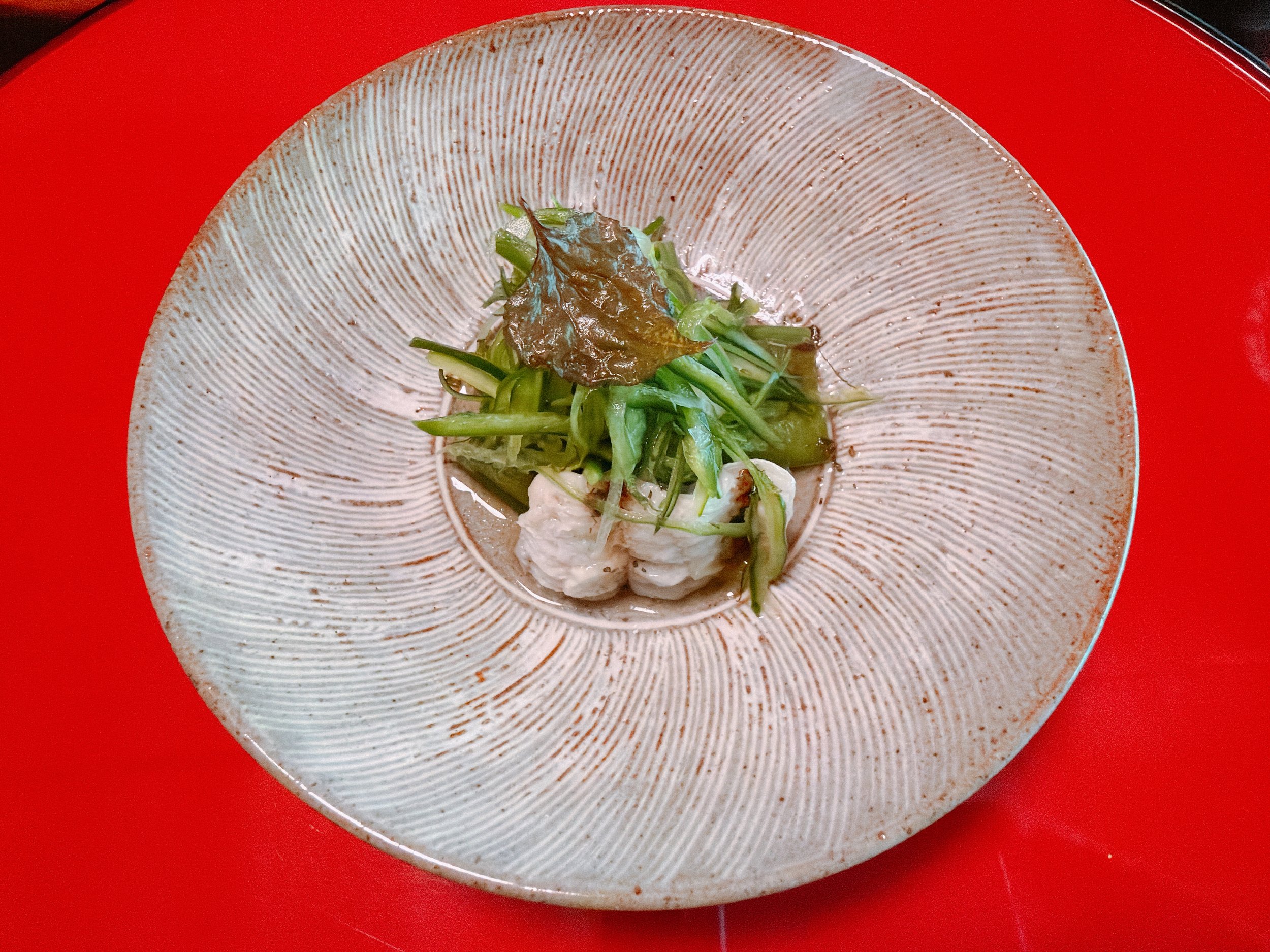
Next was an eel served with roasted green peppers, cucumbers and green beans. Maybe representing an eel among underwater flora? The eel was cooked close to perfection, it was served warm and its seasoning gave it an intense flavor. Among the best eels that I've ever had (18 or 19, if rated individually). Unfortunately, the greens, served at a lower temperature, were “only” fine: crunchy but not revelatory (maybe a 14). On average 17.
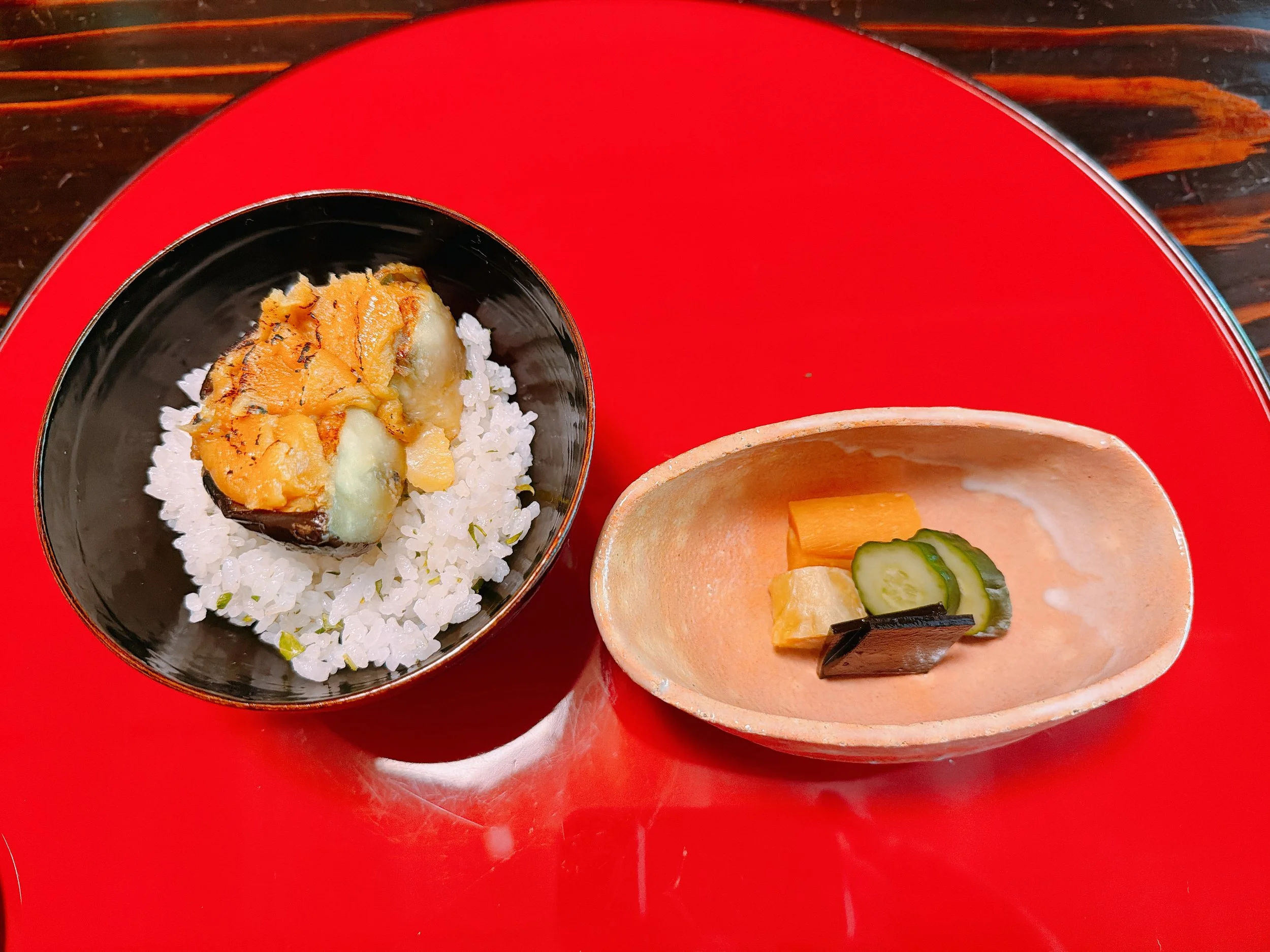
The following rice course heralded the end of the savory part of the menu. The rice contained some herbs and was topped with an eggplant and a miso sauce. On the side were some pickles: cucumber, daikon, cabbage, and kelp. Starting with the rice: it was fine, but any potential herbal flavor was very faint. The eggplant had a good texture, but its sauce was a tad too sweet for my taste and also overwhelmed whatever flavor the eggplant might have had. As for the pickles, the daikon had a very strong crunch, the cabbage tasted essentially like sauerkraut, and the kelp (at least to me) tasted of licorice of all things. Definitely unusual 15.
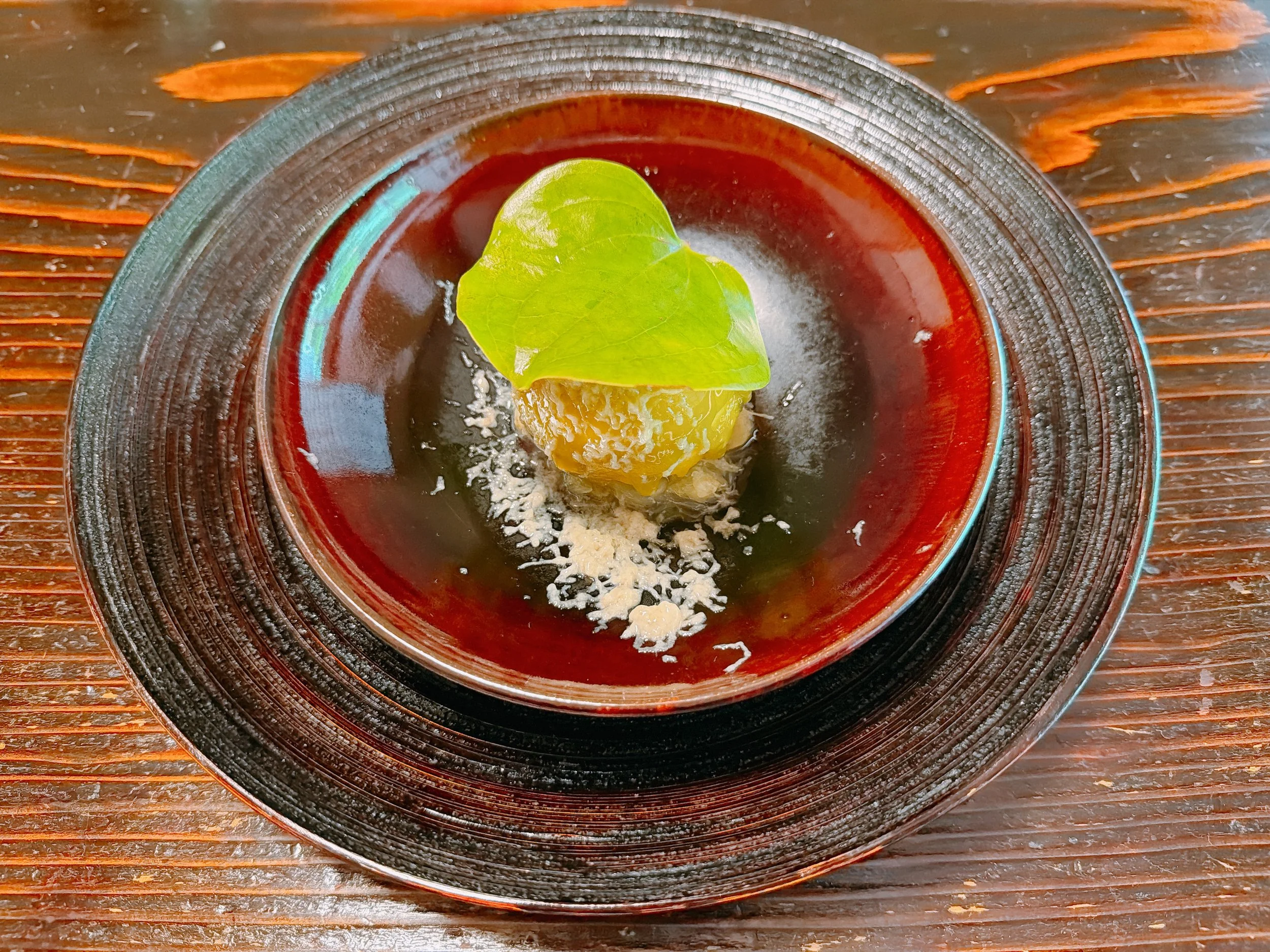
The main dessert was a ball of banana mousse containing a few cocoa nibs. Under the mousse were some citrus fruit and passion fruit. This was a commendably light dessert - the mousse's texture was very airy, and the dish overall was not too sweet. The banana flavor was (for better or worse) relatively light; adding more citrus and/or passion fruit might have give the dish more of a kick 15.
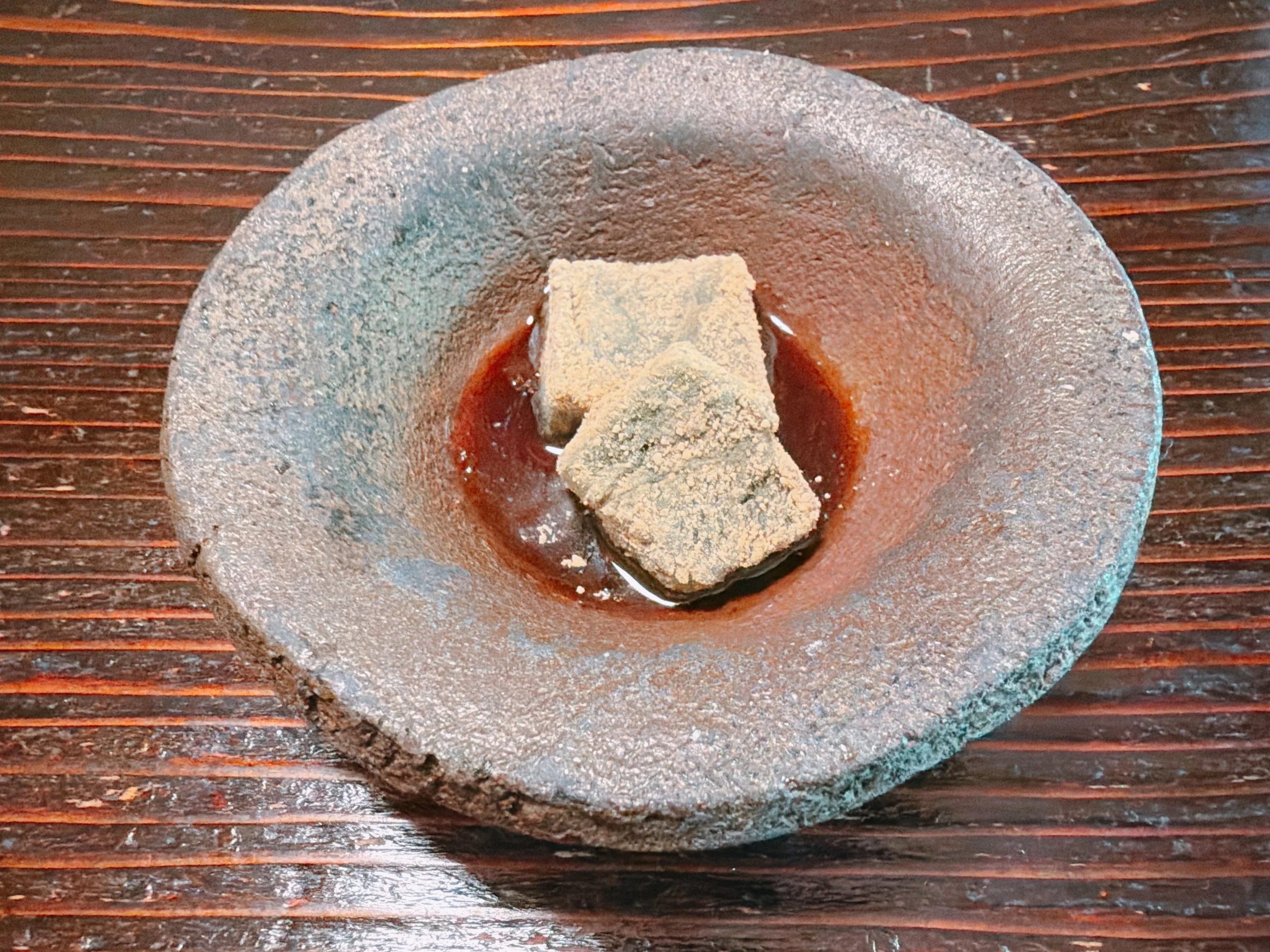
Concluding the meal was a mugwort mochi served in a sweet sauce, presumably kuromitsu. The mochi did indeed taste a bit grassy, or at least “green” 16.
Overall: I loved the setting of the restaurant, its ambiance, the views from our tatami room, and the playful, nature-inspired presentations of the food. This was a very loose take on kaiseki cuisine with many local (i.e., mountain/forest) ingredients, some of them being quite unique. However, the actual taste of the food frequently didn't wow me. There were some bits and pieces that were at a three-star level, but the majority was well below that. So I find myself in an odd spot. Would I recommend going here just for the food? Probably not. But for the entire experience of eating good food in a beautiful, serene setting? Definitely, yes 16.