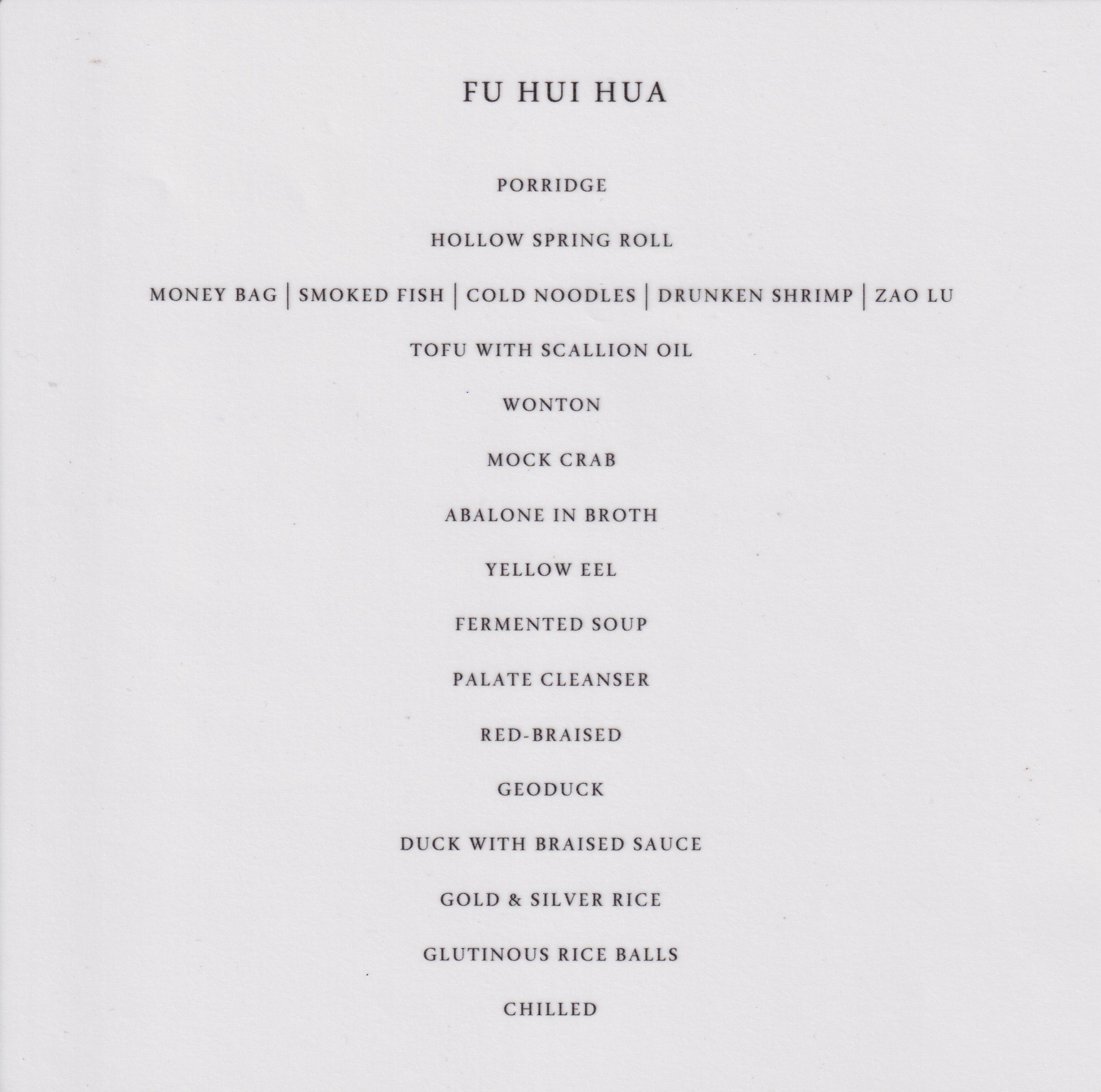
Fù Huì Huá - San Francisco
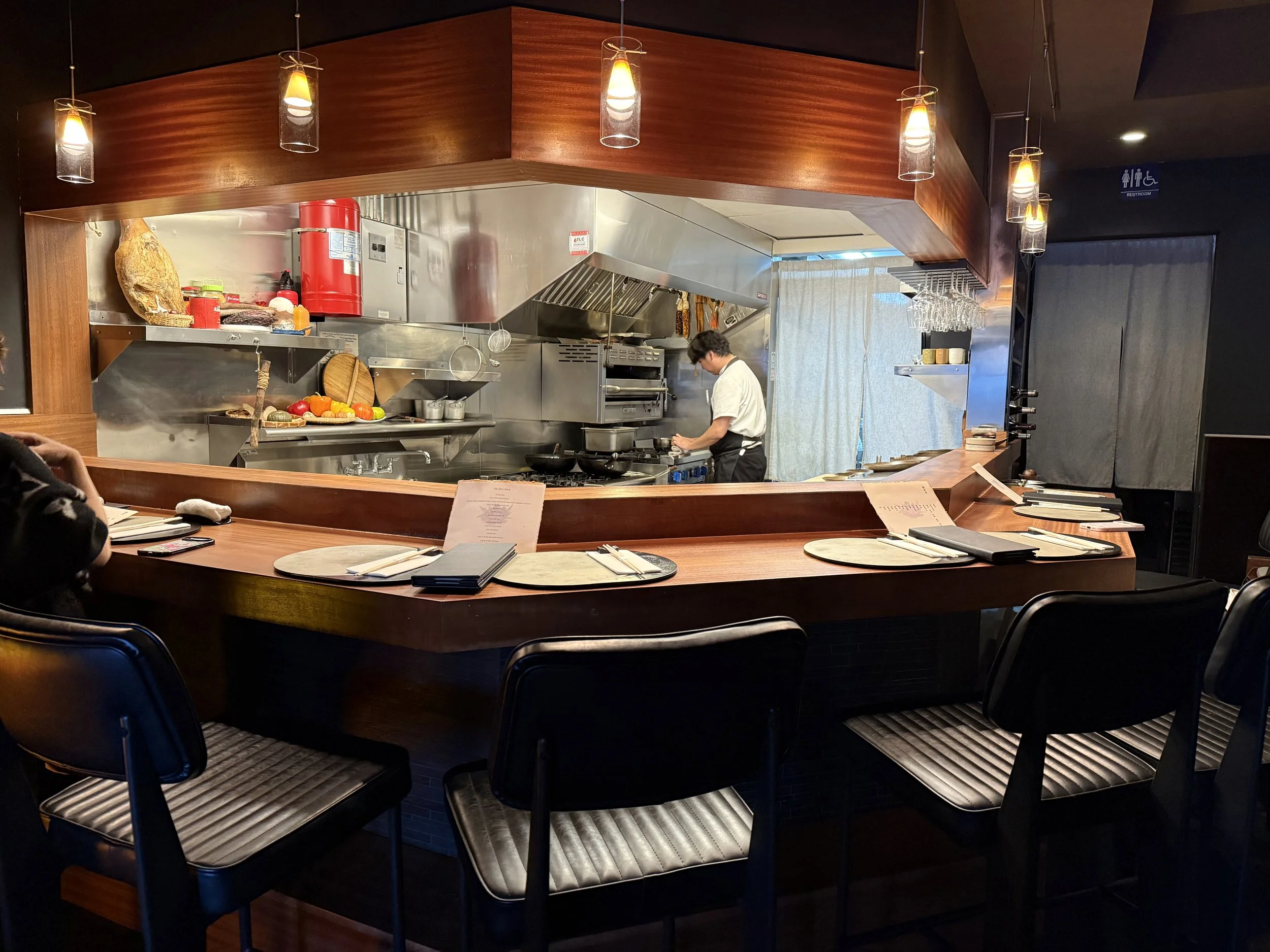
Counter seats surrounding the two-man kitchen
Rating: 15/20
Where: San Francisco, CA
When: Dinner for 2 on 21 February 2026
Cost per Person: Tasting menu $258, Sake Pairing $78
Accolades: SF Chronicle Best New Restaurant 2025
Why: Unique, accomplished blend of Chinese and Japanese cuisines
If I went strictly by the name of this blog (“Travels for Stars”), then I shouldn't be writing about “Fù Huì Huá”. This restaurant neither required traveling (other than a 45 minute car ride), nor does it have any Michelin stars - not yet anyway, since it opened after last year's guide came out. But by some measure, it might be San Francisco's hottest reservation at the moment - it took us several tries to finally score one, since they get snatched up instantly on Tock. The San Francisco Chronicle recently declared the restaurant to be the city's best new opening for 2025, and online reviews are unanimously glowing (except from some disgruntled commenters who couldn't get a reservation).
Part of the reason why reservations are so hard to get is the size of the restaurant - there are only eight counter seats in front of an open kitchen. Said kitchen only has two chefs, the father and son team of William and Tao Ge. Both are originally from Shanghai, but the elder Ge worked in Tokyo for ten years during the 1990s. That experience informs a cuisine that is predominantly Chinese, but has some notable Japanese influences, which makes it quite unique among Chinese restaurants, even (or maybe especially) among the fine-dining variety.
In order to find the restaurant, one truly needs its address, since there are no signs marking its inconspicuous location on 24th Street in San Francisco's Mission district. There aren't any windows either, but their lack becomes immaterial once seated, since the kitchen is where the true excitement happens. Fù Huì Huá serves a single tasting menu that changes with the seasons and based on whatever special ingredients might be available on the day. We had just missed their slightly pricier “crab season menu”, and received the restaurant's “normal” winter menu instead. No dietary restrictions were accommodated - presumably due to having only two people in the kitchen. That said, my self-described “easy pescatarian” dining companion encountered only a single dish that she had to pass on to me - the main duck course. (That's no guarantee for the future, obviously.) Wines were only available by the bottle - we tried a lovely 2018 Les Héritiers du Comte Lafon Macon-Milly-Lamartine, priced at $100. But the wine choices were outnumbered by the sake options, and that’s what most of the other guests went for. A four-glass sake pairing was also available for $78, with decent pours and a good variety of different sakes - not a bad choice, for sure.
During our visit, I was the only customer who did not speak Mandarin, and the other three couples even received their menus in Chinese. However, all dishes were introduced in English (by the younger chef Ge), making me feel a bit self-conscious, since was done essentially just for my benefit. I'm glad that I didn't miss out, though - the son went into considerable detail in his explanations. He described the motivations and cooking methods behind every dish, what special ingredients they used (or didn't), even down to which kind of rice was chosen based on the other ingredients in a dish. A refreshingly open and unpretentious discussion of what went on behind the scenes.
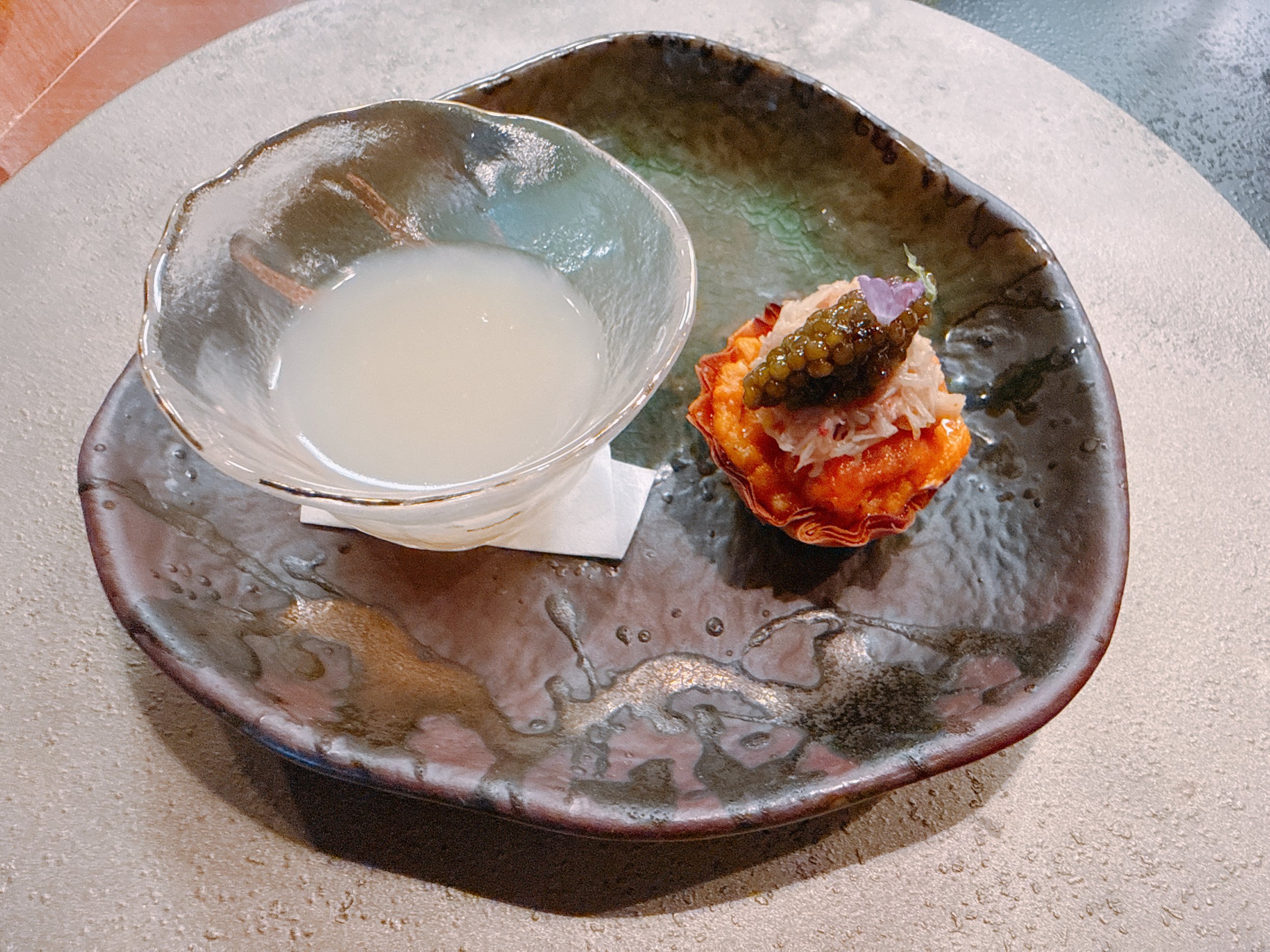
Our dinner started with a dish inspired by breakfast. In a glass cup was a “congee”, i.e. rice porridge, but not the traditional kind. Made from three different kinds of rice, young ginger and bamboo leaves, the chefs served only the top layer of the congee, essentially a rice starch-thickened broth without any actual rice in it. The result might be somewhat of an acquired taste - to me it tasted of almost nothing. Were this an actual congee, I would have added some toppings, but there weren’t any available. By itself, this might have rated an 11 - not my cup of congee, so to speak. Next to the broth was a little cracker shell filled with several layers. At the bottom were several different kinds of vinegar, followed by a Shanghai hairy crab sauce, Hokkaido crab leg meat, uni (sea urchin) washed with sea kelp water, and finally some caviar on the top. This bite was pretty much the opposite of the congee, in that it was bursting with flavors. Creamy, vinegary, with a light crunch, it had a great combination of different ingredients 17.
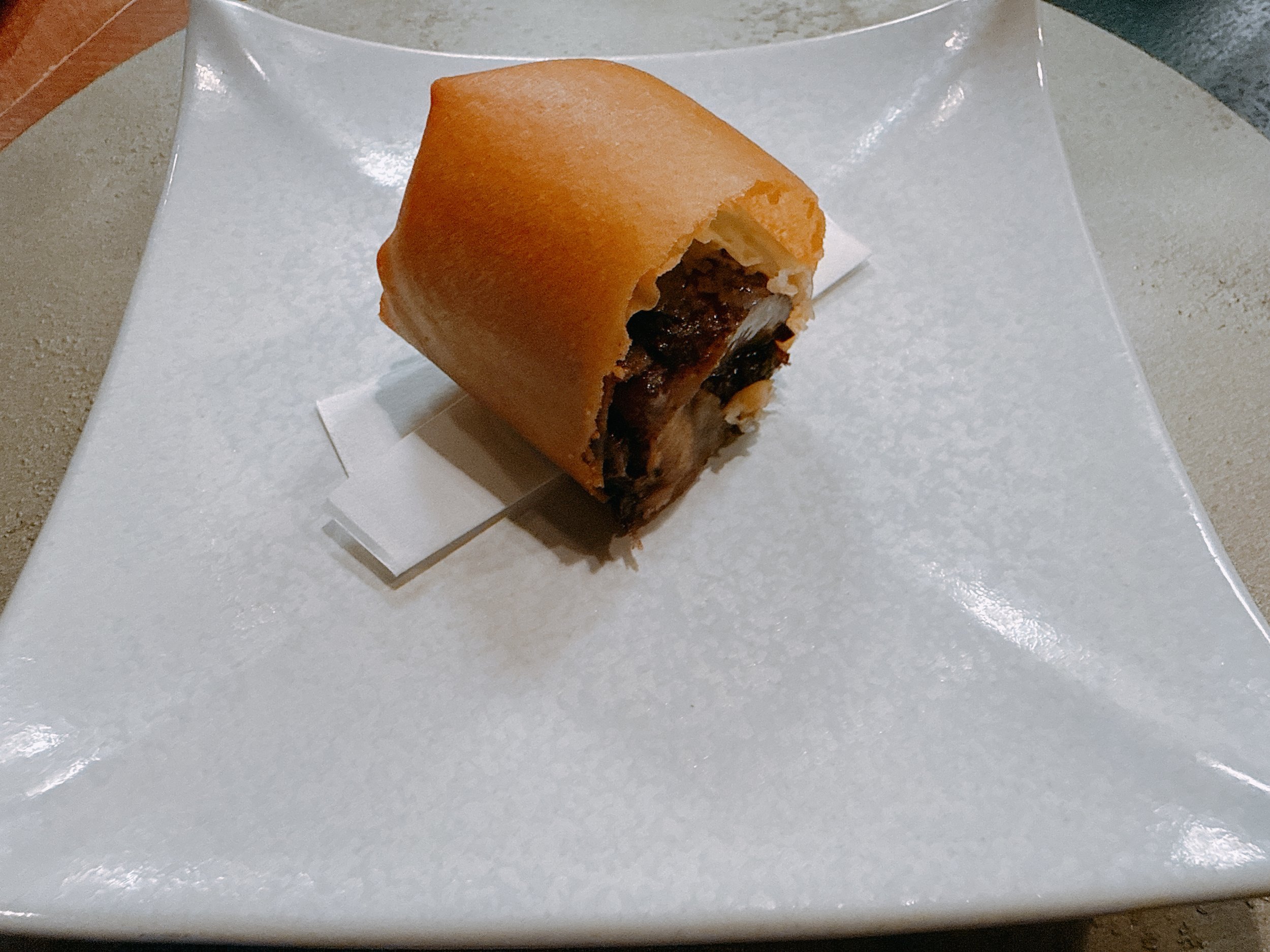
The following dish was a large, airy spring roll - very similar to the one that we had tried at Hong Kong’s Wing a year prior. The chef mentioned that the typical filling for such a spring roll would be pork belly, but that they were using sea cucumber instead. It was paired with preserved vegetables that had been cooked together with pork, but none of the meat remained in the dish. The spring roll was nicely executed: the wrapper was pretty light, and had a great crunch, the sea cucumber was tender, and the vegetables gave the dish most of its flavor (though I didn't taste any pork) 15.
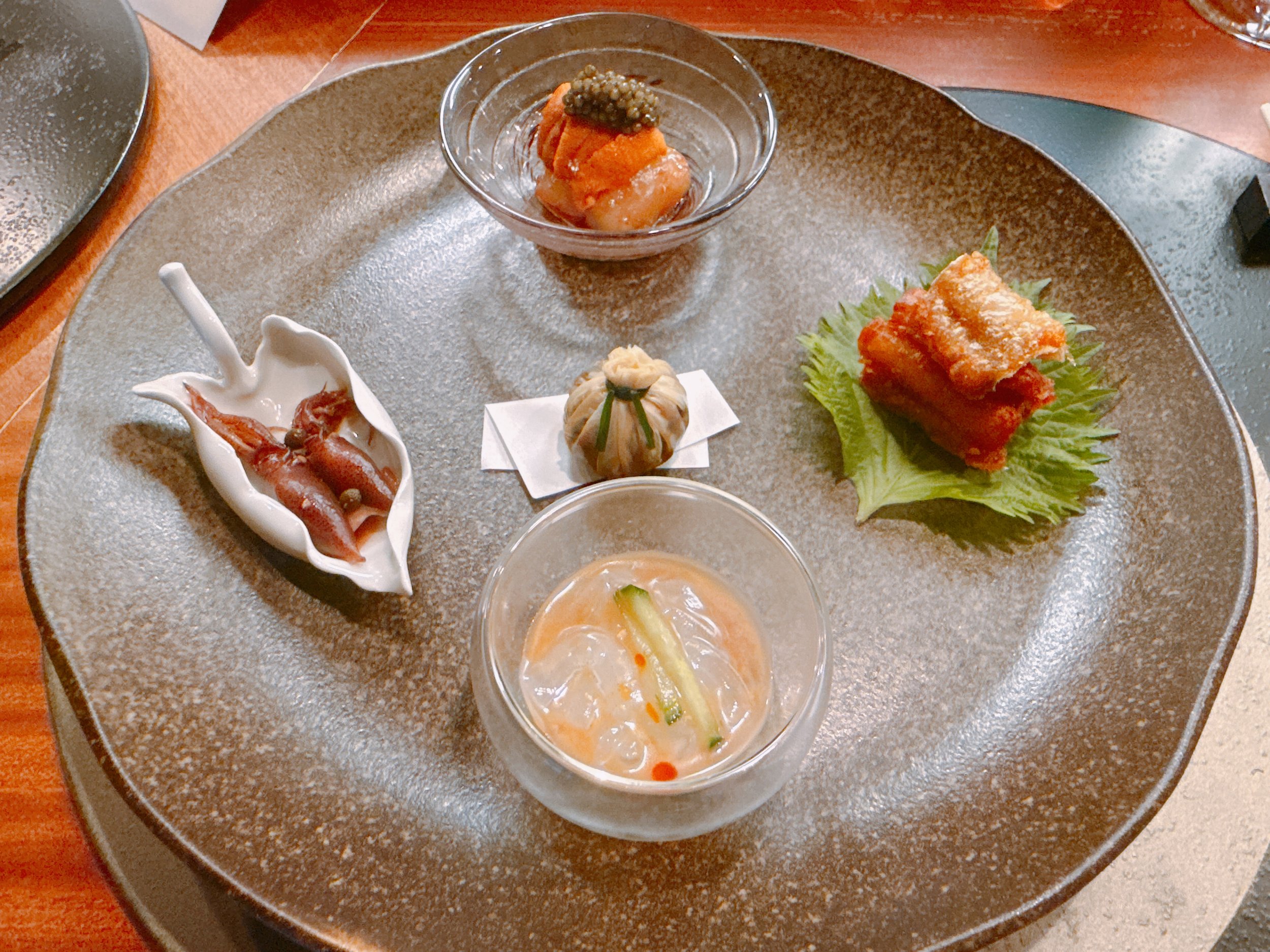
The next course consisted of five appetizers. A sashimi grade spot prawn had been marinated with two kinds of shaoxing wine, and was served with soy sauce, red uni and kaluga caviar (top of picture). The creamy shrimp had a hint of sweetness, but overall this dish was lighter in flavor than the uni bite at the beginning (15 by itself). Firefly squid were served with a Shanghainese fermented rice sauce and sansho peppercorns (left in picture). The squid were quite flavorful, but the pepper was not spicy at all (15). Cold noodles had been made from baby eels and were served cold in a broth made with peanut butter (bottom of picture). Essentially gelatinous noodles with a slightly vinegary sauce - and maybe a hint of peanuts (14). A “money bag” was a little dumpling filled with mushrooms and tofu (center of picture). Nicely juicy (14). Finally, two pieces of beltfish were very deep-fried, almost like Chinese breakfast donuts, feeling quite heavy and fatty, without too much flavor (12). On average 14.
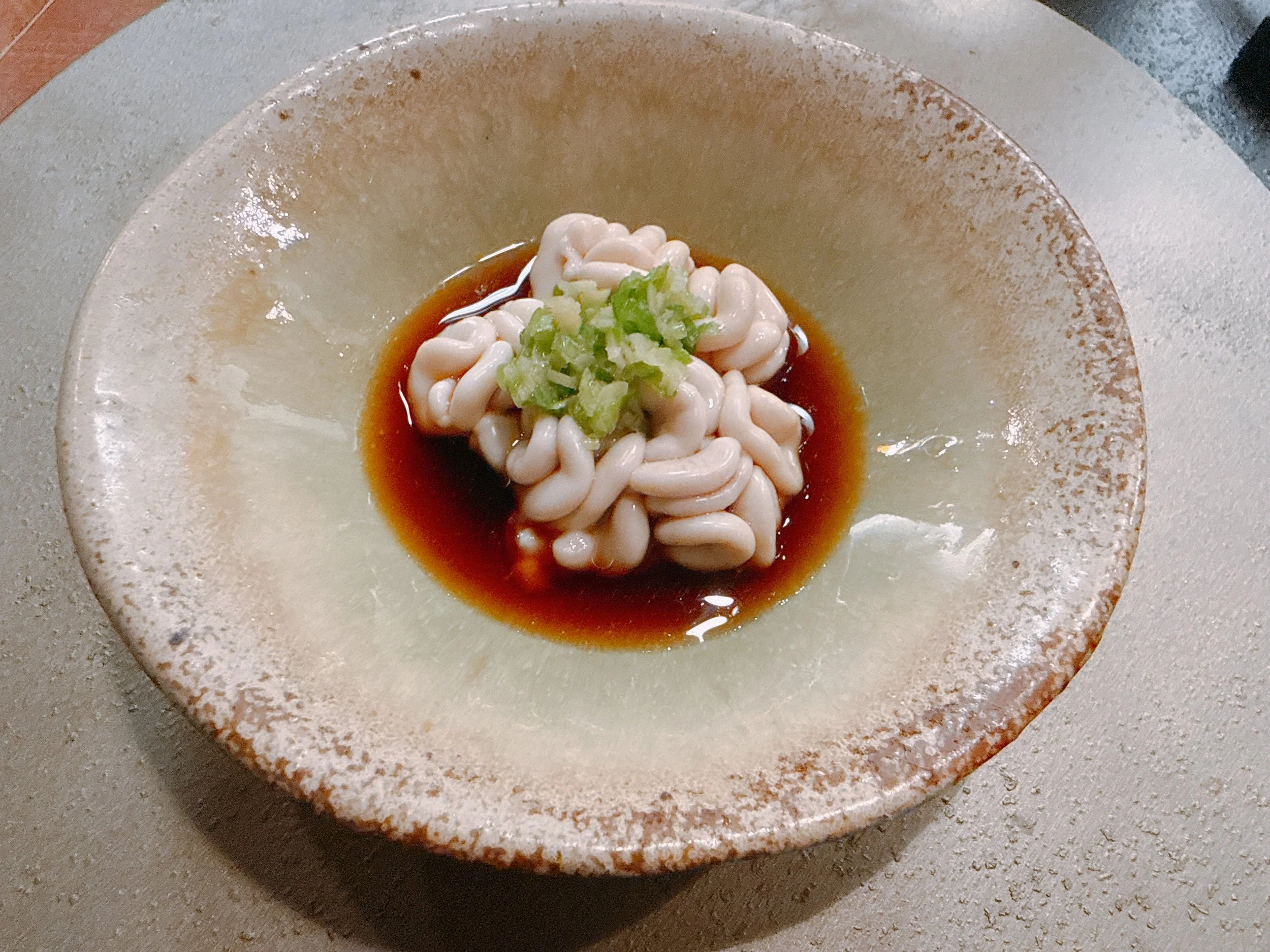
When a dish is listed on the menu as “tofu” and introduced as “cod eggs”, but in fact is neither, then you know it's time for an ingredient that is a bit of an acquired taste. Shirako (or milt in English) is a Japanese ingredient, but was prepared here Chinese-style. Washed multiple times and cooked sous vide, it was served with a ginger-scallion sauce that usually accompanies Cantonese white cut chicken (bai qie ji). Personally, I would have preferred the chicken over the shirako... oh well. Objectively, the shirako was actually quite good, creamy and with a light texture, but without much flavor on its own. By contrast, the ginger/scallion topping and the sauce were very flavorful, and gave the dish lots of brightness 15.
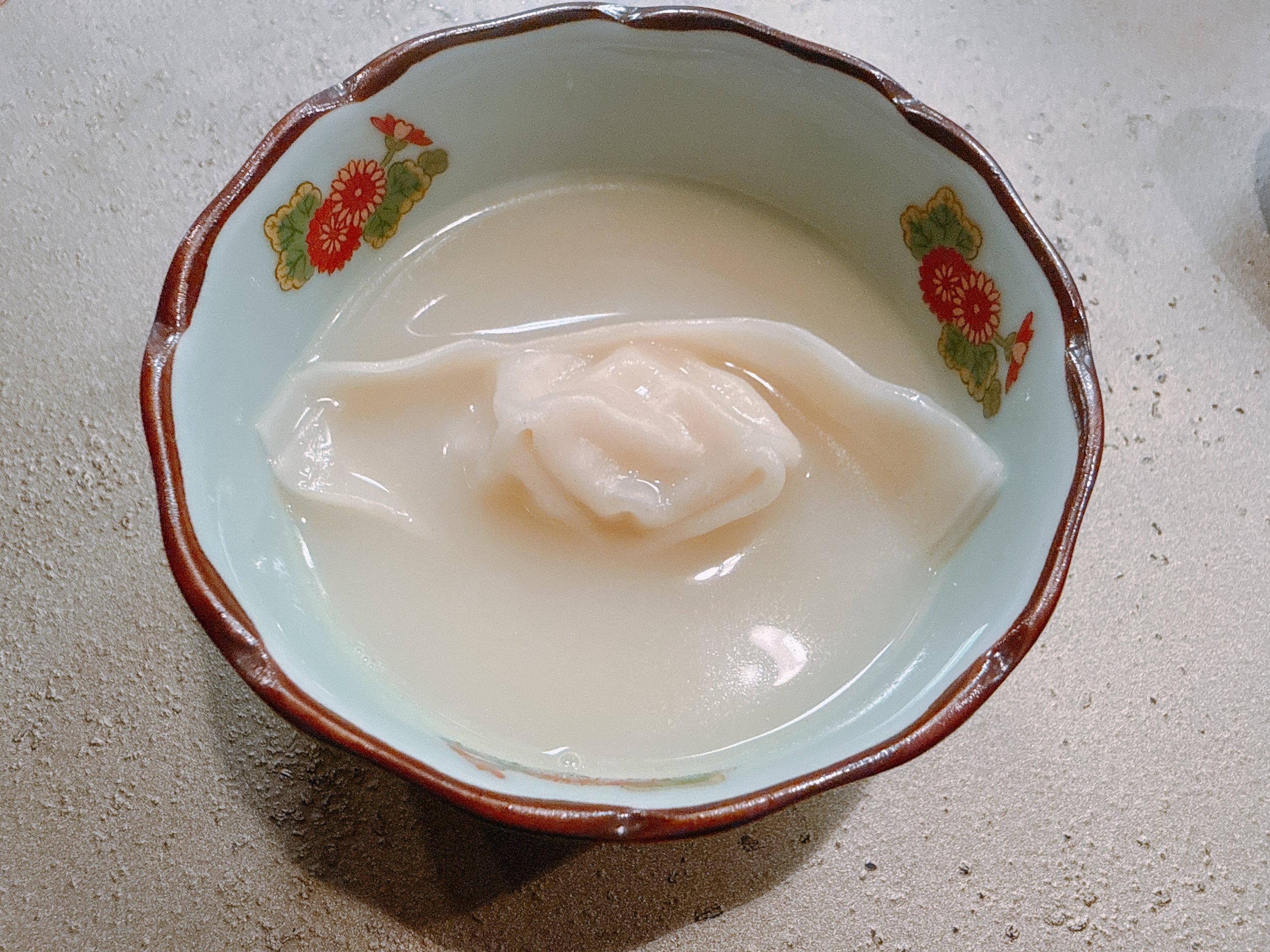
The wontons we were about to enjoy had been made by the elder chef, folding them one by one in front of us. The wrappers were homemade, using a combination of flours to achieve the desired thinness and stretchiness. They were filled with yellow croaker fish, which was also used in the broth. The fish was delightful, adding a nice flavor to the filling, and making for an aromatic soup that had just a touch of white pepper 15.
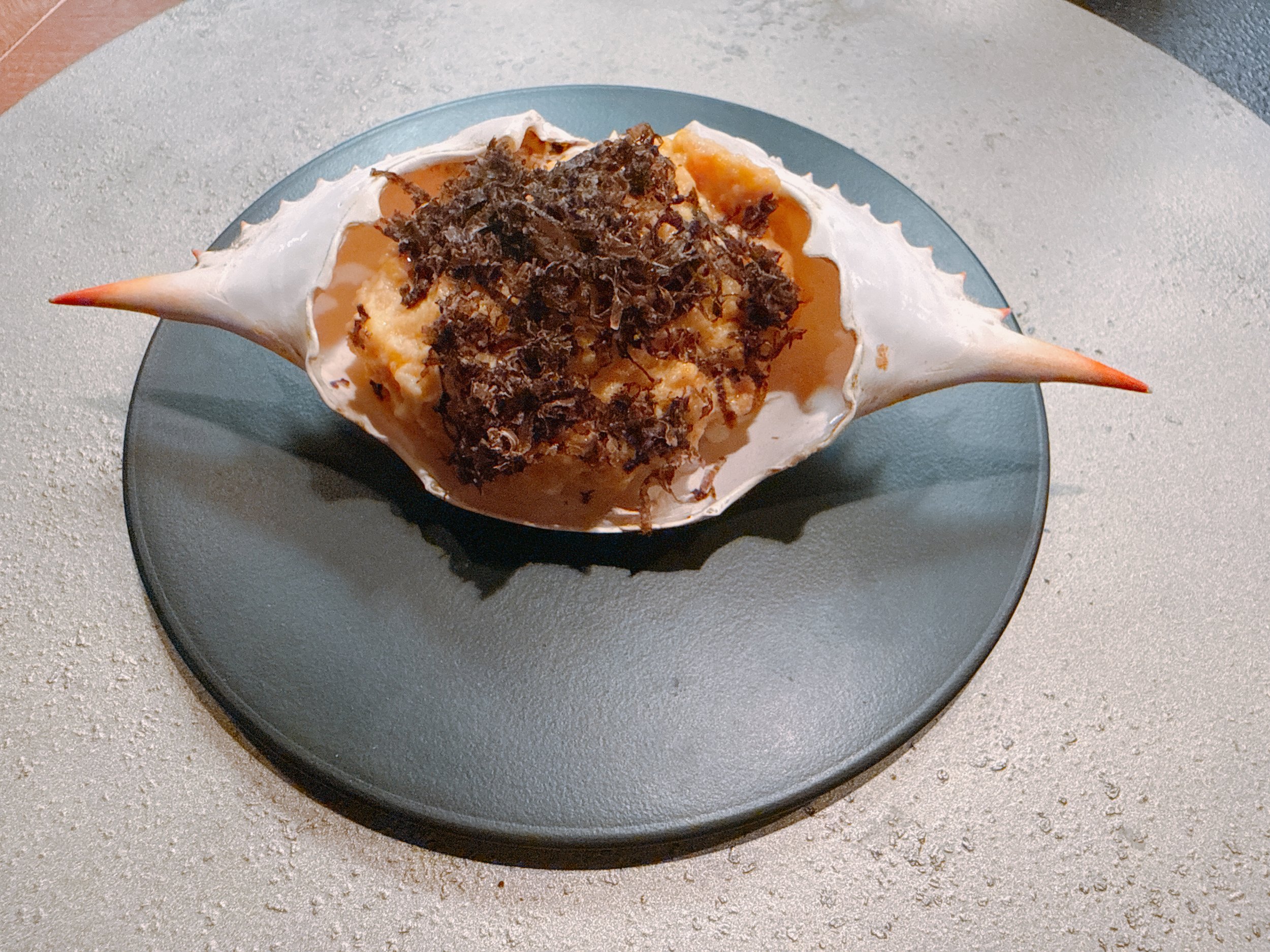
A dish of “fake crab” arrived in a crab shell, and indeed looked a bit like stir-fried crab, but was actually entirely vegetarian. For the most part, it consisted of scrambled eggs that were served over vinegared rice and topped with shaved black truffles. A few additional ingredients gave it the colored specks and crunch of real crab meat: baby carrots, potato starch, fried sliced ginger, and fried egg whites. Not bad, and with some imagination vaguely reminiscent of actual crab, albeit with a creamier texture. The vinegar in the rice was a good condiment 15.
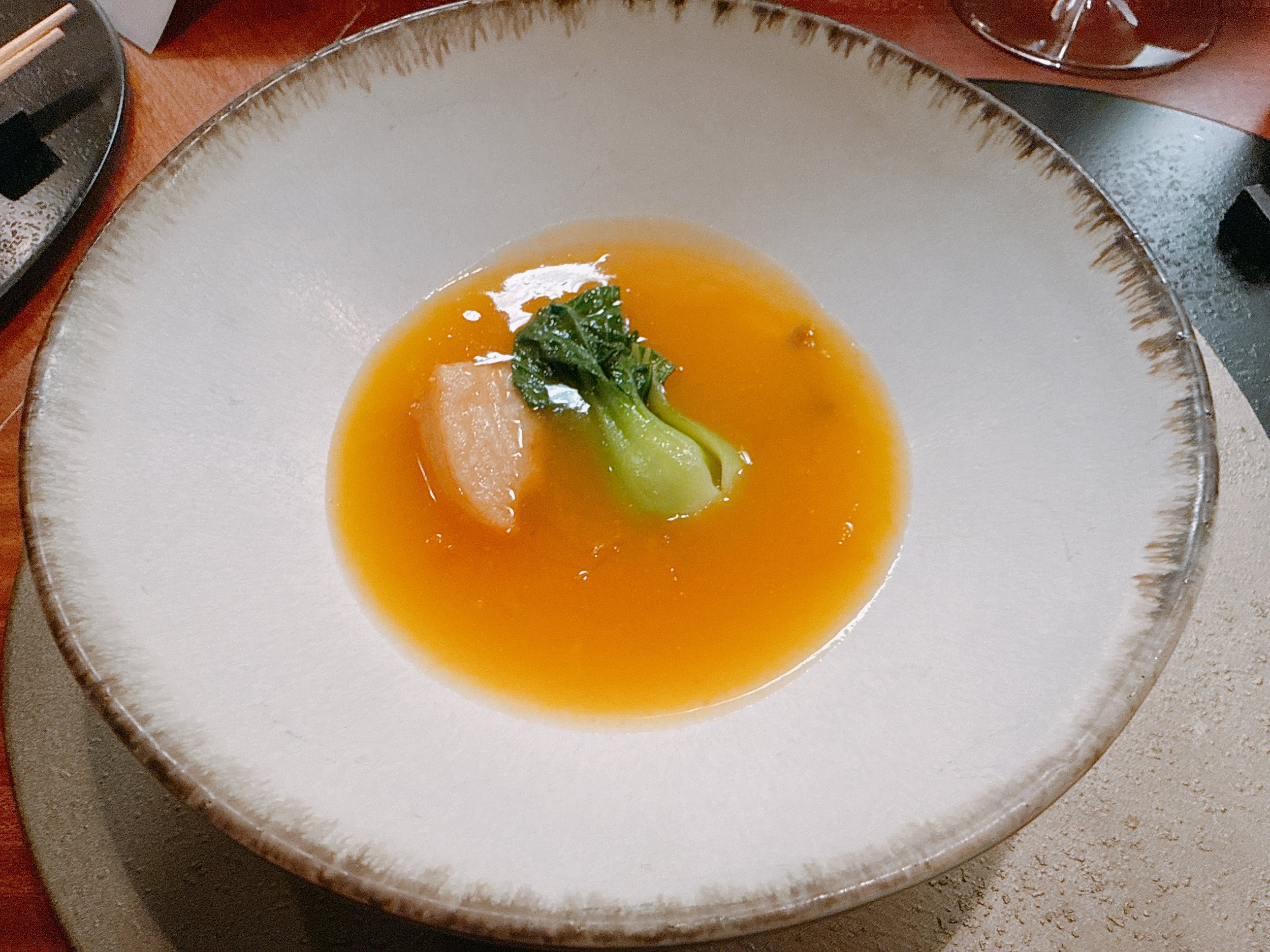
Australian abalone was served in a Buddha's jump soup made from chicken broth, goose feet, and fish maw - the latter two ingredients giving it a notably gelatinous texture. The broth also contained Peters's elephantnose fish, meant as a replacement for shark fin, which is illegal to serve in the US. Some bok choy completed the dish. On the positive side, the soup here was excellent: thick, full of flavor, with the fish being a light and reasonably close replacement for shark fin (a high 15 for the broth). The abalone, on the other hand, was among the toughest to eat abalones I've ever had. Extremely chewy, this was a workout for the jaw muscles, even though it had been scored beforehand. I like abalone to have a bit of a bite, but this was way too much, diminishing the overall experience 12.
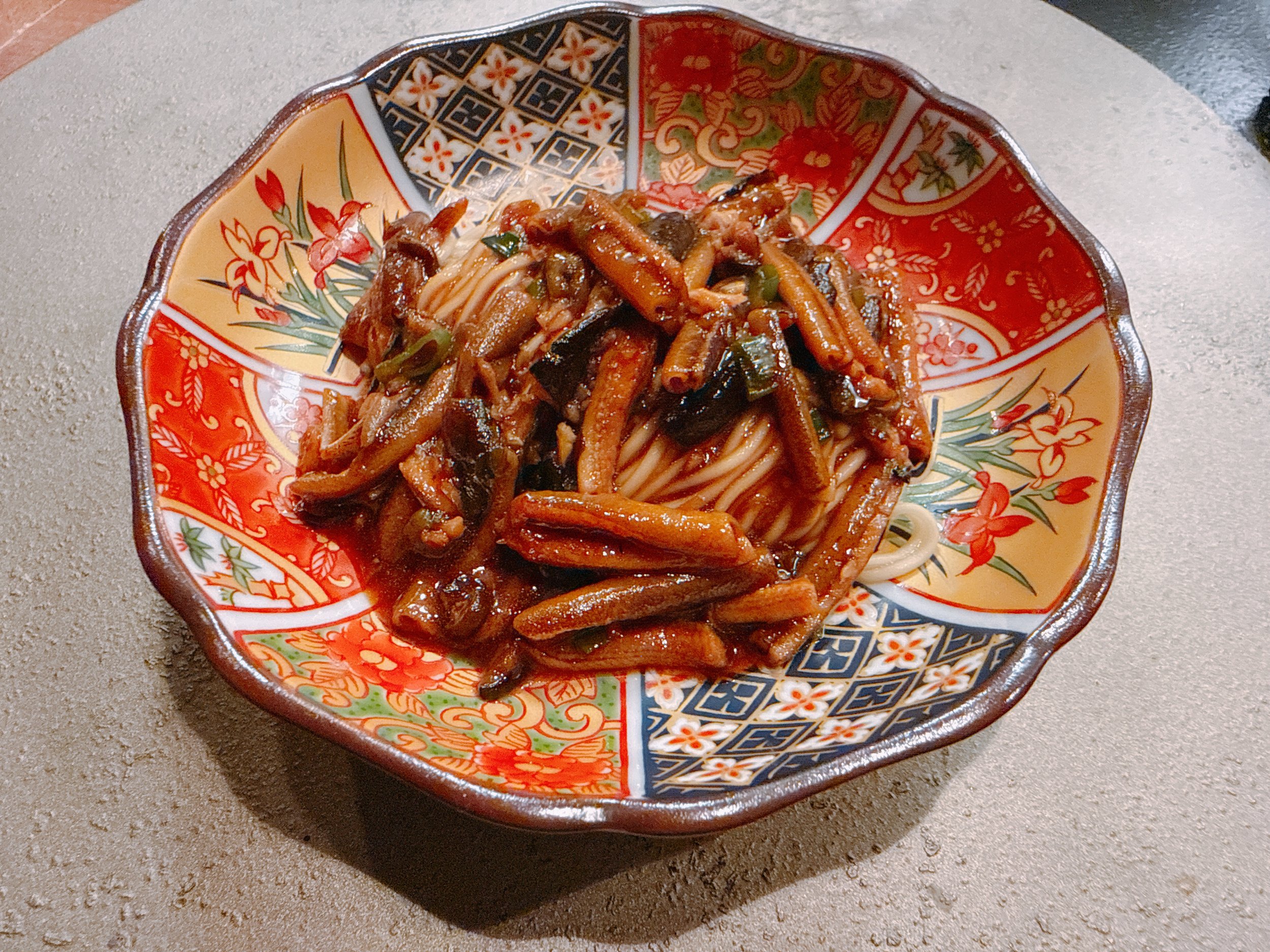
Shanghainese stir-fried conger eels were served over Osaka-style ramen and seasoned with sesame oil, scallion oil, and soy sauce. The conger eel had more of a bite than the creamier kind that we had previously encountered in Japan - hard to believe that this was the same fish. The sauce was nicely flavorful, making this a very tasty dish, that (nitpick alert!) could have been served a bit warmer 14.
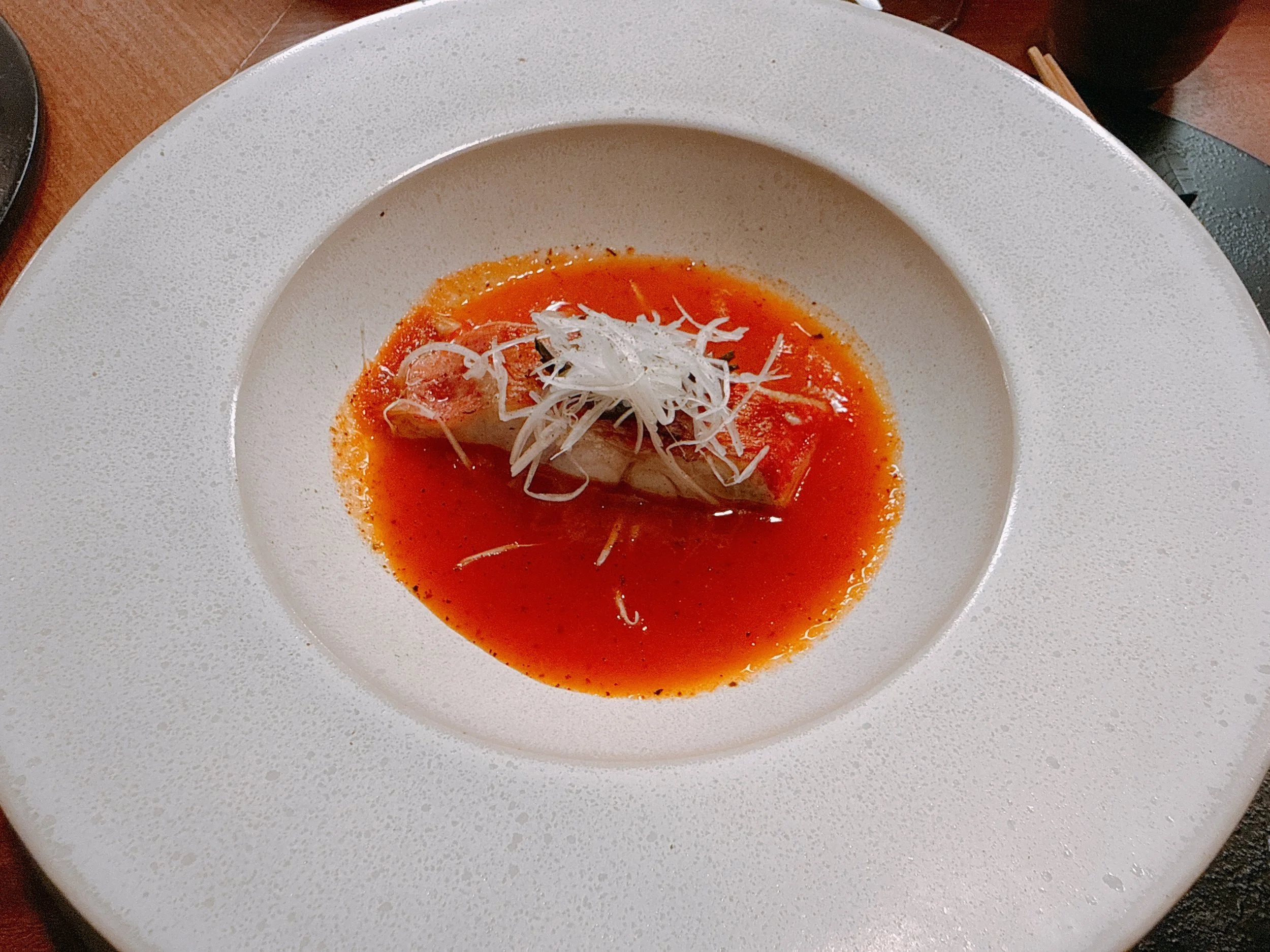
A filet of ji-kinmedai had been cooked right in front of us, first by dousing it with hot oil to crisp its skin, then by lightly smoking it over coals. That preparation give it a unique half fried/half raw consistency. The fish was served in a soup made from fermented tomatoes, fire peppers, and a beef bone broth. Topping the whole were some sliced scallions and grated mountain pepper root. The fish itself was amazing, with a great texture than really managed to feel both cooked and raw (17 by itself). The fruity tomato sauce was good, but very spicy - a tad less spice would have made this dish even better 15.
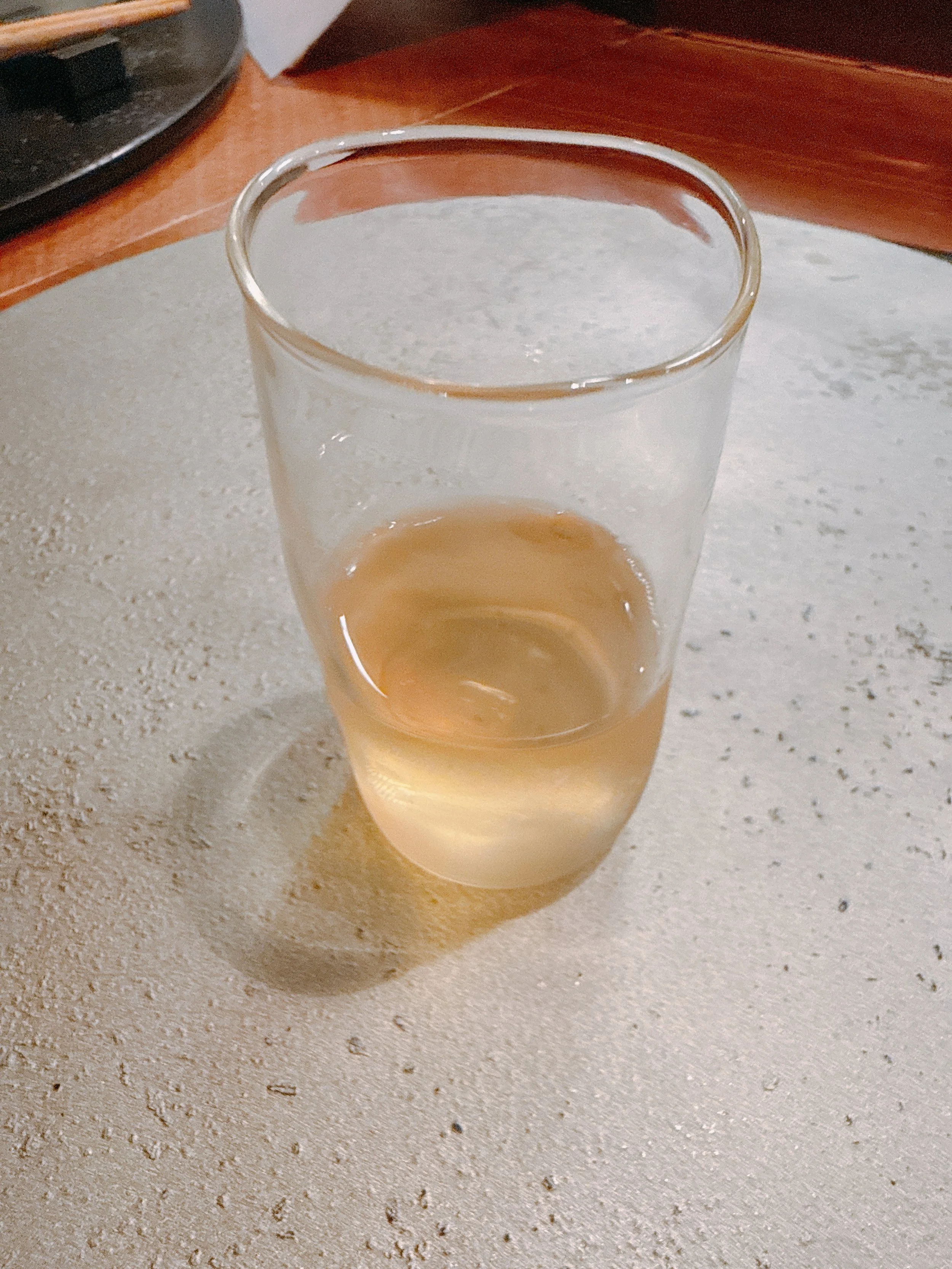
As a palate cleanser after this spicy dish, we received a clear tomato juice made from several different kinds of tomatoes. Interestingly, this drink didn't taste of tomato water, but instead was fruity and surprisingly sweet. I probably would have preferred a more savory expression of tomatoes 13.
The next dish was meant to resemble pork belly, but didn't actually contain any (no photo, unfortunately). A thick slice of daikon was topped with an all-white slice of fish maw. The daikon was juicy and flavorful, the fish maw gelatinous, salty, and somewhat fatty - since it was meant to mimic the fatty part of pork belly, that was definitely on point. Eaten together, the fish maw dominated the experience, since the daikon quickly melted in one's mouth 15.
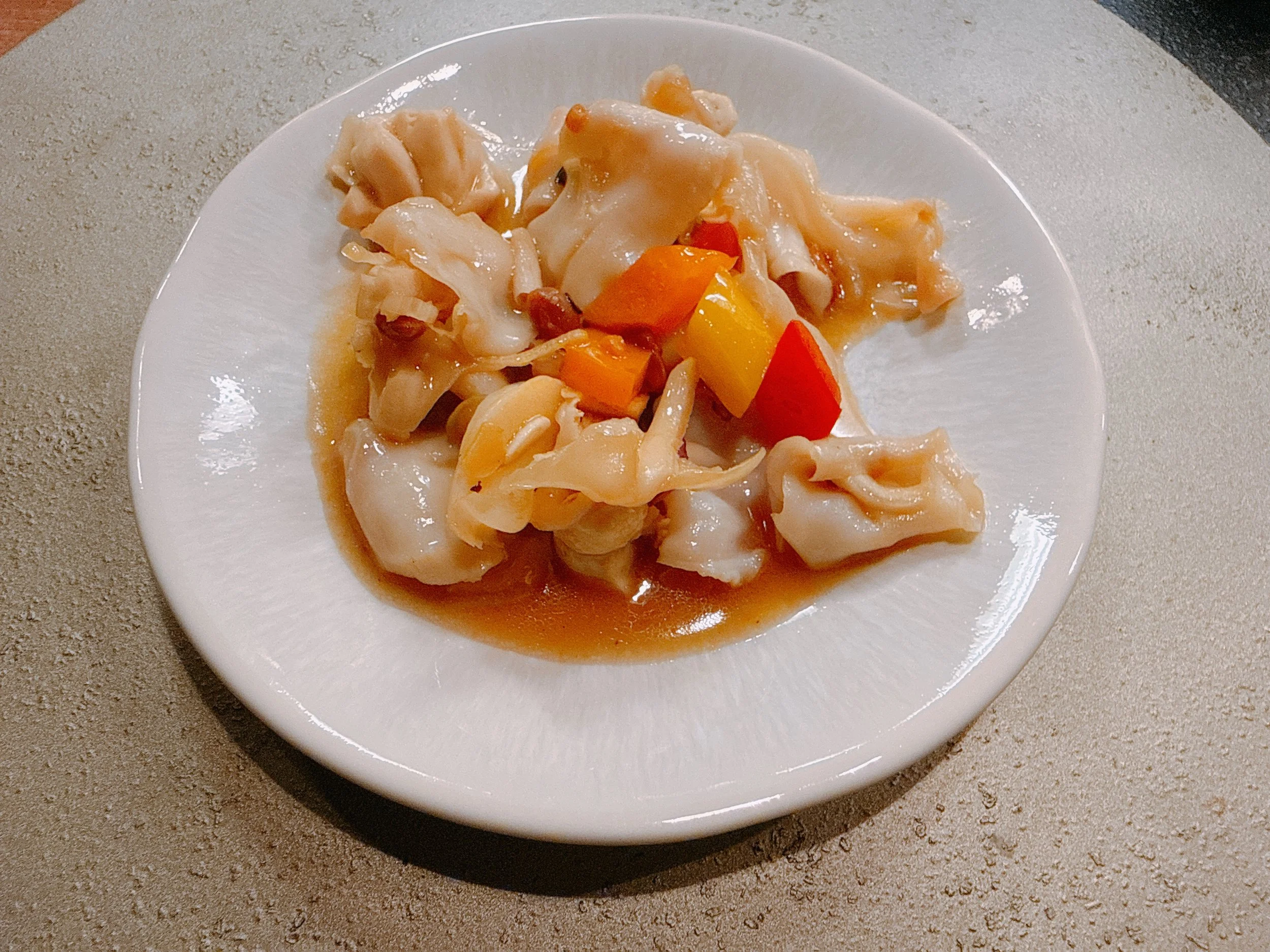
Geoduck had been fried in a wok with fermented soy beans, multi-colored bell peppers, red garlic, and garlic oil. The actual frying process took just 10-15 seconds, its impressive flames enhanced by the dimmed kitchen lights. This a la minute preparation led to a slightly smoky flavor. Most of the geoduck had some bite, but some pieces were also quite tender. The soy beans were flavorful and salty. Very nicely done 15.
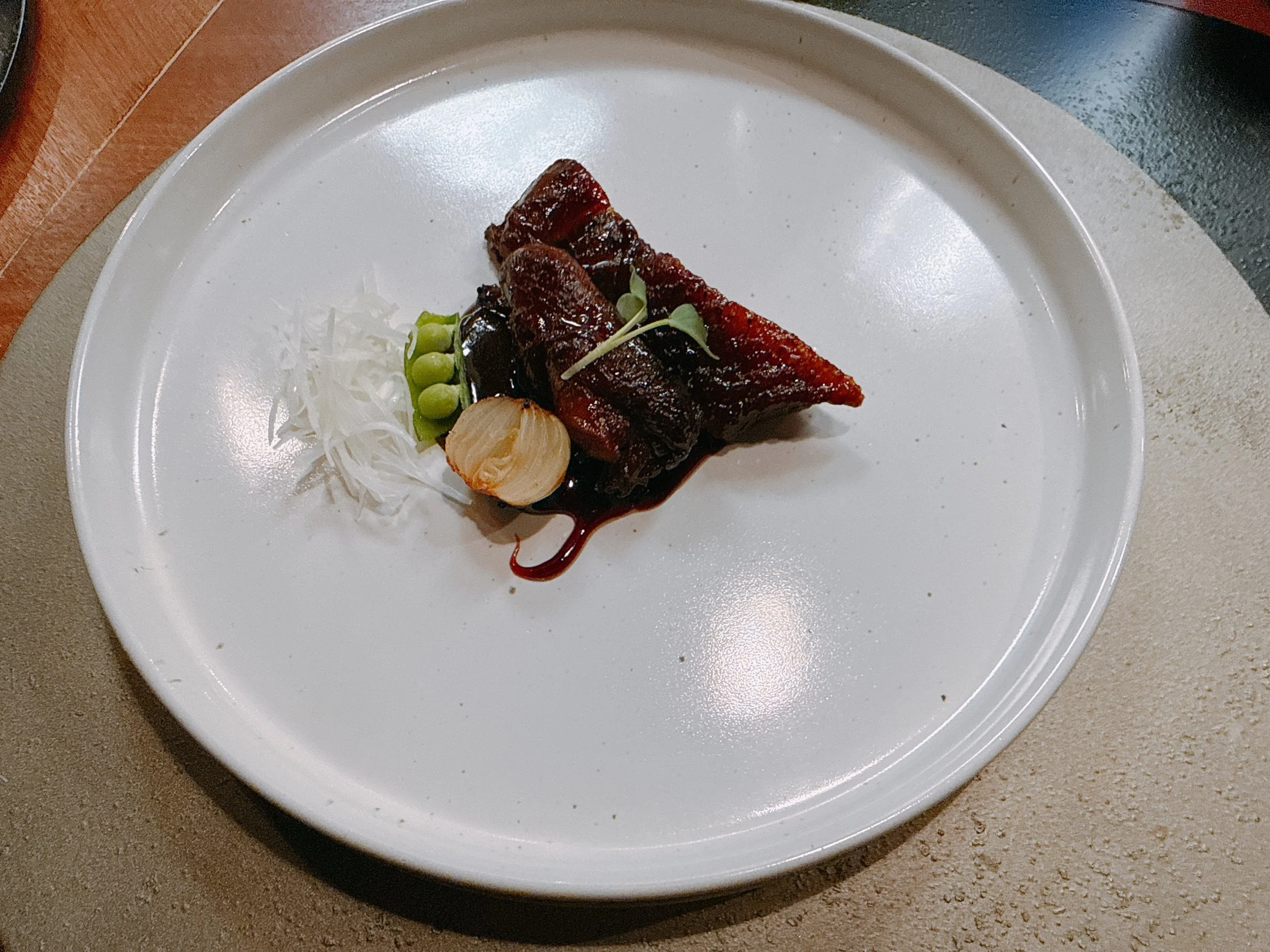
The penultimate savory course, and - as mentioned earlier - the only indisputably non-pescatarian one, was a “soy duck”. A duck leg had been charcoal-grilled and was served with a duck bone sauce, a little grilled onion, sugar snap peas, and sliced scallions. The duck was suffused with the sauce, which had lots of flavor, and was somewhat sweet and sticky. The result was meaty, not too fatty, and definitely not gamey - tastewise this could almost have been chicken. The peas were fresh and crunchy, the onion relatively sweet 15.
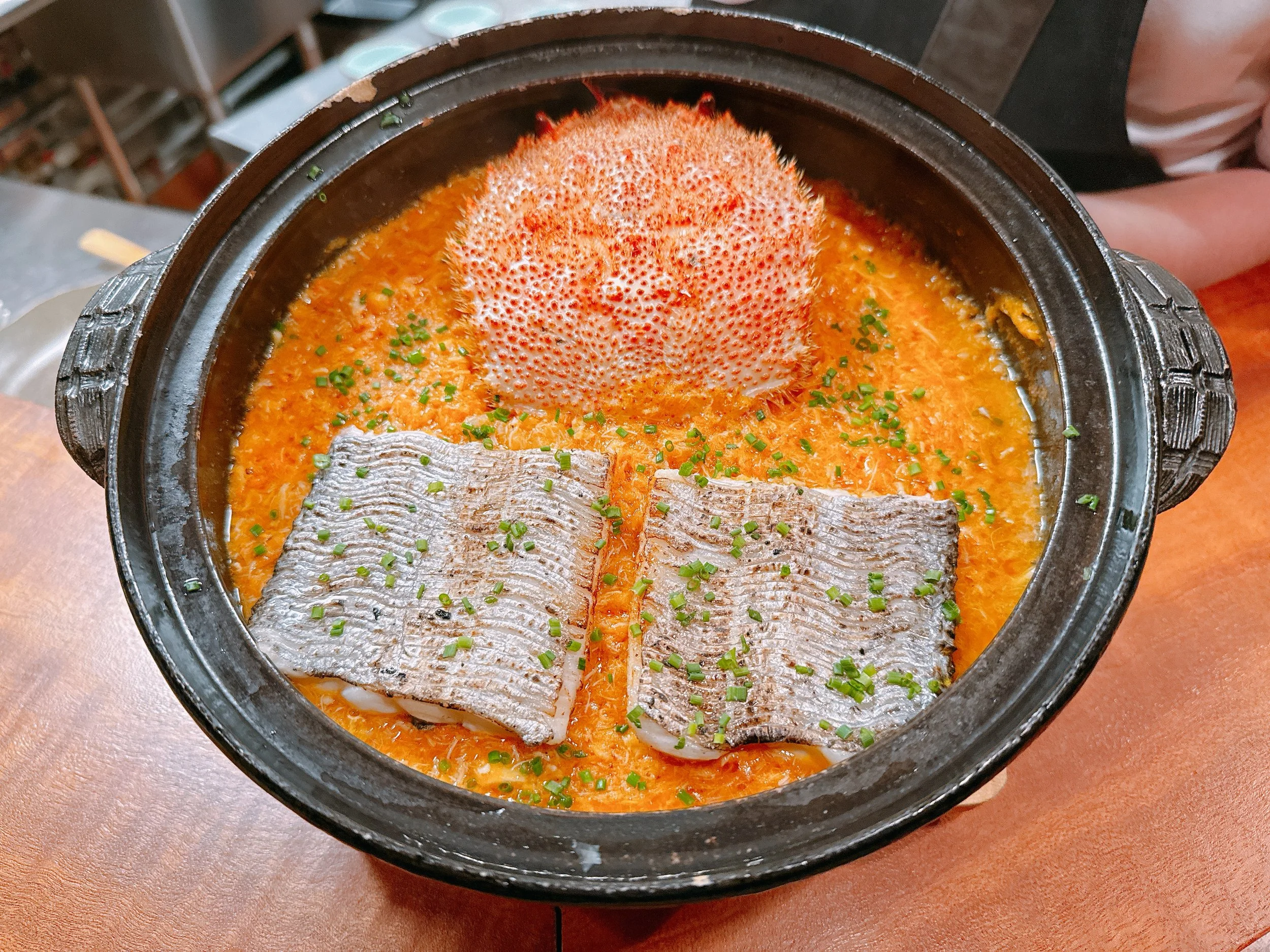
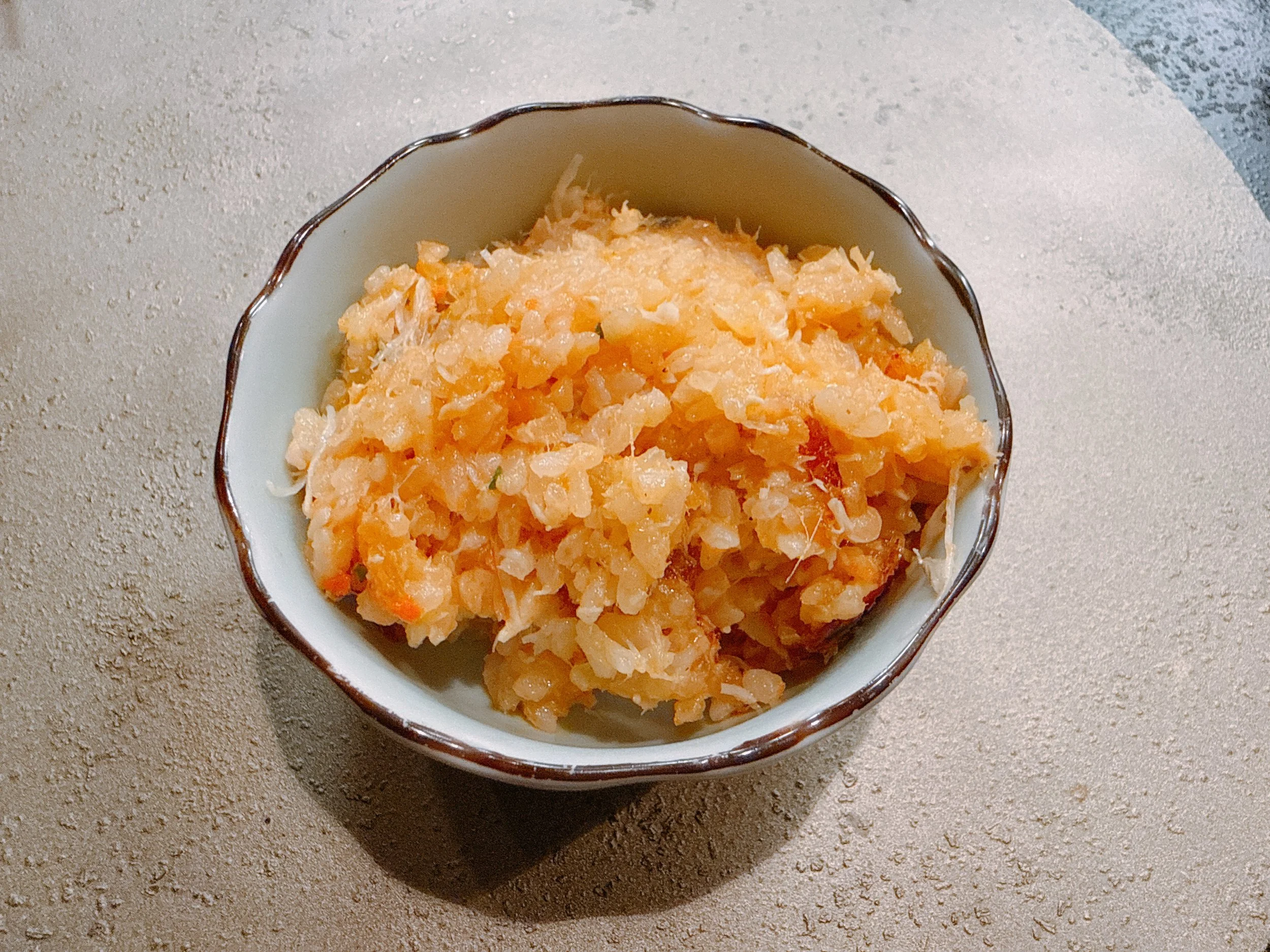
Following Japanese tradition, the final course was a rice pot dish. In this case, the rice was topped with crab leg meat and the charcoal-grilled belly of a Japanese knife-fish. The rice came from Japan's Niigata prefecture, chosen specifically to match the toppings. All of the ingredients were mixed before serving. The rice was much softer than al dente, and the seafood was pretty tender as well. That meant that most of the texture came from the parts of the rice that had been burnt by the pot - they provided a nice crunch. But overall, the taste and texture of this dish were a bit indistinctive. The supplied vinegar added a bit of a punch, but a tad more flavor besides that would have been nice 13.
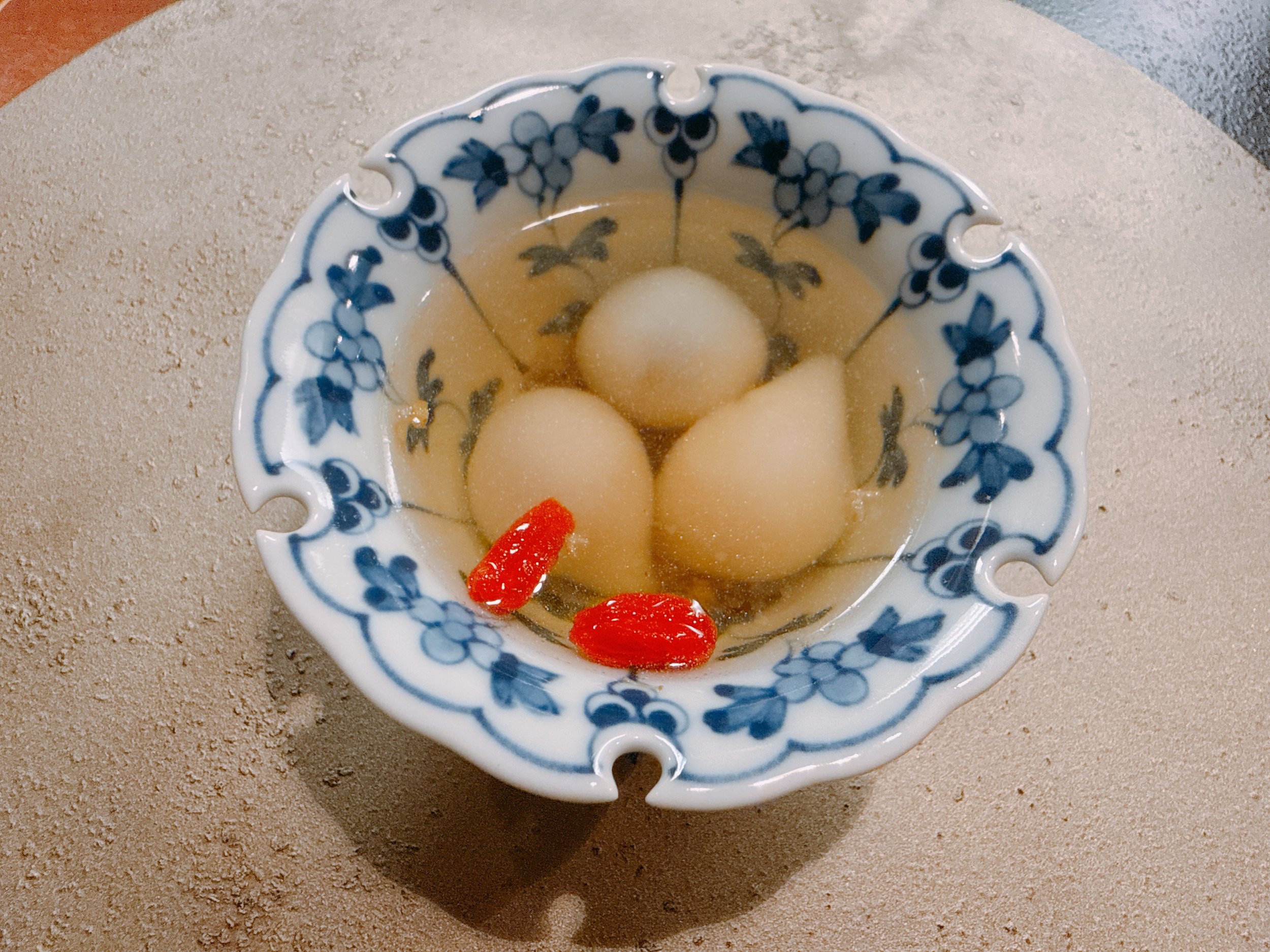
The desserts were deceptively simple and to the point. The first one had three handmade mochi, filled respectively with roasted peanuts, black and white sesame, and Chinese almonds. They sat in a broth made with water buffalo butter, dried osmanthus, goji berries, and rock sugar. The broth was lightly sweet and extremely fragrant - yum! The mochi were very tender, with (mostly) great fillings: the crunchy peanuts tasted fresh, the sesame flavor was strong, only the new-to-the-menu almonds felt much too almondy to me - reminiscent of almond essence. Ignoring the almond mochi, this was a wonderful dessert 17. (16 including the almond mochi.)
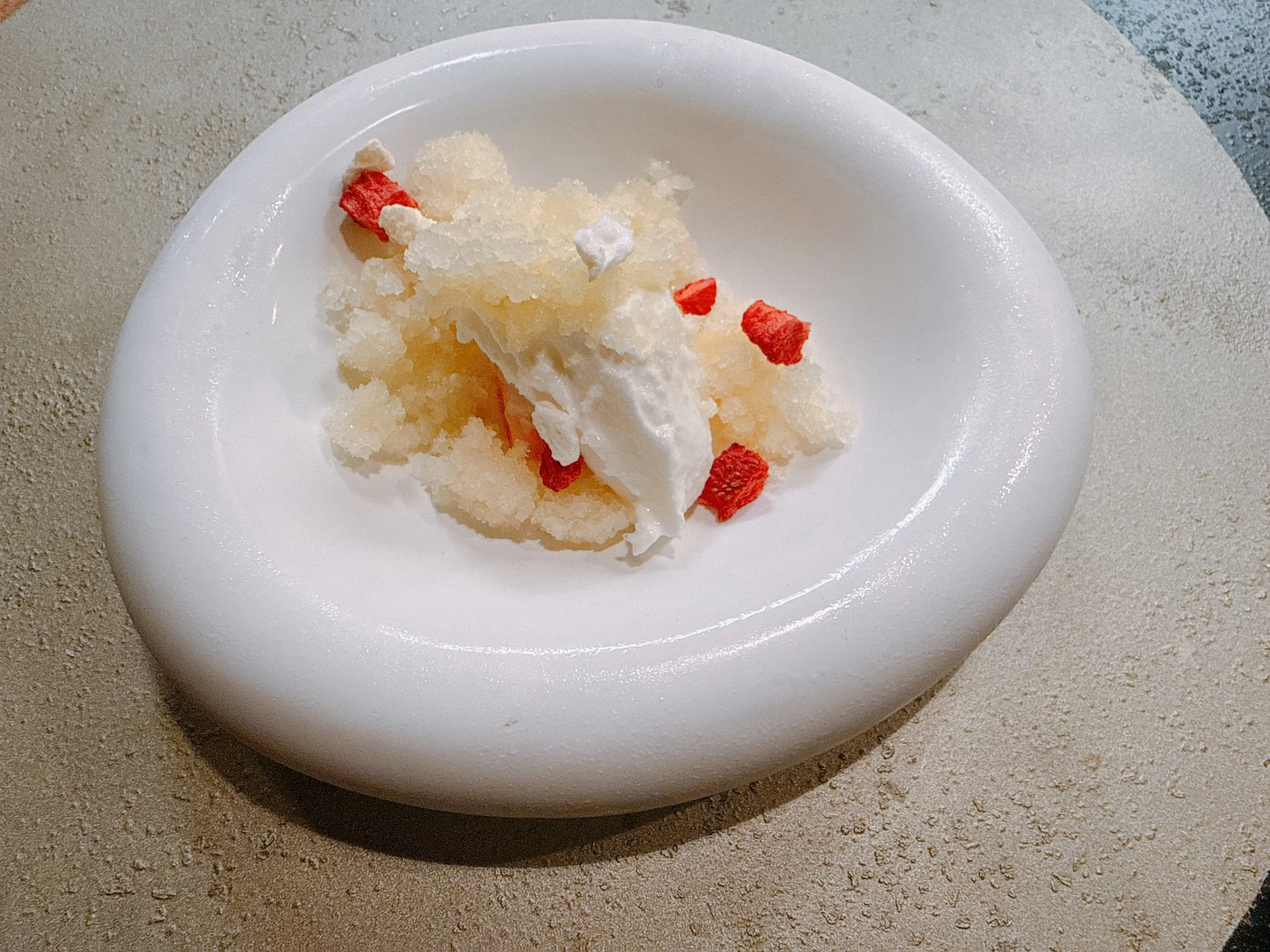
The final dish of the night was an ice cream made from coconut milk and coconut oil, paired with pink pineapple, pineapple shaved ice, and frozen dried pineapples and strawberries. This dessert was creamy and sweet from the ice cream, contrasting with the pineapple and its ice, which were more on the tarter side. A nice balance 15.
Overall: A very unique blend of Chinese and Japanese cuisine that felt surprisingly natural and assured, considering that the restaurant had been open for only a few months. The few dishes that didn't quite work for me were easily compensated for by several excellent ones. With a compelling and informative narrative, this is definitely a restaurant we'd happily return to - assuming we can actually get a reservation, that is... 15