Sorekara - Orlando
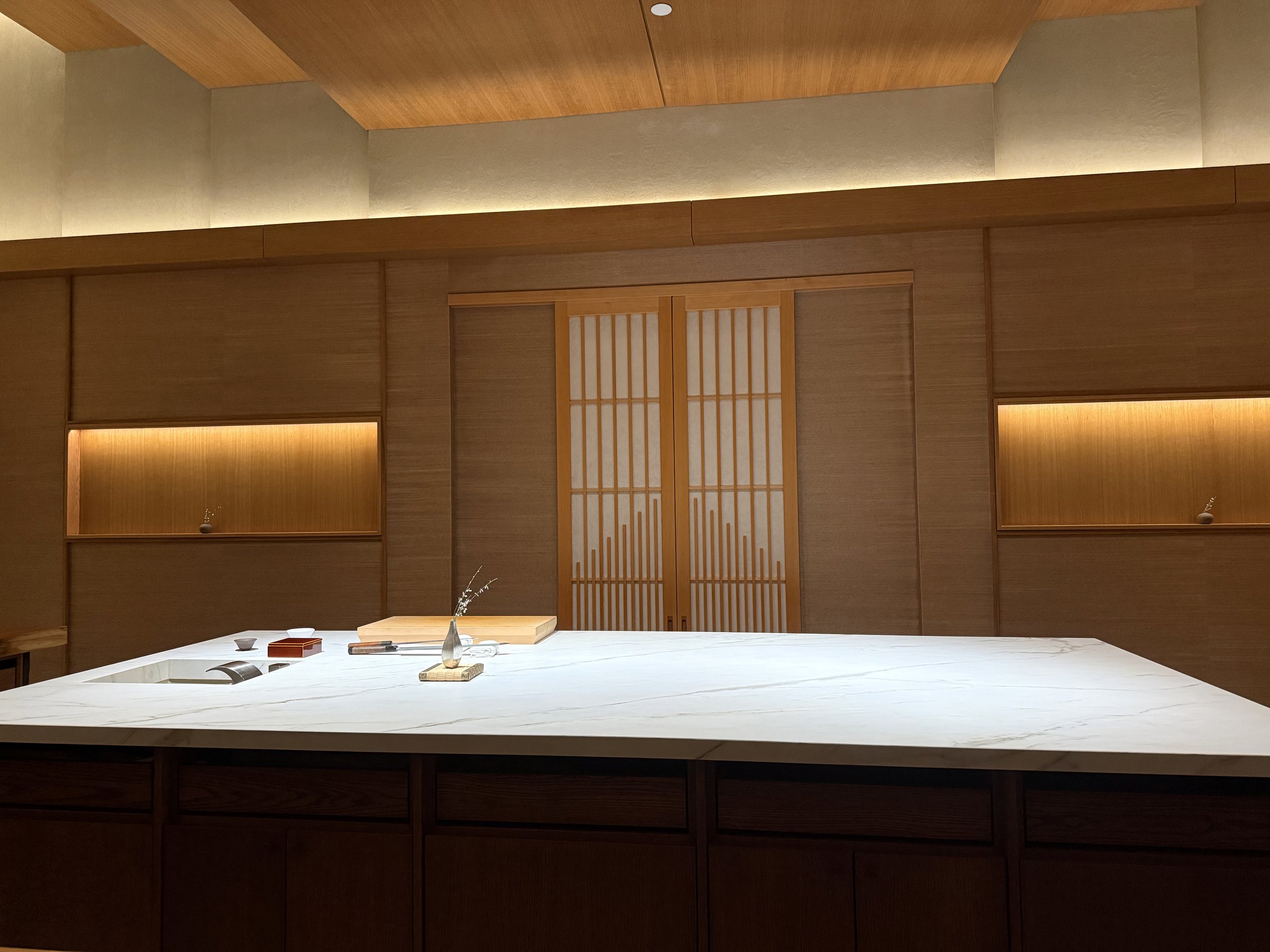
The chef’s working area (shown without chef)
Rating: 17/20
Where: Orlando, FL
When: Dinner for 2 on 3 January 2026
Cost per Person: Tasting menu $345, Beverage Pairing $195
Accolades: 2 Michelin Stars
Why: Japanese cuisine with some unusual twists and excellent desserts
“Sorekara”, a two-Michelin-starred restaurant in Orlando's Baldwin Park neighborhood, defies easy categorization. At a high level, one could call it a Japanese restaurant. But it really has an identity all of its own: courses composed of ten dishes, molecular cuisine, some French cuisine, and multiple Italian desserts - they all made an appearance during our 4 1/2 hour dinner. Definitely not what you'd expect from your “typical” restaurant in Tokyo.
Then again, you might not expect this from a restaurant in Orlando, either. For the majority of tourists, “eating in Orlando” probably still means over-priced fast food in an amusement park. But over the past few years, a number of very ambitious fine-dining restaurants have opened in the area as well, some of them even earning Michelin stars. Two days earlier, we had had dinner at one-starred “Camille”, a French-Vietnamese restaurant literally across the street from Sorekara. Apart from having the same owners and (almost) the same location, though, the two restaurants really had nothing in common. So even though we hadn’t been blown away by Camille, we were excited to see whether Orlando’s first two-Michelin-starred restaurant would live up to its lofty accolades.
Booking our reservation was a slightly unusual process. The restaurant's Tock page always declared that “Reservations are unavailable”, and it was only possible to add oneself to a waitlist via a request form on the restaurant's webpage. Not really expecting a reply, I submitted the only two dates on which we had no dinner plans while in town. But much to my surprise, I got a phone call the next day offering us two spots for dinner. Maybe the restaurant simply prefers to have a phone call with their diners rather than taking direct online reservations?
When we arrived at Sorekara, one of the staff members was already outside, waiting for us with a proffered umbrella in hand (it was raining lightly). We were quickly led to a waiting room where relaxing piano music (or as my wife deemed it, “spa music”) was playing in the background. The staff gave the waiting guests an introduction to the restaurant, explaining that “sorekara” meant “now-then” in Japanese, and dinner was meant to be such an in-between moment, where one didn't have to worry about one's otherwise busy life. One could argue that this introductory monologue and the lengthy descriptions of the art pieces in the restaurant were a bit much, but they also served a purpose other that just conveying information - they consciously slowed down the proceedings. That way, any post-dinner-supermarket-run plans were quickly ditched, and one could fully concentrate on the meal instead.
Part of the “be in the moment” ethos was the restaurant’s “please don't take too many pictures” policy. Taking this to heart, my phone took the initiative in failing to save the photos of several dishes, so apologies in advance.
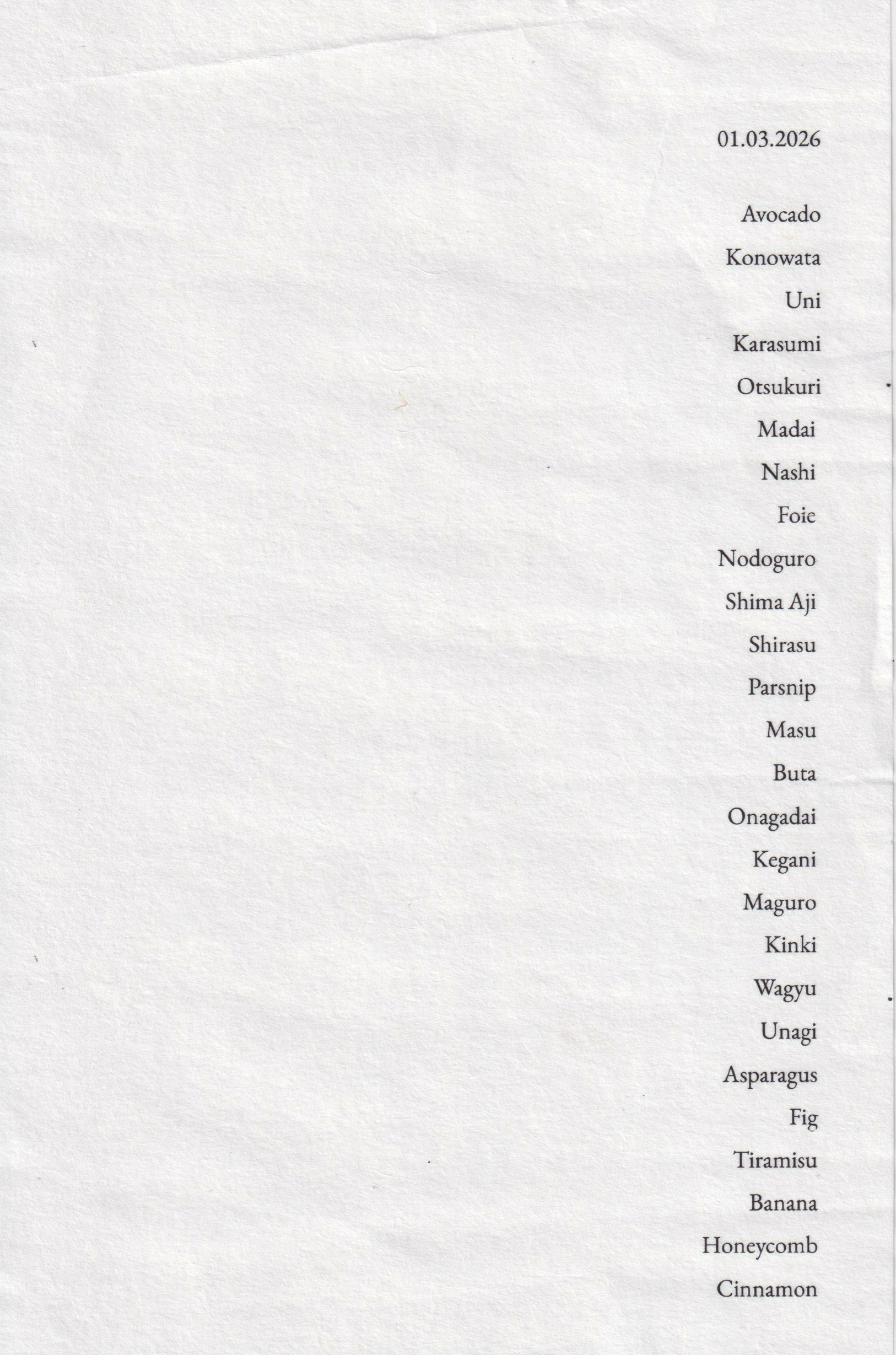
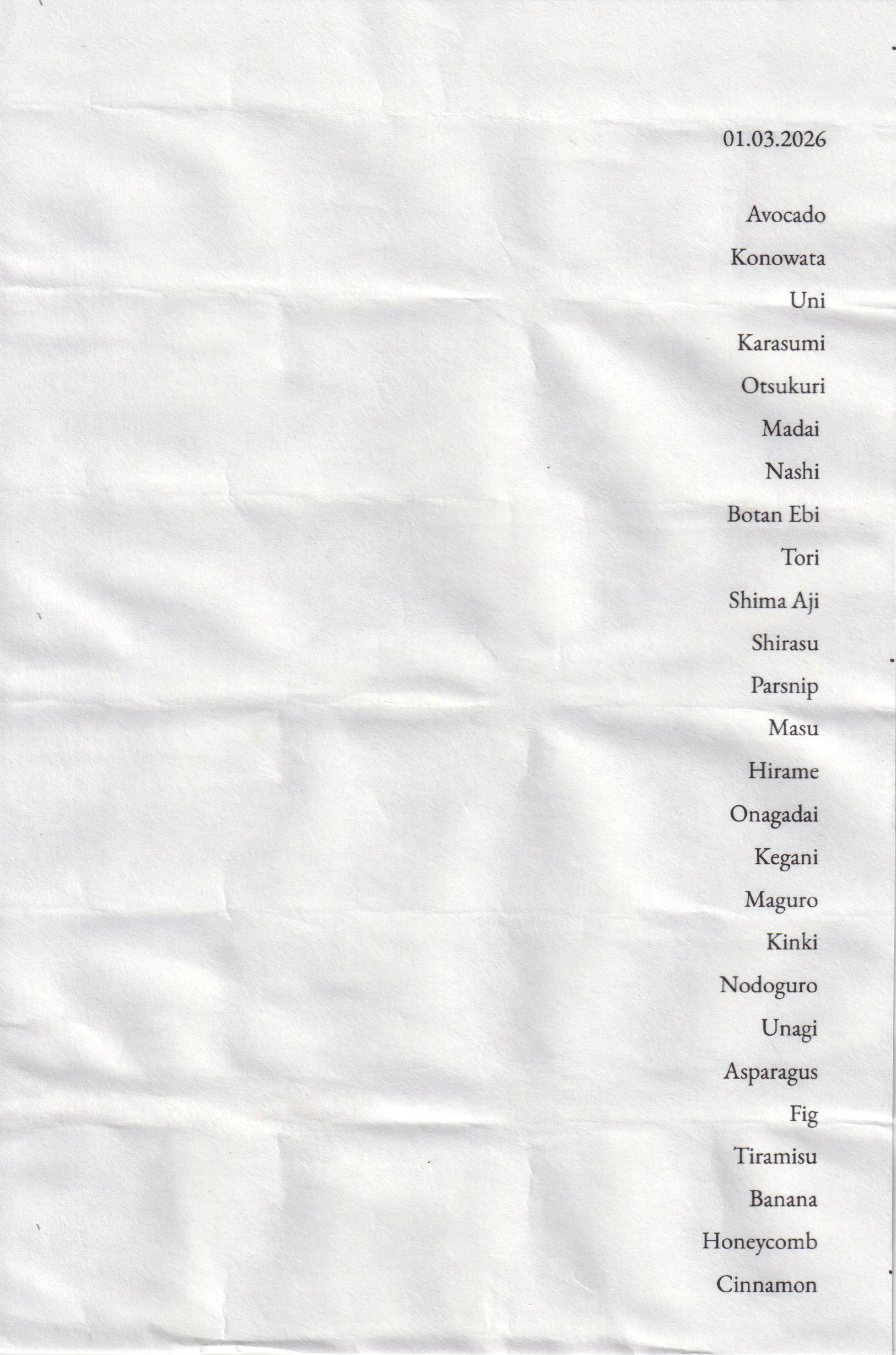
Sorekara served just a single omakase menu - we had no idea what was coming, and the printed menu was delivered only after the dinner. Drinkswise, we had the option of a combined wine/sake pairing for $195. The pairing consisted mostly of wines, there were only two sakes. All of them were generally pretty good, and the pours were not too stingy either. Definitely worth a consideration. Our sommelier was very enthusiastic, and in fact the entire staff seemed very approachable. Very professional, but still with a casual on-a-first-name-basis vibe.
Our dinner actually began in the aforementioned waiting room. Here, we were all handed a small glass of “carrot soda”, made from fresh carrot juice, yuzu, tea, and a Japanese ginger soda. It had a thick-ish consistency and was quite sweet. A nice start, but not one that gave any indication of what was to come 16.
We were instructed not to finish the carrot soda, in order to drink it along the first bite of food. That bite was served at a bar in the restaurant's private dining room. The room was dominated by a large wooden dining table, which faced a panoramic window looking into the kitchen.
Our “bar bite” looked like half of a very small avocado, complete with a brown pit in the center (no picture). In reality, this was actually a meringue seasoned with avocado power and avocado cream. The pit was a creamy chocolate praline - which explained why the chef preparing the dish in front of us was part of the dessert team. The meringue was very light (in both weight and flavor), and this dish tasted mostly of chocolate, with the avocado adding some creaminess. Not bad, but also unusually sweet for an appetizer, particularly in a Japanese restaurant 16.
After this brief tour of the building (which I suppose might not happen if the private dining room was in use), we were led - one party at a time - to the main dining room. Here, ten diners ended up seated around an U-shaped wooden counter. At the center of this U-shape was a large wooden counter helmed by chef William Shen. During the following dinner, servers and/or chefs would deliver dishes to each party individually. So while everyone was always on the same course, we were not served at the exact same time. In fact, when all five parties were handed their dishes simultaneously, the five overlapping conversations became a bit cacophonous. Seating-wise, there were substantial gaps between neighboring parties, making it feel more like separate tables rather than a true counter experience.
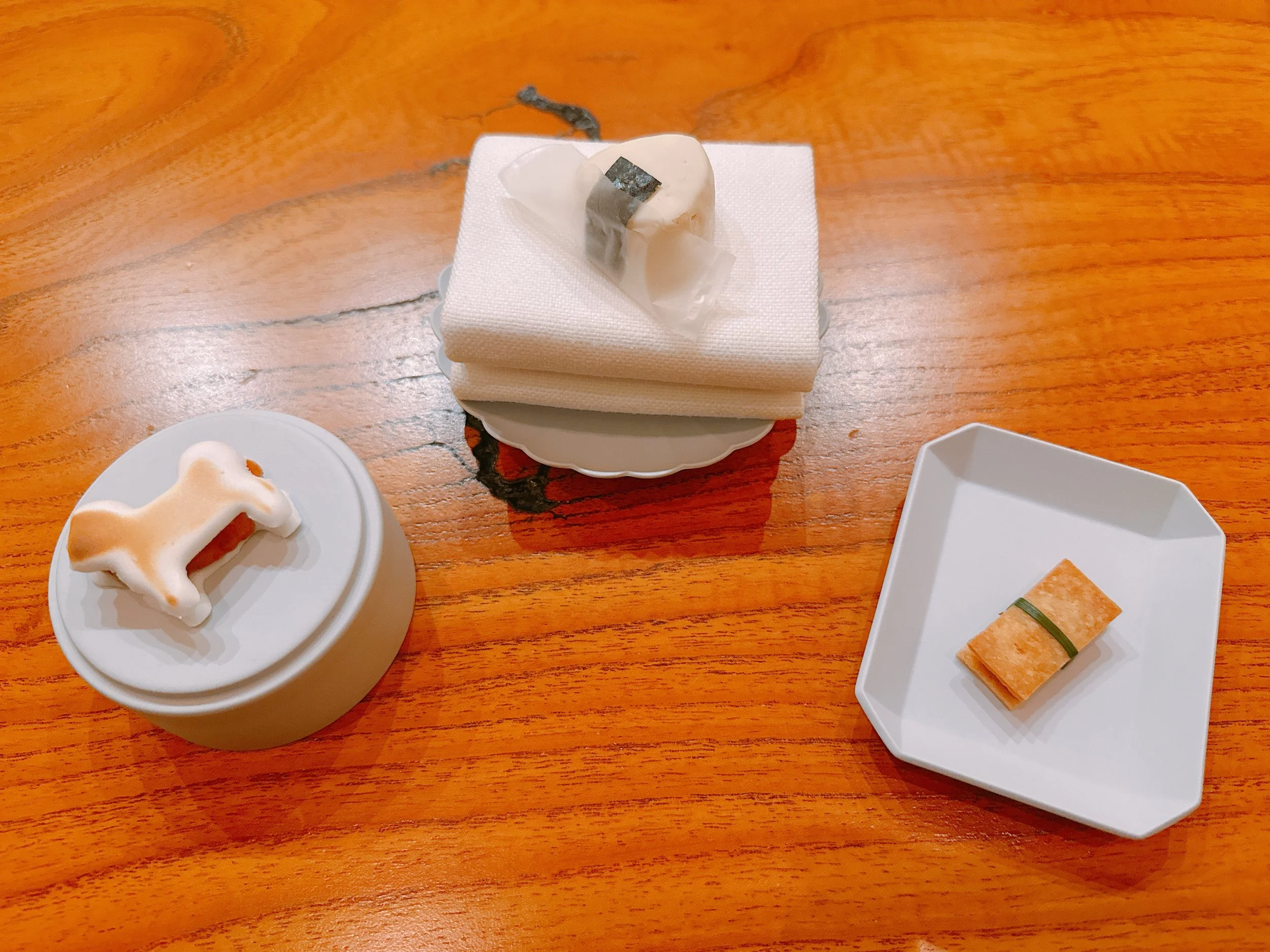
Our first course consisted of three individual bites, each meant to represent a typical Japanese ingredient (from the north, middle and south of the country, respectively). First, there was some uni (sea urchin) from Hokkaido, served sandwiched between two dashi meringues shaped like a dog. (The chef's dog is called “Uni”.) When eating this, the meringue with its light sweetness seemed like an odd choice at first, but the main taste impression quickly changed to a strong uni flavor. This was a dish that definitely put its star ingredient front and center 16. What looked like a little onigiri was actually a white chocolate praline filled with fermented sea cucumber and partially wrapped in nori and an edible potato paper. Here, the flavor balance wasn't quite as compelling: the white chocolate was predominant, and once it had melted away, there was “just” an aftertaste of nori. Not bad, but maybe not exactly what had been intended 15. Finally, we had another little sandwich, this time two toasted crackers filled with mullet roe and wrapped with chives. Similarly to the first bite, there was a progression from slightly sweet (the cracker) to savory (the roe). The roe had the chewy texture that one would expect from bottarga 16. Somewhat unusually, we got a presentation of the three main ingredients (uni, fermented sea cucumber, and mullet roe) after rather than before the course. I suppose that works equally well.
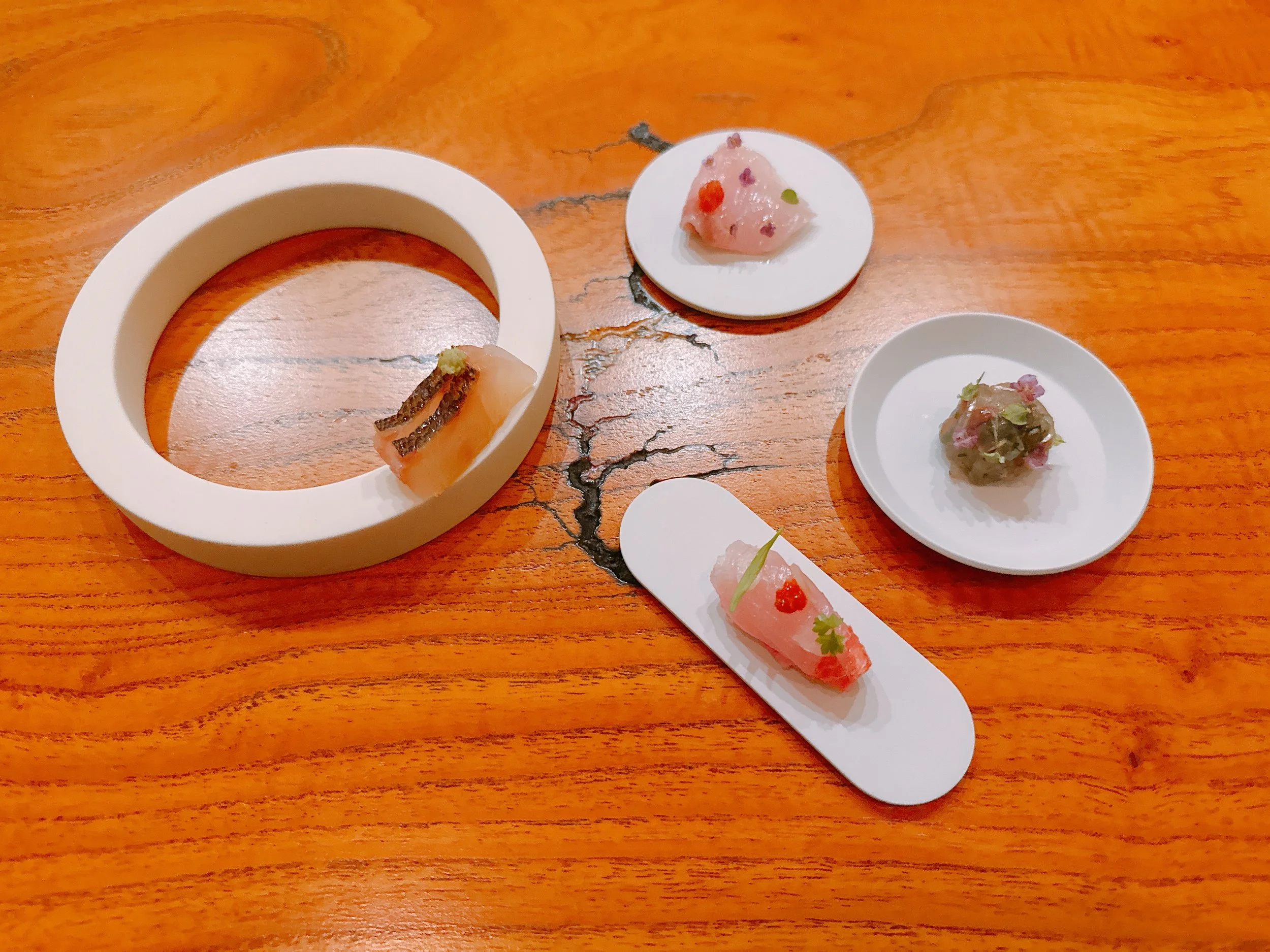
A sashimi course was next. Many of the fish had been caught by a friend of the chef's in Japan and then dry-aged, giving them a slightly different texture from raw fish. We tried the fish in clockwise order starting on the left in the picture. First, served on a ring-shaped plate, was isaki (grunt fish), dressed only with soy sauce and wasabi. A nice piece of fish that definitely made the aged texture stand out, with maybe a trace of smokiness 15. Ishidai was topped with some microgreens, seaweed, salt and pickled plums. This was another fish with a great texture, and one could really taste every ingredient: the acidity of the umeboshi and the herbaceousness of the microgreens 17. Aji (horse mackerel) was served as a tartare with shiso, ginger and chives. A fatty fish, but not particularly fishy in this case - a pretty rich bite with lots of flavor 17. Kinmedai (goldeneye snapper) was quite spicy, but also very tasty with (again) a great texture 17.
The next course was cheekily introduced as a collection of ten different “snacks” (otsumami) that one might find in Japanese convenience stores such as a 7-Eleven or Family Mart. Well, if at all, these were significantly souped up versions of the same. No eating order was specified - in hindsight we probably should have tried the only hot bite first, but going for the sweetest one last was definitely a good call.
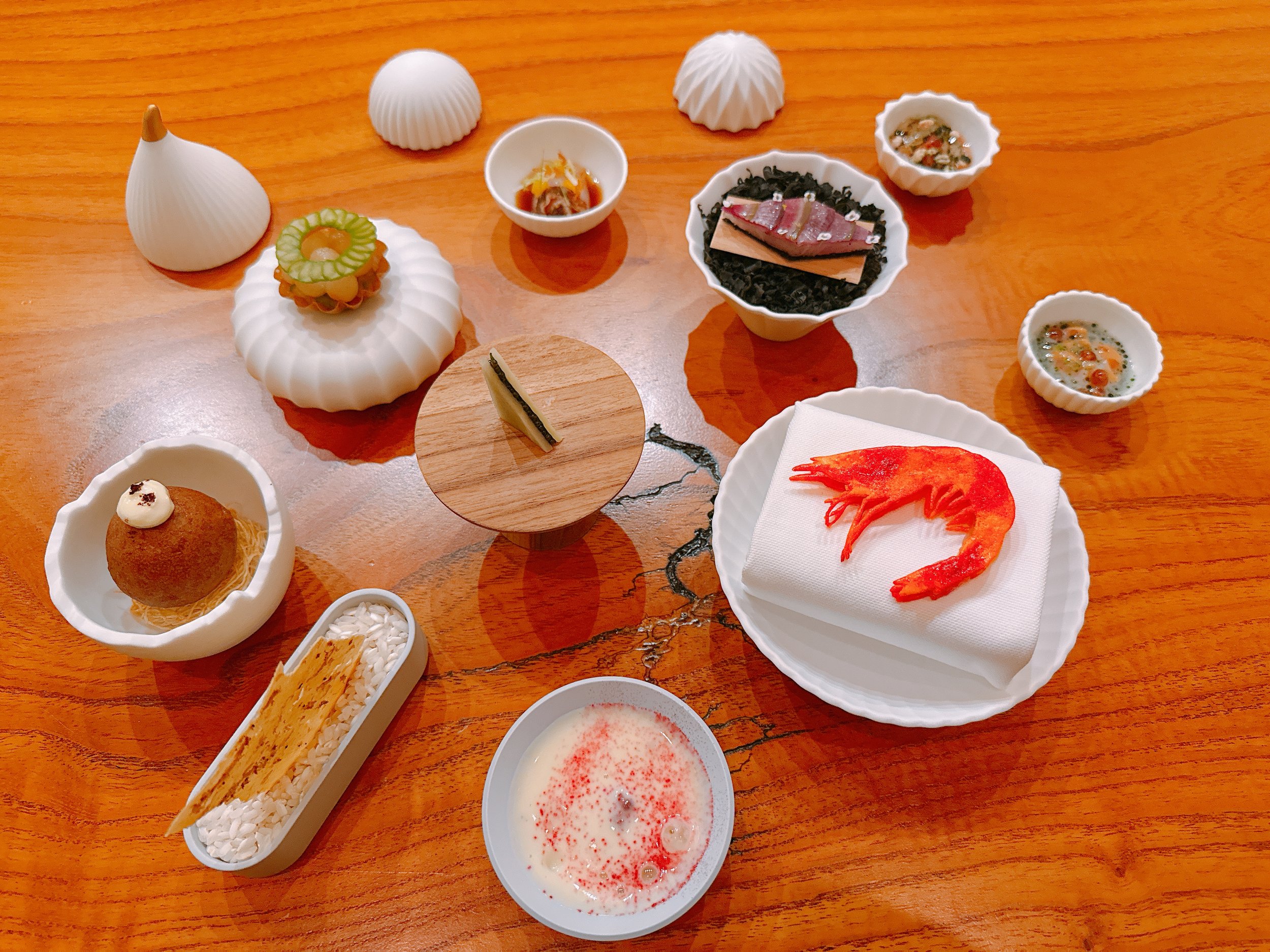
First, we sampled a sandwich filled with Nova Scotia spot prawn tartare. The sandwich that looked exactly like said spot prawn, but was made from carrot juice paper. The tartare was seasoned with fermented carrots as well. The result was lightly sweet, maybe a bit too sweet for my taste, and had what felt like a vanilla note 14. Next was a foamy manchego cheese mousse that covered a duck leg confit, foie gras and raspberries. The duck legs were full of flavor, and went great with the cheese 17. The pescatarian version of this dish used roasted apples instead of meat, which made for a much sweeter, but still cheesy dish. Not as distinctive 15. A thin rice cracker was meant to be dipped into the cheese dish. The little “smudges” on the cracker turned out to be baby ice fish. By itself, the cracker was not particularly exciting, having essentially no taste (similar to a water cracker), not even a hint of fish flavor 13. Next was an “egg sando”: an egg sandwich sitting on a wooden pedestal at the center of the presentation. The “bread” of this sandwich was actually thin slices of parsnip seasoned with paprika, and its filling was made from caviar and cod roe. That sounded interesting, but tasted mostly just of parsnip, with maybe a bit of herbs 13. The only warm dish among the ten was a donut filled with chicken meat, truffles and garlic. It had a very strong truffle taste - yum! The chicken meat was essentially just there for texture. As I mentioned before, we probably should have eaten this bite first, and it had cooled down since being served. Assuming a slightly warmer version 18. Next, we tried a shima aji “sandwich” (in a white cup on top of a black decorative filling). The base of this sandwich was made from aged kombu seaweed, crispy nori, and fermented radishes, giving it a very strong seaweed flavor. The fish was of great quality as well 17. Norwegian trout was served with tomatillos and a cashew butter (rightmost in picture). The fish was relatively light in flavor, but one could distinguish all the other ingredients 17. Nodoguro (seaperch) was served with a blood orange ponzu and jicama. A nice fish with a very strongly seasoned ponzu that made the dish almost too salty 16. Madai (sea bream) came with a tomato seed vinaigrette and a tomato vinegar jelly. Lighter in flavor, this dish was somewhat herbal, fresh, and had some crunchy grains (I think) for texture 16. Finally, we tried a potato tartlet filled with French pears, honey, and red wine. It was topped with a halo of thinly sliced asparagus. Maybe we waited too long, but the filo dough-like shell had started to go a bit soft. Fine, but mostly just a sweet pear/honey bite 14.
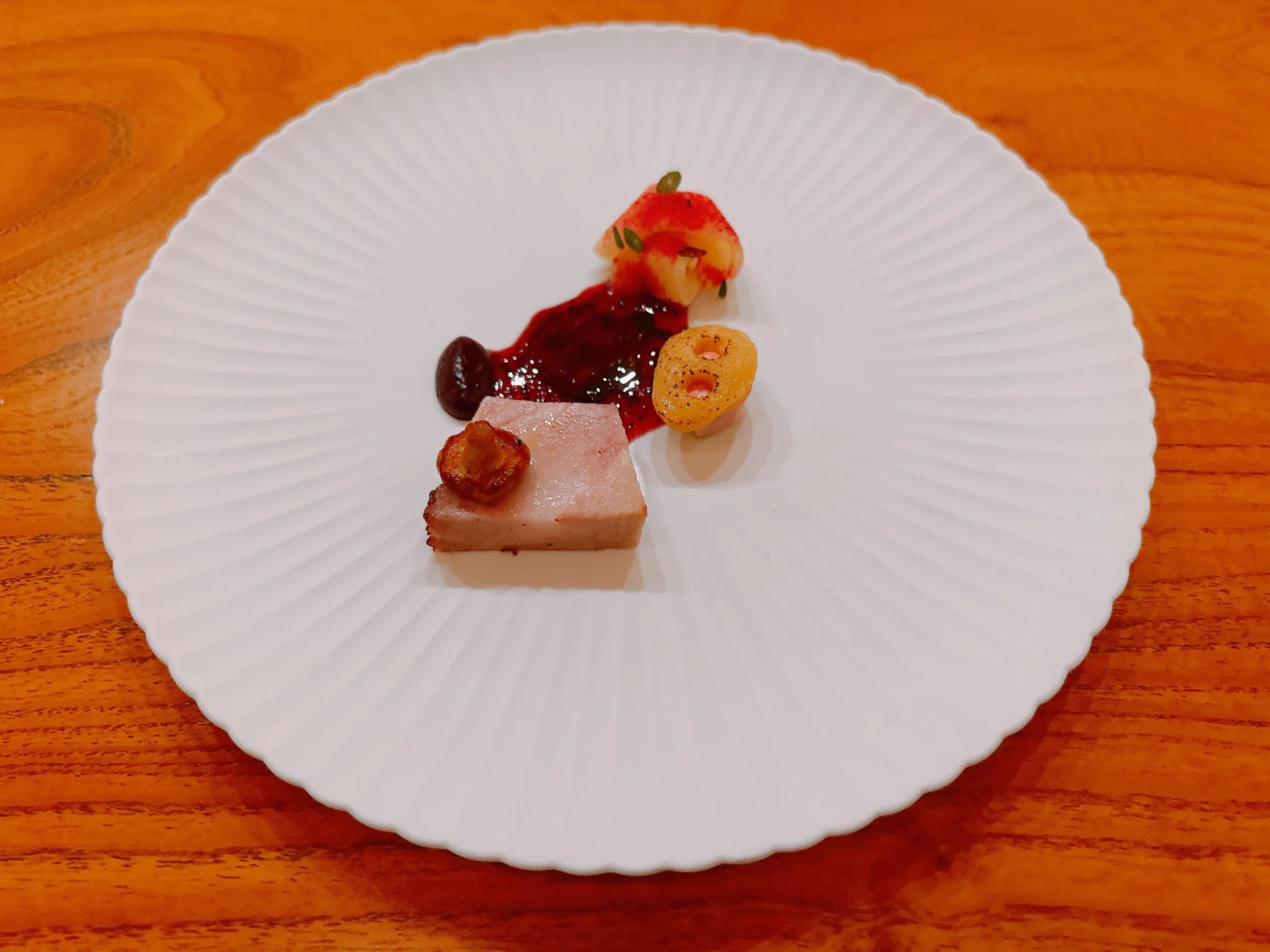
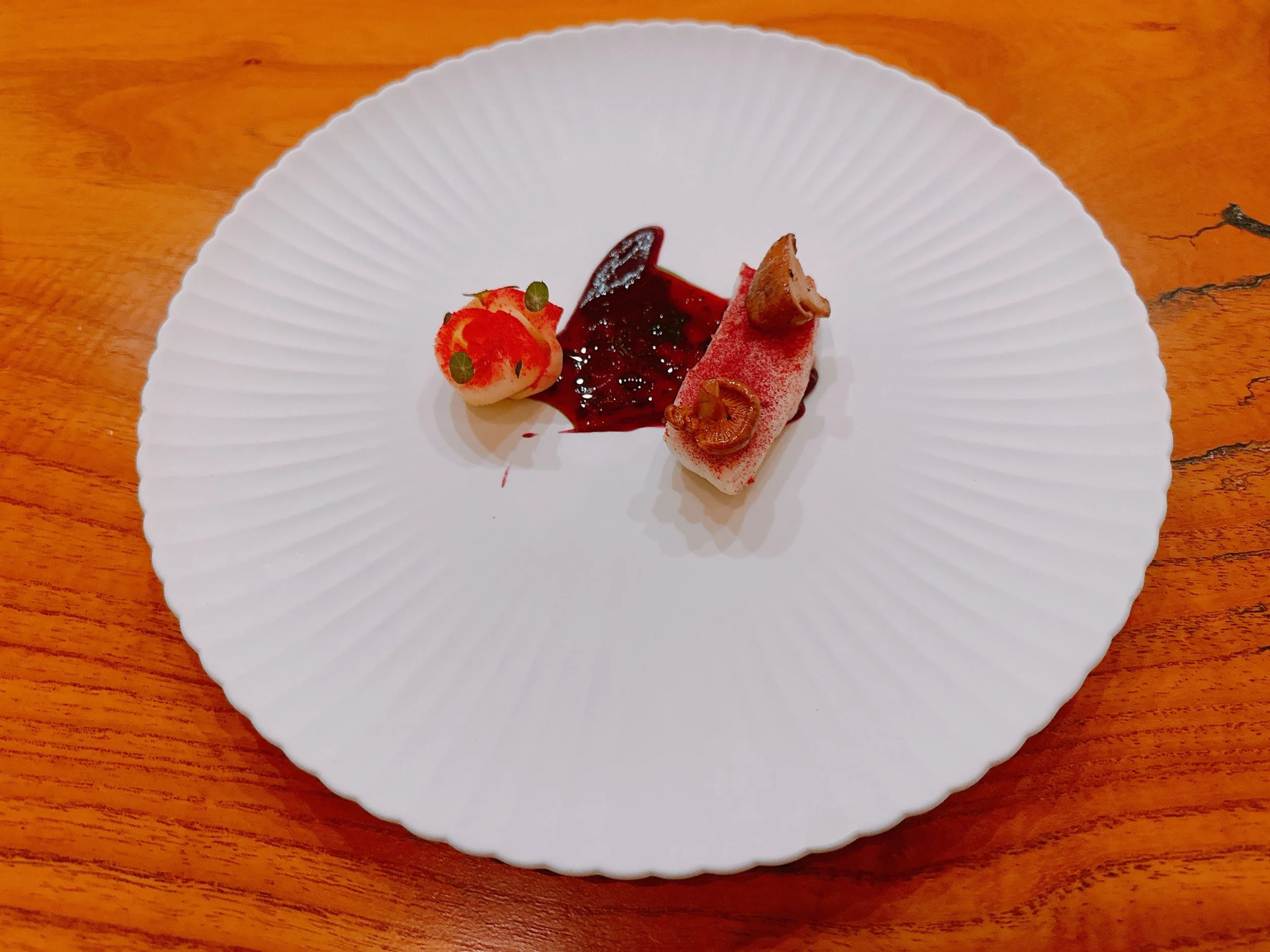
After this extravaganza, the courses became more traditional and also more substantial in size. A filet of pork had been marinated in miso with sesame and koji. On top of it sat a chanterelle mushroom, and on the side were a beet puree, a “snout” made from pancetta water, an salad of sliced apples, and a beets/koji sauce. The pork was cooked excellently: tender, juicy and flavorful, and it went great with the sauce, which had a strong beet flavor, and was acidic rather than (too) sweet - a nice balance. The very acidic apples also cut through the fattier parts of this dish. The only headscratcher was the snout, which was quite porky but otherwise not particularly exciting 17. The pescatarian version of this dish replaced all the pork-based parts with a filet of hirame (flounder). A soft, flaky fish that also went well with the sauce, but wasn't as flavorful as the pork 16.
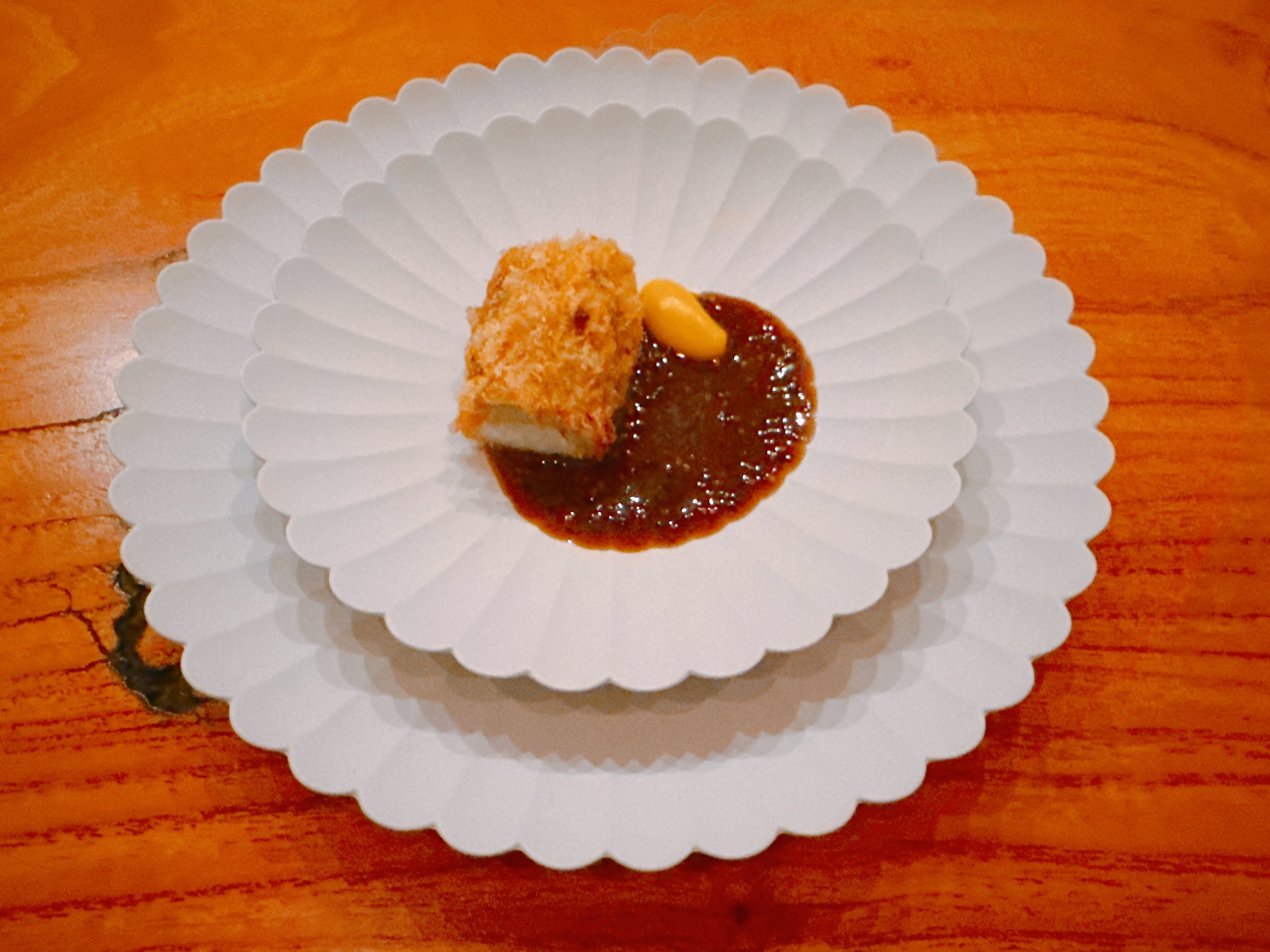
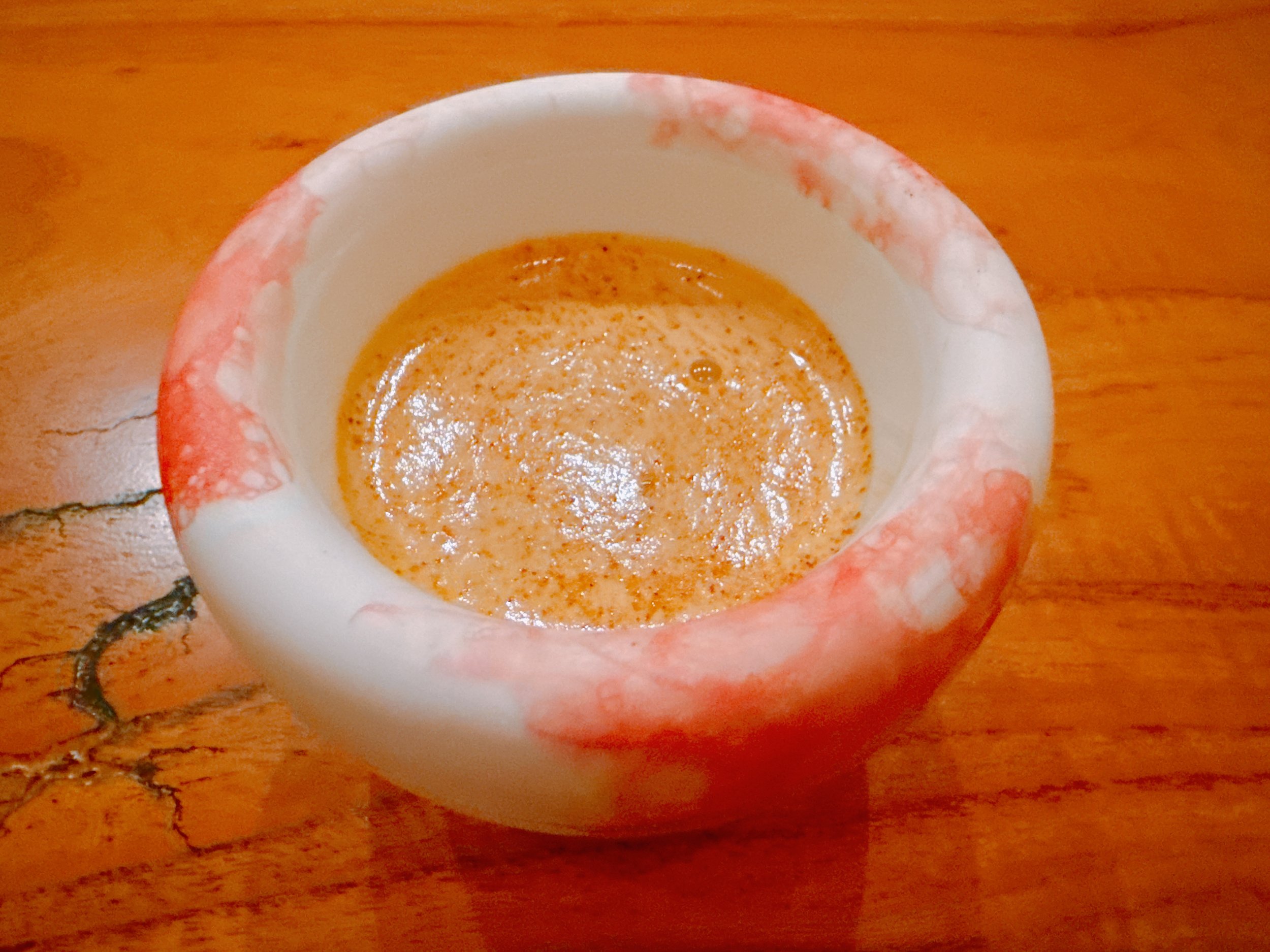
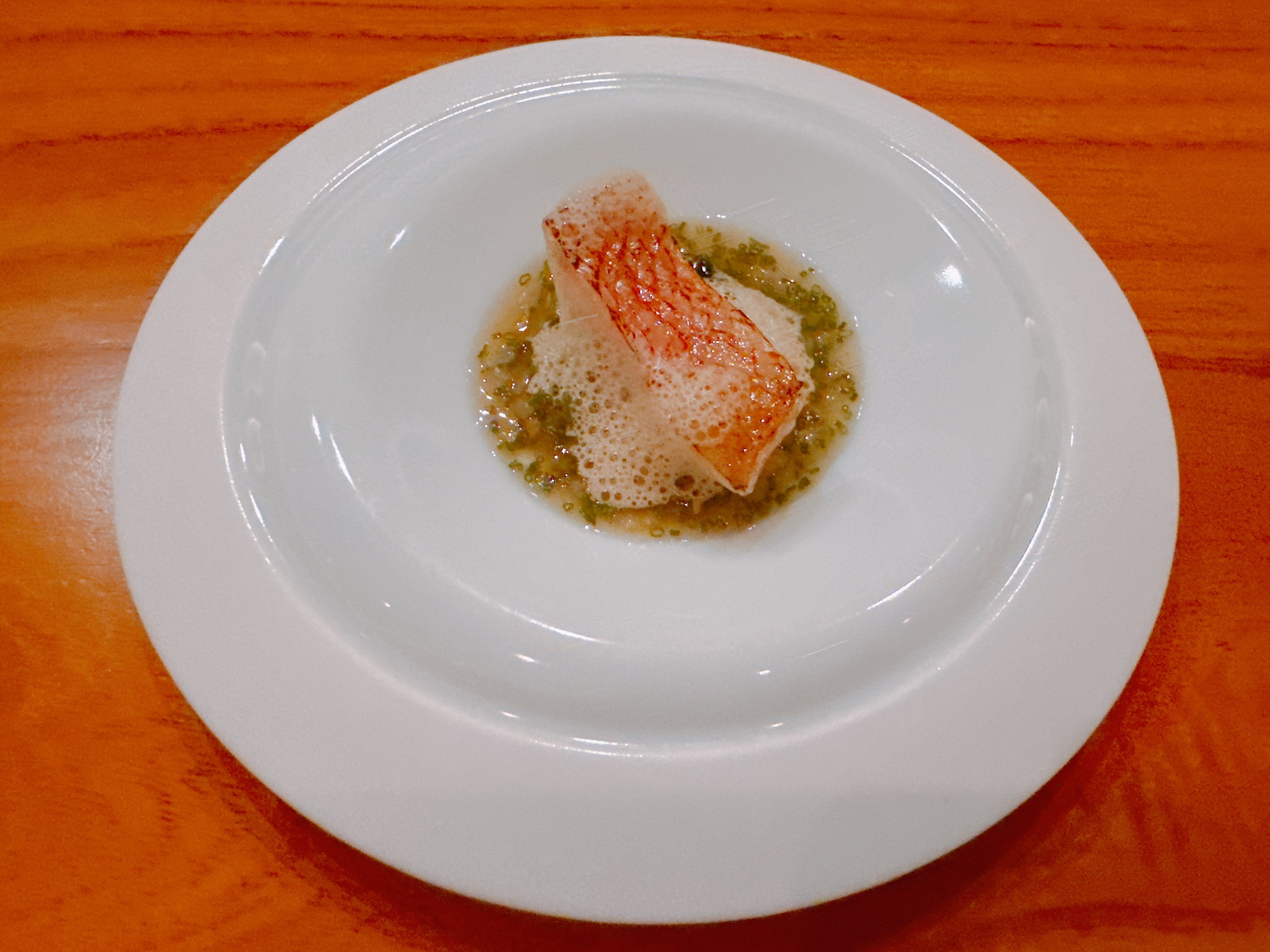
A fish course featured a longtail snapper filet that had been cured with sakura leaves. Together with a kombocha squash farce it had been breaded and fried. On the side was a kombocha squash puree and a black truffle demi-glace. This kind of looked like a tonkatsu dish with mustard on the side, but was nothing of the sort. The fish was quite tender and the sakura taste was palpable. Compared to previous dishes, the flavors were a bit more subdued 16.
Next came a ramen-inspired dish. Cuttlefish had been cut into the shape of noodles, and was combined with hairy crab meat and red bell peppers. All of this came in a dashi thickened with kudzu powder, an aerated tomato foam, and espelette pepper powder. Served very hot, this dish was very good: full of flavor, in particular of tomatoes, and lightly spicy. Overall, the flavor profile was more rustic compared to most previous dishes, but good 17.
The following dish, sadly missing a picture, was an akami tuna tartare paired with a soy jelly ice cream, some crunchy quinoa and a wafer made from dashi. The wafer was a bit sweet, so maybe not the right fit for this dish, but the tartare itself was nicely seasoned 16.
A filet of kinki fish was served with grilled avocado, an oyster, celeriac, a thickened dashi and hojicha milk foam. The fish was cooked nicely, but was served lukewarm at best. The oyster had a strong flavor, and the sauce reminded me of cooked pickles. A fine dish, but had it been served warmer or given more flavor, it would have been even better 16.
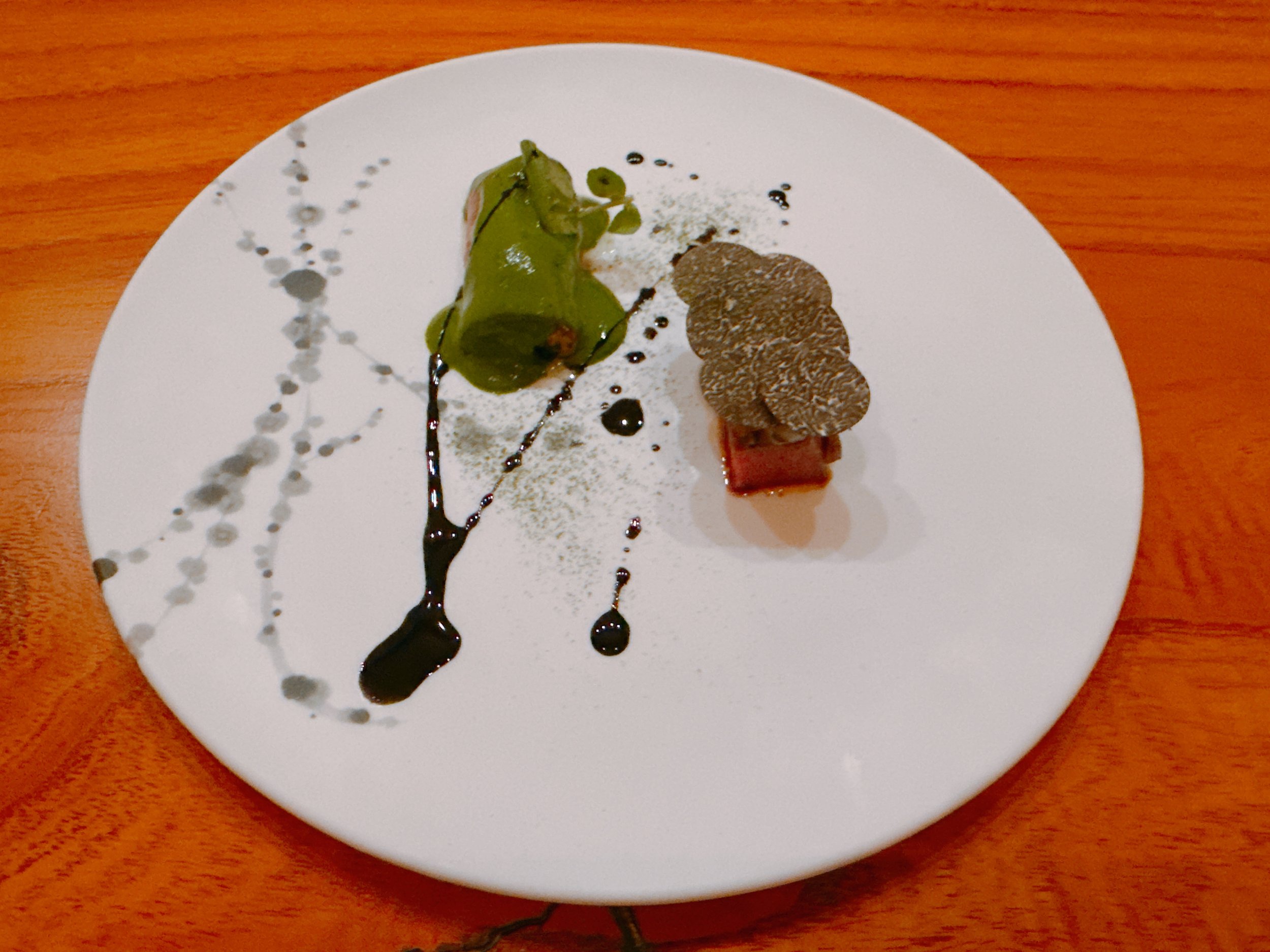
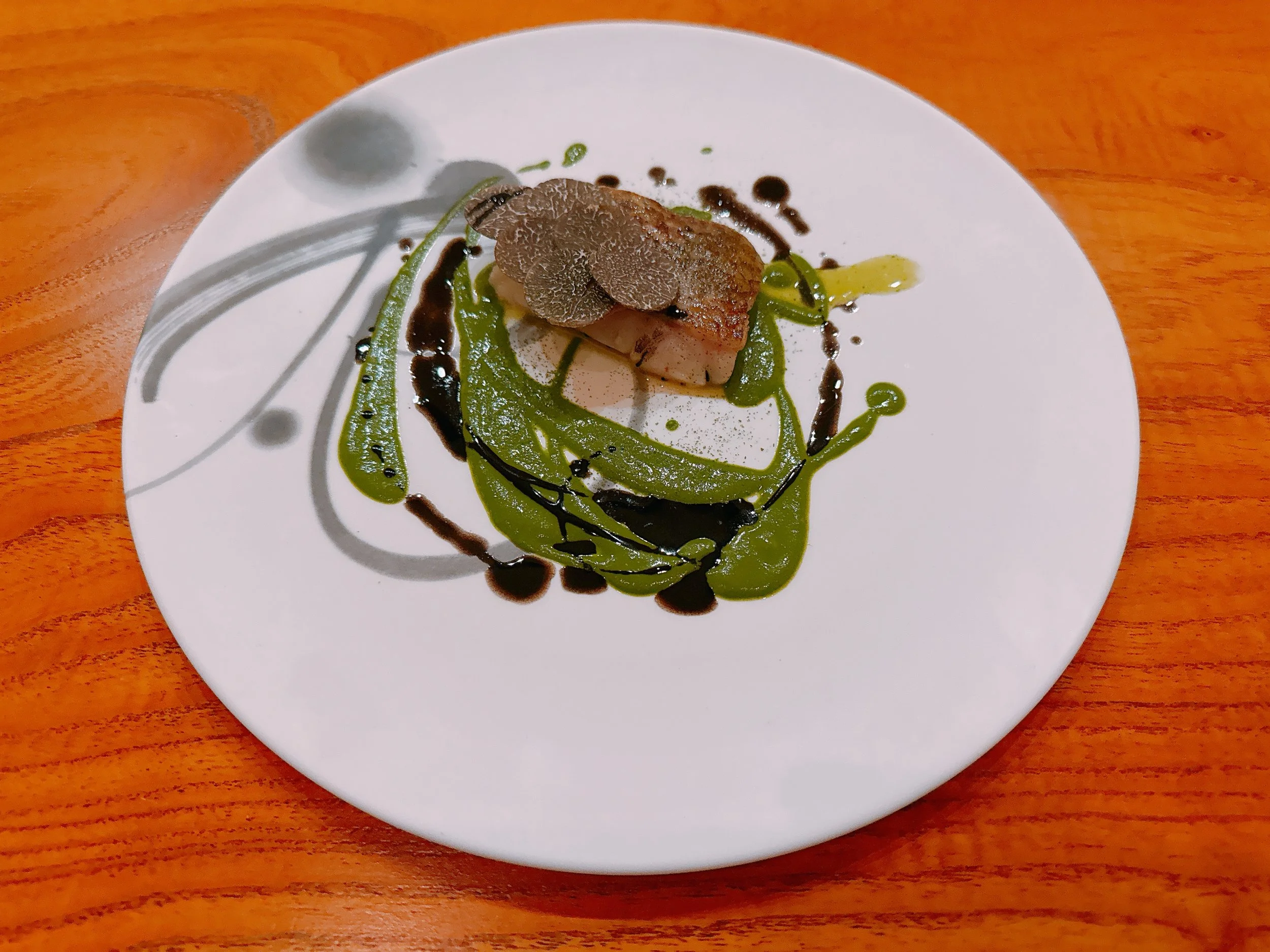
The final meat course featured A5 wagyu beef, served in two different cuts over mussels, accompanied by black truffles and a watercress sauce. The meat was of excellent quality and went great with the mussels - a combination that I honestly hadn't expect to work this well. There was some crunchy texture as well - not sure from what, though. The best part here were the beef “cannelloni” drenched in watercress sauce. They were off the charts: amazingly tender, bursting with flavor, with a hint of spice - a close to perfect dish. But like the previous course, all of this could have been served a bit warmer 19. The pescatarian version of this dish replaced the beef with a filet of grilled nodoguro (seaperch), a fatty fish that was quite nice, but also could have been served warmer 16.
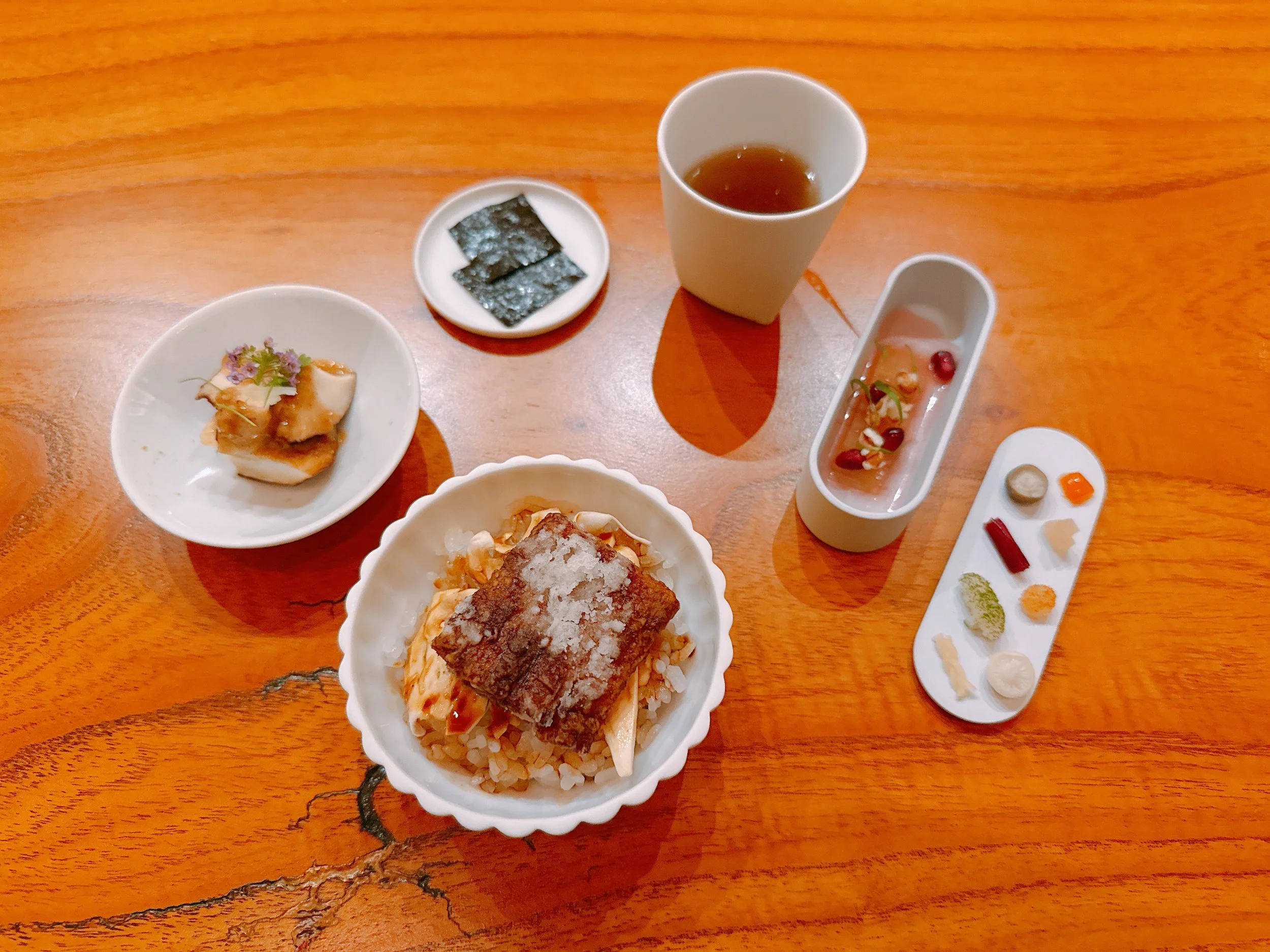
Following Japanese tradition, the final savory course was a rice dish. Japanese koshikikari rice was topped with unagi (eel) and sliced matsutake mushrooms. On the side were some optional additions for the rice: Grilled matsutake mushrooms from Oregon with toasted sesame and fennel. Fermented rutabaga with pomegranate seeds and puffed barley. Toasted sheets of seaweed. A mushroom consommé. And finally, a collection of minuscule pickles: kohlrabi, mushrooms, persimmons, and several others. Starting with the rice dish: the unagi was a bit mealy in texture, and sadly only lukewarm. The rice was pretty sticky - I would have preferred it to be a bit more granular (14 for this part). The grilled mushrooms however were nicely cooked and very flavorful with a sesame taste (17). The consomme was full of mushroom flavor as well - yum (17). The rutabaga was the opposite: pretty thin on flavors, a bit sweet and seeming less Japanese than the rest of the presentation (14). The pickles were quite good, and it was fun to try so many different kinds, but slightly larger portions might have been more practical (16). Overall 16.
At this point, we entered the domain of the dessert chef, Francesco Benedetto. Originally from Italy, chef Benedetto had worked for five years at three-starred Quique Dacosta in Denia, Spain, before moving to the United States to open Sorekara. Maybe an indication of the ambitions of this enterprise.
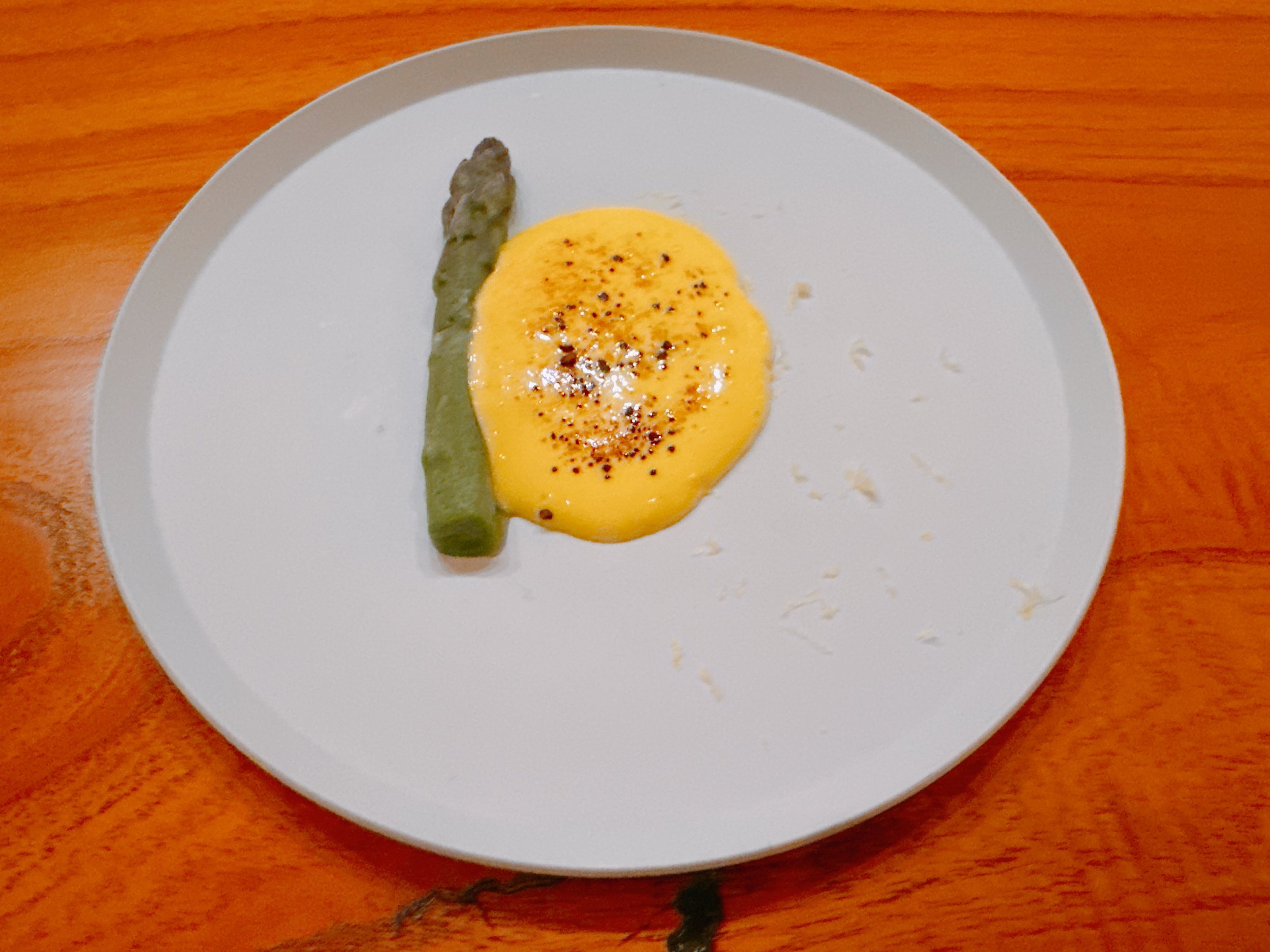
The next dish looked like a spear of green asparagus with a savory sabayon, but was actually a white and green asparagus sorbet paired with a sweet sabayon. The latter was topped with toasted hazelnuts, lemon zest and coffee powder. The sorbet tasted very much of asparagus, and actually worked quite well with the crunchy hazelnuts and the sweet sauce 17.
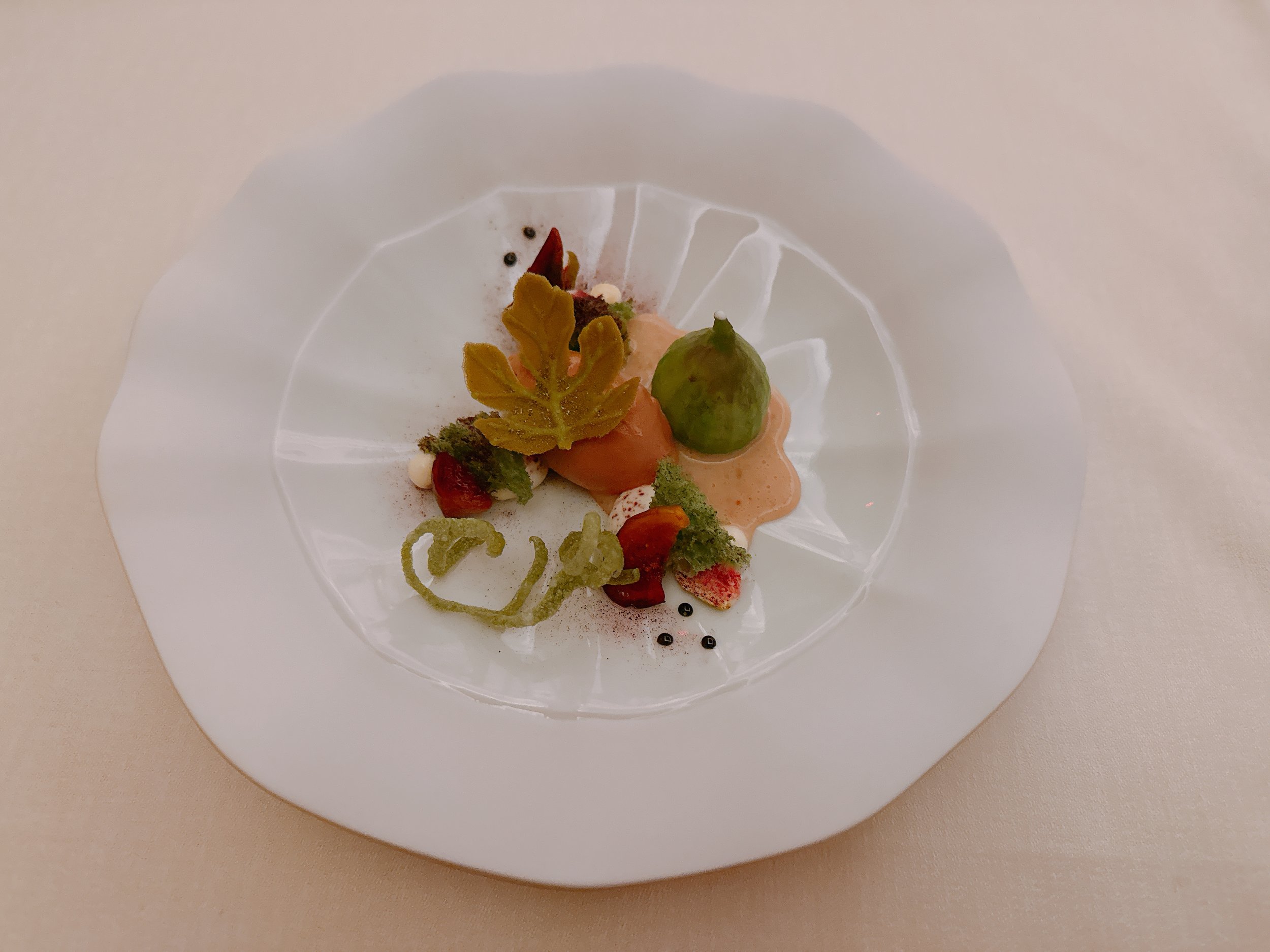
We spent the rest of the evening in a dessert lounge, seated at one of five white-table-clothed tables. Our first dessert here was based on figs. At the center of the plate was a fig gelato, surrounded by honey, horchata, sherry, some thyme branches, and some “figs” that were actually miniature cheesecakes. It was nice to have lots of different aspects of fruit in this dish, the only thing missing (presumably due to the season) was a significant amount of fresh figs. The lightly salty cheesecake prevented the dish from becoming too sweet 16.
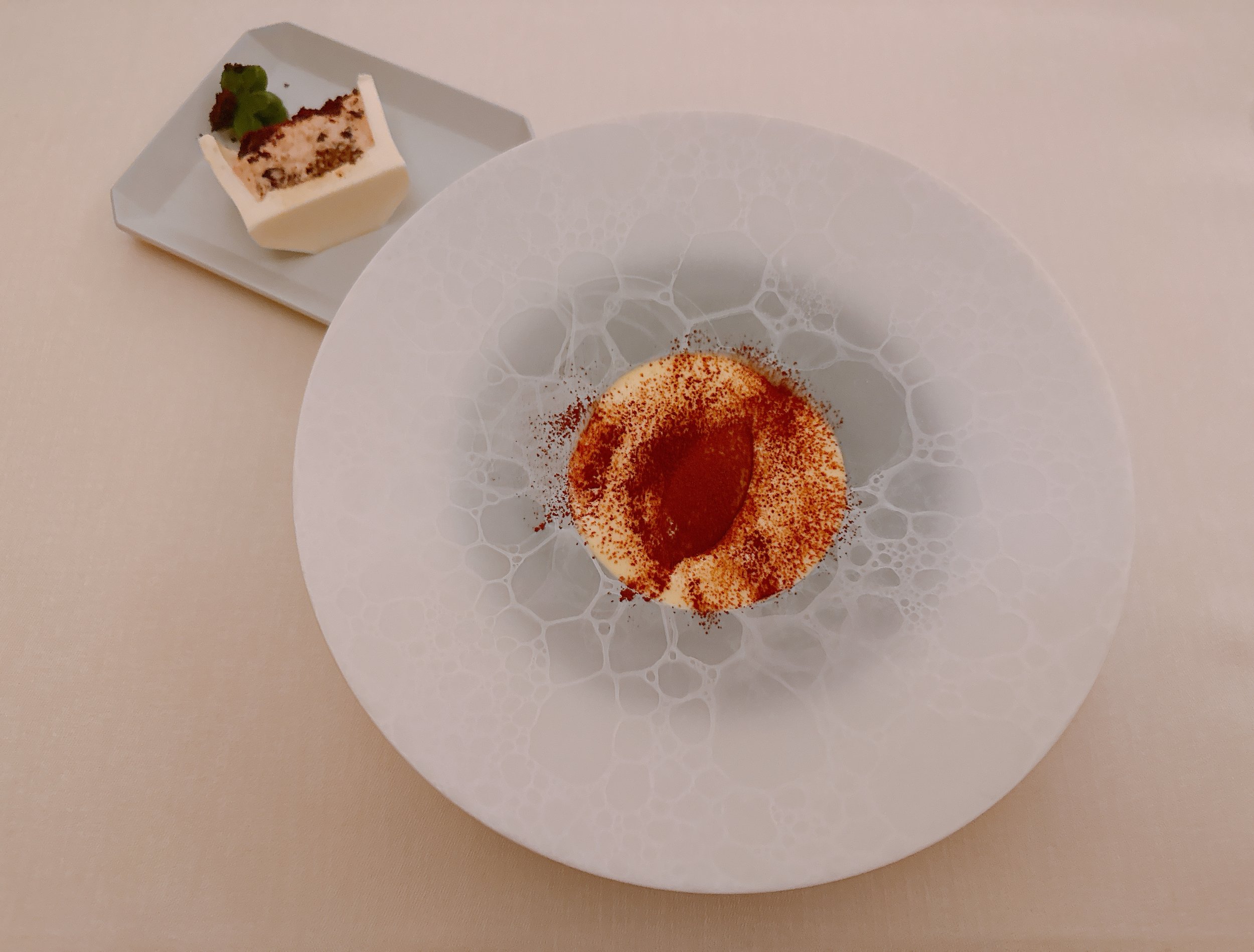
The next course came in two parts. One was a plate of “tiramisu”: salted chocolate crumbles, a mascarpone foam, an espresso parfait, and cocoa powder. This was close to a perfect dessert, a wonderful combination of warm and cold, of different textures - crunchy and foamy -, of saltiness and sweetness, and all of this without being too heavy. “Tiramisu” might sound a bit simple for a Michelin-starred dessert, but this was executed marvelously (19). On a separate plate, we received a cocoa cream with chocolate crumbles and matcha inside a white chocolate ganache. That ganache had a strange gelatinous texture, which really distracted from the dish, especially considering how much of it there was. The rest of the dessert was fine, but not as compelling as the tiramisu had been (16 maybe). A clear case of less would have been more 18.
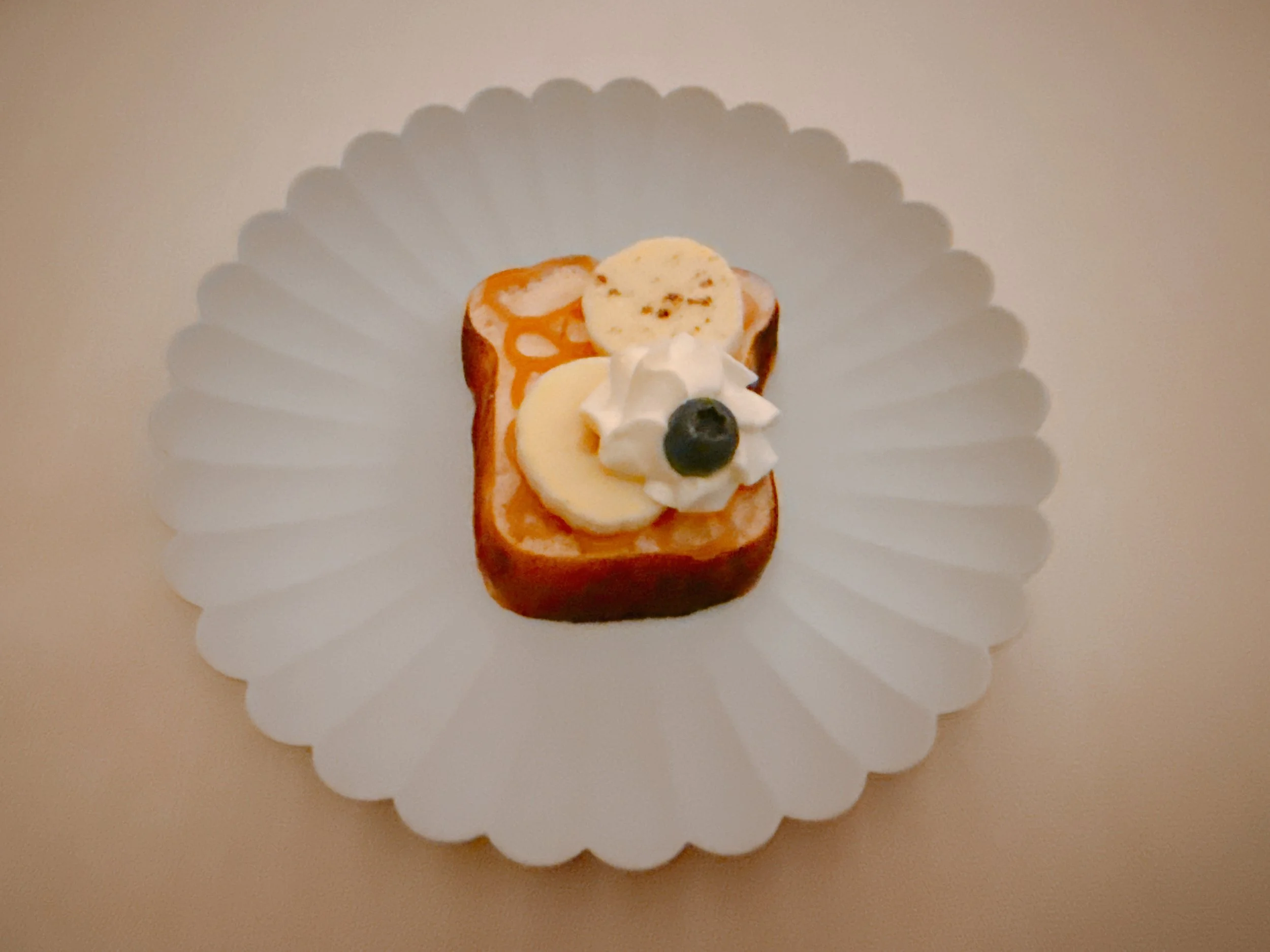
The last dessert was another one that was not what it seemed like. What looked like a French toast with slices of bananas and blueberries actually had none of these ingredients. The “bread” was a meringue made from apple water, methyl cellulose and toffee. The “banana” was actually an ice cream made with saffron, and the “blueberries” were made with algae. Not just a very creative dish, but also one that was quite yummy - not out of this world great, but the complexity of the dish was impressive. The bread was extremely light, and the banana ice cream actually did taste of bananas 17.
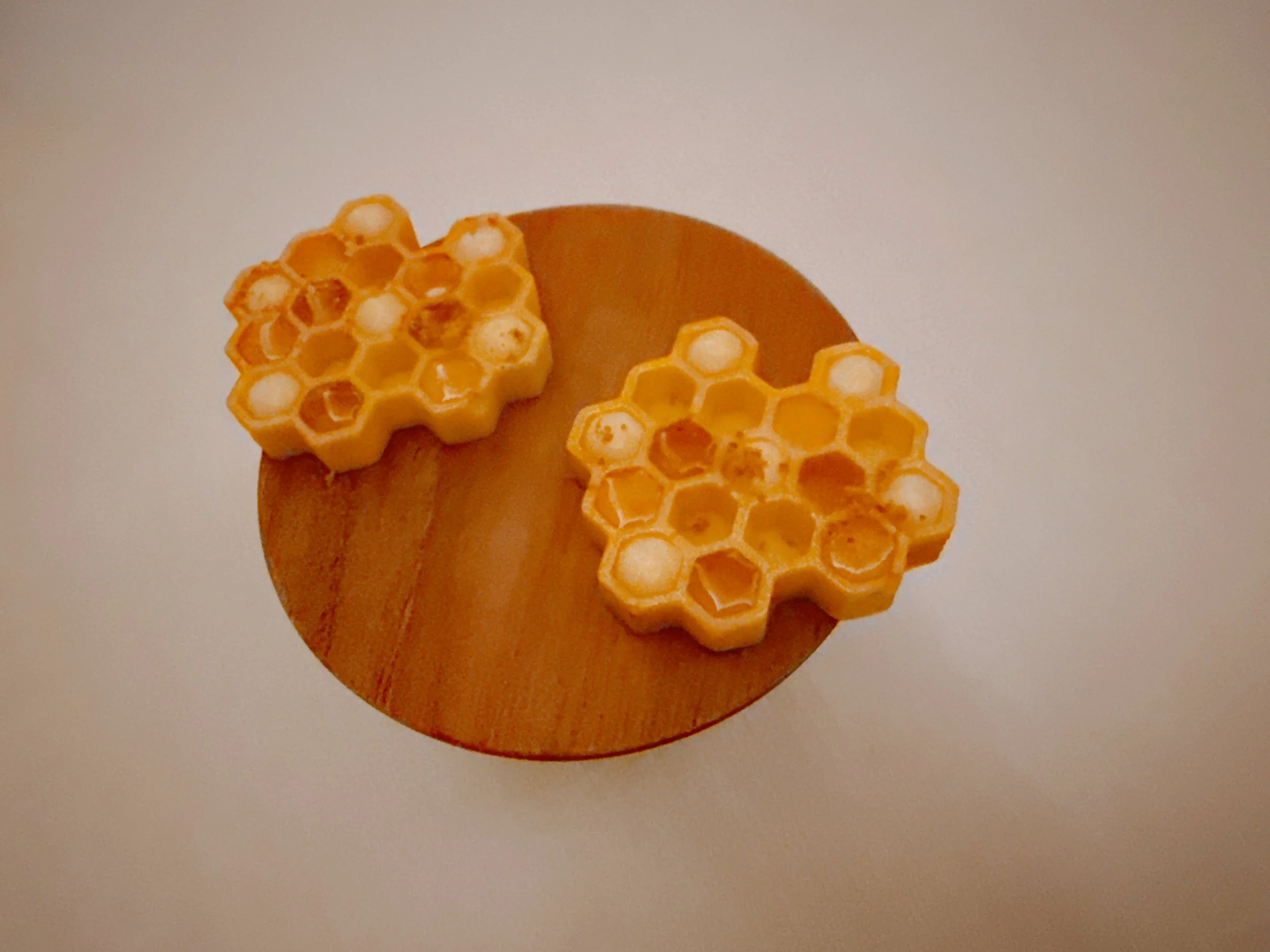
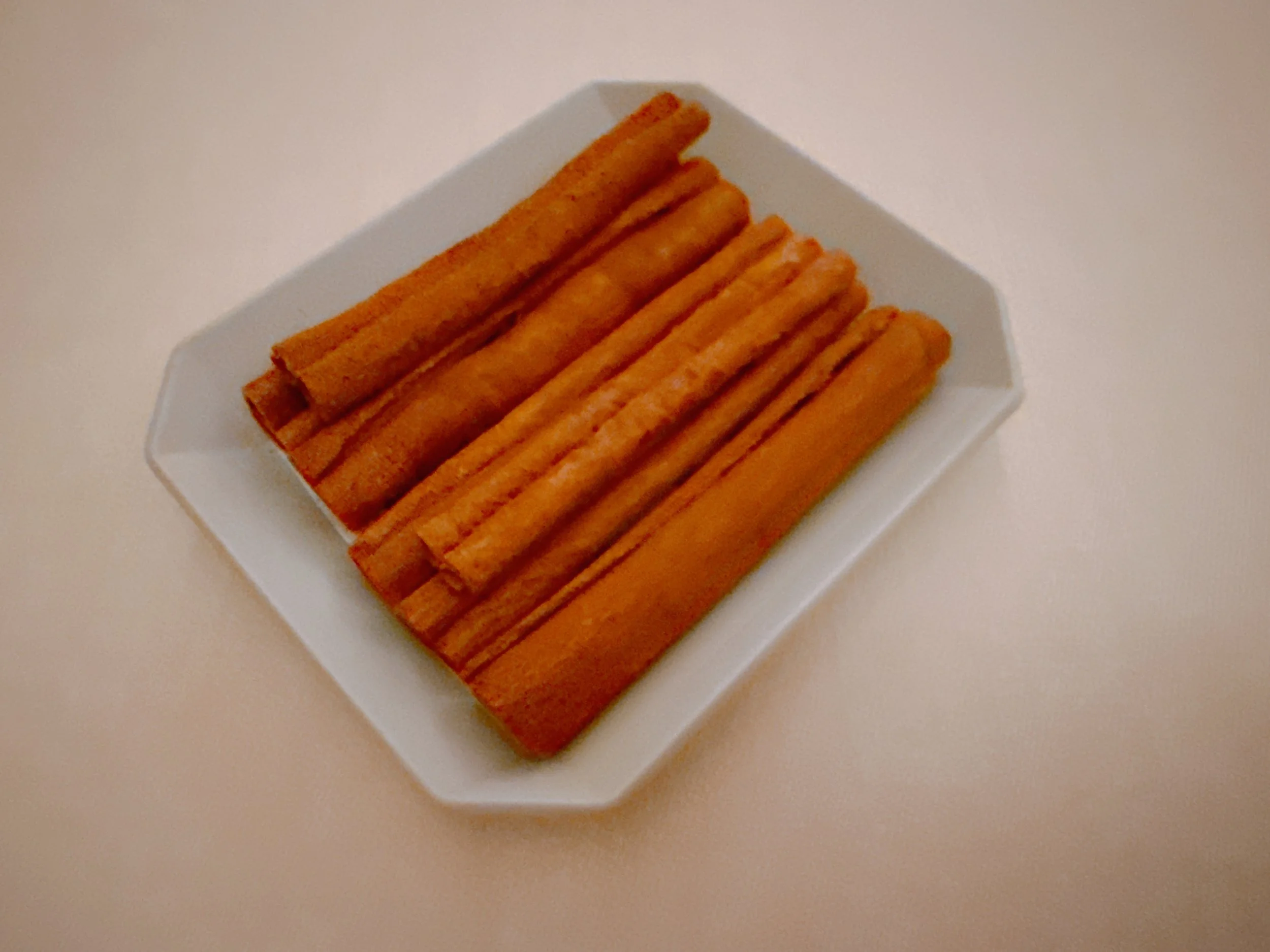
Two smaller bites concluded our dinner. A white chocolate honeycomb was filled with yuzu cream, honey and bee pollen. A very sweet confection that tasted predominantly of white chocolate 16. Finally, what looked like a cinnamon stick was actually an edible cookie - cinnamony and crunchy, it provided a soft landing for our dinner 15.
Overall: A very impressive dinner of not-too-traditional Japanese cuisine with Western desserts, displaying a sense of whimsy throughout. This was easily the best meal I've ever had in Florida. It was solidly at a two-star meal, with some dishes even edging into three-star territory. Now if only all the dishes could be served properly warm… The service, professional and friendly, was already at a three-star level. One to watch, for sure 17.